
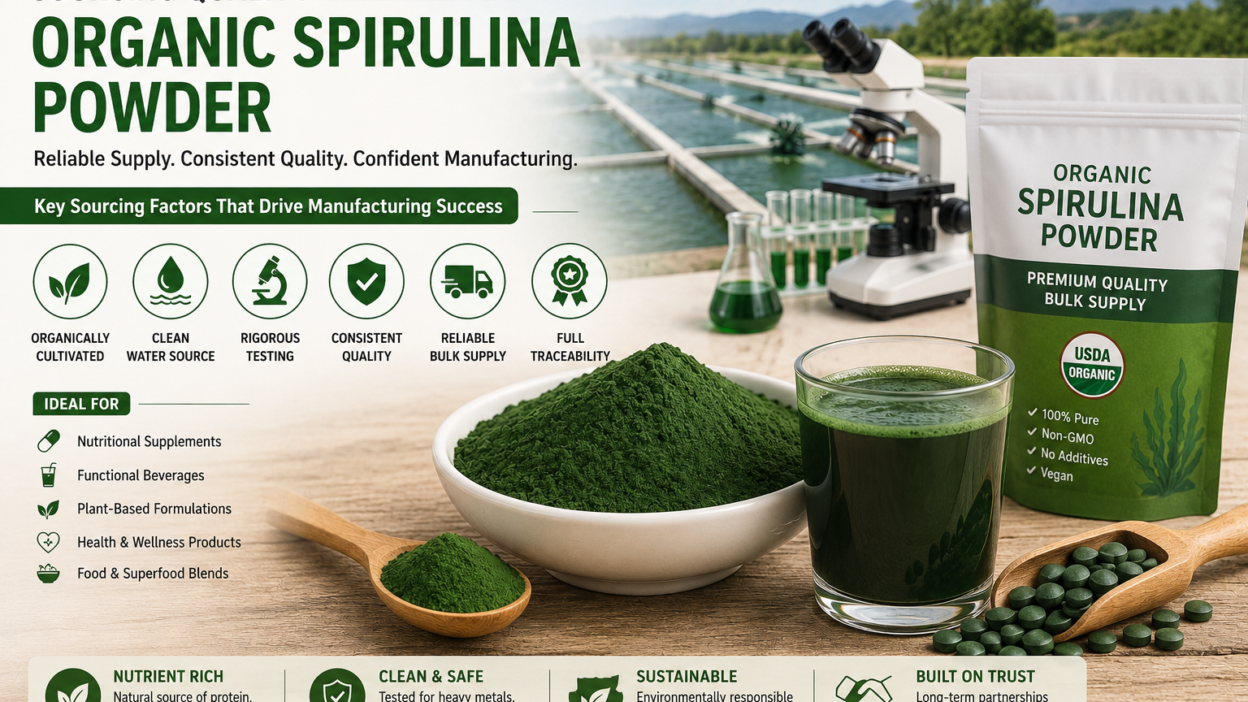
As demand for algae-based ingredients continues to expand across the US nutraceutical, functional beverage, and food industries, procurement teams are placing greater emphasis on supplier transparency, cultivation methods, and manufacturing consistency. While Organic Spirulina Powder has become a staple ingredient in many clean-label formulations, sourcing decisions are becoming increasingly technical as manufacturers seek long-term reliability rather than simply competitive pricing.
In most sourcing scenarios, one issue we often see is that two suppliers can provide Organic Spirulina Powder with similar specifications, yet the material performs differently during formulation and commercial production. These differences are often linked to cultivation environments, harvesting practices, drying technologies, and quality management systems rather than the analytical values listed on a Certificate of Analysis.
For procurement managers, formulators, and R&D professionals, understanding these sourcing variables helps reduce manufacturing risks and improve product consistency.
Understanding Organic Spirulina Powder in Industrial Manufacturing
Organic Spirulina Powder is produced from Arthrospira platensis, a blue-green microalga cultivated in controlled freshwater systems. Commercial production takes place in regions with abundant sunlight and stable climates, including the United States, India, China, and parts of Southeast Asia. After harvesting, the biomass is filtered, washed, dried under carefully controlled conditions, and milled into a fine powder suitable for industrial applications.
The cultivation environment plays a significant role in determining ingredient quality. Water quality, nutrient management, harvesting schedules, and drying temperatures all influence the final powder’s color, particle consistency, moisture level, and handling characteristics.
Manufacturers frequently choose Organic Spirulina Powder because it offers:
- Excellent compatibility with powdered formulations
- Clean-label and plant-based positioning
- Efficient storage compared with liquid ingredients
- Easy incorporation into capsules, tablets, and beverage mixes
- Stable handling during commercial manufacturing
These operational benefits continue to increase demand across nutraceutical and functional food sectors.
Why Procurement Teams Evaluate More Than Certifications
One common misconception is that Organic certification alone guarantees manufacturing consistency. While Organic certification, Certificates of Analysis (COAs), microbiological reports, heavy metal testing, allergen documentation, and MSDS files remain essential, experienced procurement professionals routinely evaluate additional production-related factors.
These often include:
- Cultivation method and water source
- Harvest frequency
- Drying technology
- Moisture management
- Particle size distribution
- Batch-to-batch color consistency
- Packaging integrity
- Inventory reliability and traceability
These characteristics frequently influence production efficiency more than laboratory specifications alone.
Suppliers capable of maintaining consistent processing conditions generally provide greater manufacturing reliability over long-term procurement programs.
Technical Considerations During Formulation
From a formulation standpoint, Organic Spirulina Powder integrates well into numerous commercial applications. However, production-scale manufacturing often exposes variability that laboratory evaluation may not identify.
Powdered Nutraceutical Systems
Organic Spirulina Powder is widely incorporated into capsules, tablets, powdered drink mixes, stick packs, and botanical nutrition blends.
Formulators commonly evaluate:
- Powder flowability
- Moisture stability
- Uniform particle size
- Blend consistency
- Dust generation
- Color uniformity
Maintaining consistency across these characteristics supports efficient high-volume manufacturing.
Whole Powder vs. Extract Formats
Procurement teams frequently evaluate whether a formulation is better suited to whole Organic Spirulina Powder or a more concentrated extract.
Whole powder is commonly selected where manufacturers want to preserve the complete algae matrix in minimally processed formulations. In contrast, products requiring concentrated functional components may source from an Organic Spirulina Extract Powder Supplier, depending on formulation objectives and processing requirements.
The intended application, product format, and manufacturing process usually determine the preferred ingredient type.
Bulk Sourcing Challenges Manufacturers Encounter
As commercial demand continues to increase, sourcing Organic Spirulina Powder presents several practical challenges.
Differences in cultivation systems, harvesting practices, and drying methods can create noticeable variation between production lots. Another issue procurement teams frequently encounter is inconsistent moisture management, which may affect powder flowability and storage stability.
To reduce sourcing risks, experienced buyers commonly request:
- Cultivation traceability
- Organic certification records
- Heavy metal testing
- Moisture validation reports
- Particle size specifications
- Batch retention samples
- Packaging verification
- Supply continuity planning
These operational indicators often provide greater confidence than specification sheets alone.
Market Trends Driving Demand
Demand for Organic Spirulina Powder continues to grow across the United States as manufacturers expand clean-label, plant-based, and algae-derived product portfolios.
Emerging applications include:
- Nutritional supplement blends
- Functional beverage powders
- Plant-based nutrition systems
- Green superfood formulations
- Botanical wellness products
- Protein and vegetable blend formulations
As these markets mature, procurement teams increasingly prioritize suppliers capable of providing consistent production quality, transparent sourcing, and dependable long-term inventory.
Conclusion
For procurement managers, formulators, and sourcing professionals, Organic Spirulina Powder procurement has become significantly more sophisticated than comparing prices or reviewing compliance documentation.
Cultivation methods, harvesting practices, drying technology, moisture management, particle consistency, and supplier transparency all influence manufacturing performance. In many commercial sourcing environments, the strongest supplier relationships are built on consistent production quality and dependable operational support rather than analytical specifications alone.
As demand continues to grow, manufacturers that evaluate suppliers through both technical and supply chain perspectives will be better positioned to maintain formulation consistency, production efficiency, and resilient sourcing strategies for Organic Spirulina Powder.
