
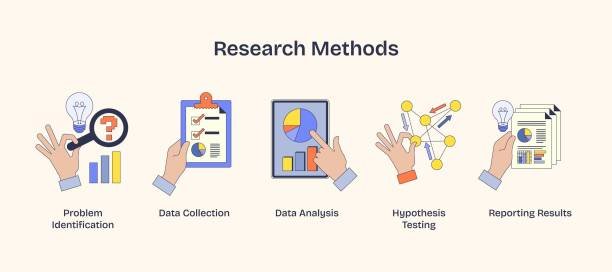
I still remember the first time a tutor handed back my methodology section with one line scrawled at the top: “Why this method? You haven’t told me.” I’d spent two weeks running a survey that, in hindsight, answered a completely different question than the one I’d actually set out to ask. That mistake taught me more about research design than any lecture did and it’s the mistake I see students make over and over again.
So here’s the thing nobody tells you early enough: choosing a research method isn’t really about knowing the theory. It’s about matching what you’re asking to how you go about answering it, inside the time and word count you’ve actually got. Let’s work through how to do that properly.
Start With the Question, Not the Method
Most students pick a method first “I’ll do a survey” and only work out what they’re asking afterward. That’s backwards. Your research question should decide the method, not the other way round.
A quick gut check: are you trying to understand why something happens, or how people experience something? That’s usually a job for qualitative research. Are you trying to work out how much, how many, or whether a pattern shows up consistently across a group? That’s quantitative. Need both the number and the story behind it? You’re looking at mixed methods.
It sounds obvious written down, but under deadline pressure it’s astonishing how often this step gets skipped entirely.
The Three Main Approaches, in Plain Terms
Qualitative research
This is the depth option interviews, focus groups, open-ended surveys, case studies. It’s the right call when your assignment wants exploration rather than measurement: attitudes, motivations, lived experience, the messy “why” behind a phenomenon. It won’t give you a tidy statistic, but it will give you insight that a number can’t capture on its own.
Quantitative research
This is the measurement option closed-question surveys, experiments, statistical analysis of an existing dataset. If your brief uses words like “measure,” “test,” “compare,” or “correlation,” you’re almost certainly expected to produce numbers, not narrative.
Mixed methods
Sometimes one alone won’t cut it. A survey can tell you what a group of students think about a new teaching tool; follow-up interviews can tell you why they think it. Combining both gives markers a fuller picture but only attempt it if you’ve genuinely got time to analyse both properly. A rushed mixed-methods project usually does worse than a well-executed single-method one.
Primary or Secondary Don’t Assume You Need to Collect New Data
This trips people up constantly. Primary research means generating new data yourself running a survey, conducting interviews, doing an experiment. Secondary research means working with data or literature that already exists.
For a lot of undergraduate assignments, secondary research is not a lesser option. It’s often exactly what’s expected. A tight, well-argued literature review can demonstrate just as much analytical skill as a small primary study with a fraction of the risk and logistics. Save primary data collection for briefs that explicitly ask for it, or for dissertation-level work where original data is the whole point.
What Actually Decides Your Method (Beyond the Textbook)
Theory tells you what’s ideal. Deadlines tell you what’s possible. Here’s what genuinely shapes the decision in practice:
How much time you actually have. Interviews need arranging, running, and transcribing. Experiments need designing and piloting. If you’ve got three weeks, a longitudinal study or a large-scale survey with follow-up interviews simply isn’t realistic no matter how well it would suit the question in theory.
Whether you can reach the people or data you need. A method only works if you can execute it. If you can’t realistically get 50 people to fill in a survey, don’t plan a method that depends on it.
Your word count. A 1,500-word assignment can’t sustain both a proper literature review and an original survey with statistical write-up. Pick one and do it well rather than splitting a small word count across two half-finished approaches.
Ethics approval. Anything involving human participants may need sign-off from your institution before you can start collecting data. That process takes time build it in early, not the week before submission.
What’s normal in your field. A psychology brief tends to lean quantitative by default. A sociology or literature brief tends to lean qualitative. Look at a handful of published papers close to your topic and notice what method they use it’s usually a strong signal for what your marker expects to see.
A Step-by-Step Way to Land on the Right Method
- Write your research question in a single sentence. If you can’t do that clearly, you’re not ready to choose a method yet.
- Decide whether it’s exploratory (why/how), descriptive (what/how much), or evaluative (does this work).
- Check the method against your actual deadline and word count not the ideal scenario.
- Skim four or five sources close to your topic and note what method they used.
- Write one paragraph justifying your choice. If you can’t explain why it fits, pick again.
- Sketch your data plan before you start writing the assignment itself.
That last step is the one most people skip, and it’s the one that causes the most rewriting later. Once you’ve got a rough plan, it helps enormously to see what a finished one actually looks like on the page. Assignment Experts put together a Assignment Experts research proposal sample based on a real UK-style proposal, and it’s a genuinely useful reference for seeing how a methodology section gets structured before you attempt your own.
Mistakes I See Most Often
Picking a method because it’s familiar. Defaulting to a survey because you’ve run one before, not because it’s the right tool for this particular question.
Ignoring sample size. A survey of eight people can’t support a serious quantitative claim, regardless of how polished the chart looks.
Skipping the justification entirely. Markers aren’t just grading what you did they’re grading whether you can explain why you did it that way. Leave that paragraph out and you’re leaving marks on the table.
Overcomplicating for the sake of it. Mixed methods look impressive on paper. If you don’t have the time to do both halves justice, you’re better off nailing one method cleanly.
Final Thoughts
There’s no universally “best” research method only the one that actually answers your question, fits inside your deadline, and matches what your field expects. Start from the question. Be honest with yourself about time and access. Justify the choice on the page instead of assuming it’s self-evident.
Get that alignment right early, and the rest of the assignment the data collection, the analysis, the write-up tends to fall into place a lot more easily than it did for me back when I ran the wrong survey for two weeks straight.