
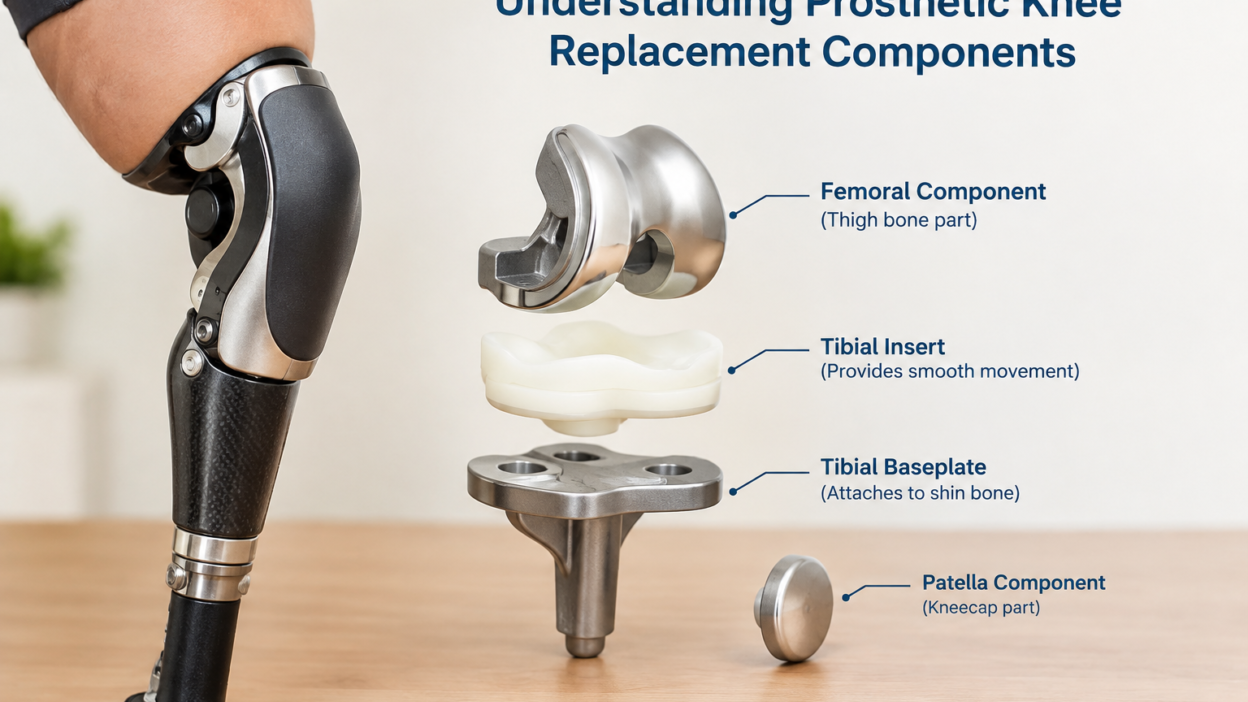
Doctors love throwing around terms like “tibial insert” and “femoral component” without explaining what any of it actually means. If you’re gearing up for surgery or helping a parent get ready for theirs that can be pretty frustrating. You want to know what’s actually going into your body, not just nod along in the consultation room.
So let’s break it down properly. This guide walks through what a prosthetic knee replacement is made of, why each piece matters, and how it all comes together to give you a working knee again.
What Exactly Is a Knee Prosthesis?
At its core, a knee prosthesis is an artificial joint that steps in when your own has worn out usually from osteoarthritis, rheumatoid arthritis, or an old injury that never quite healed right. Instead of replacing your whole leg, it resurfaces the damaged ends of the femur and tibia so they can move against each other smoothly again, the way they used to before arthritis wrecked the cartilage.
It’s worth pointing out early: this is a different animal from above knee amputee prosthetics. Those replace an entire missing limb from outside the body. A knee replacement, on the other hand, keeps your leg exactly where it is surgeons are just rebuilding the joint surface itself.
The Four Parts That Make Up a Knee Replacement
Most total knee replacements come down to four components. Each one has a specific job.
Femoral Component
This is the curved metal cap that fits over the end of your thigh bone, basically recreating the natural rounded shape of the femur. Surgeons typically use cobalt-chromium or titanium here both hold up well under the kind of repeated pounding a knee takes over decades of walking, standing, and climbing stairs.
Tibial Component
Think of this as the foundation. It’s a flat metal tray that anchors to the top of your shin bone, often with a stem drilled down into the bone for extra stability. Everything else in the joint sits on top of this base.
Tibial Insert (the Polyethylene Bearing)
Here’s the part people rarely ask about but probably should. Between the femoral and tibial components sits a piece of medical-grade plastic polyethylene that acts like a shock absorber. It’s essentially doing the job your cartilage used to do. Some designs keep this insert fixed in place; others let it rotate slightly for a more natural feel when you walk or turn.
Patellar Component
Not every patient needs this one. If your kneecap is still in decent shape, surgeons might leave it alone. But when it’s damaged too, they’ll resurface the underside with a polyethylene button, which helps a lot with pain during bending motions like squatting or going down stairs.
What’s Actually Inside These Implants?
There’s a reason surgeons don’t just use whatever metal is lying around. The materials have to survive inside your body for decades without breaking down or triggering a reaction. That usually means:
- Titanium or cobalt-chromium alloys for the metal parts strong, corrosion-resistant, and well-tolerated by the body
- Medical-grade polyethylene for anywhere two surfaces need to glide against each other
- Bone cement, in cemented implants, to lock everything into place right away
None of this is experimental, by the way. These materials have been refined and tested for decades in orthopedic medicine.
Not All Knee Replacements Are Built the Same
This is where things get a little more personalized, depending on your age, activity level, and how much of the joint is actually damaged.
Total vs. Partial Replacement
If the whole joint is worn out, you’ll likely get a total knee replacement. But if only one section is damaged which happens more often in younger, active patients a partial (or unicompartmental) replacement might do the job while preserving more of your natural knee.
Cemented vs. Uncemented
Cemented implants get bonded to the bone with surgical cement, so you’re stable from day one. Uncemented versions work differently they have a porous surface that your own bone gradually grows into. That approach tends to suit younger patients with strong, healthy bone.
Fixed vs. Mobile Bearing
Fixed-bearing inserts don’t move simple, reliable, and used successfully for decades. Mobile-bearing inserts rotate slightly, which can reduce wear over time but demands more precision during surgery to get right.
How Everything Works Together
Once it’s all in place, here’s roughly what happens: the femoral component glides across that polyethylene insert sitting on the tibial tray, recreating the natural rolling-and-gliding motion your knee used to do without thinking about it. If you have a patellar component too, it tracks along the femoral piece every time you bend or straighten your leg. The end result is weight distributed properly across the joint and a range of motion that’s a world better than what a bone-on-bone arthritic knee could offer.
This is really the key distinction from limb-level solutions like above knee amputee prosthetics a knee replacement is about restoring function within your own anatomy, not building an external replacement from scratch.
So How Long Does This Actually Last?
With today’s materials and surgical techniques, most knee replacements hold up for 15 to 25 years. But that number isn’t fixed it depends on things like:
- How active you are and how much weight goes through the joint daily
- Your bone quality going into surgery
- How precisely the components were positioned
- Whether you stick with physical therapy and rehab afterward
Higher-impact activity, extra body weight, and weaker bone density can all speed up wear, which sometimes means a revision surgery down the line.
Warning Signs Worth Paying Attention To
Most knee replacements go smoothly, but it’s still worth knowing what shouldn’t be ignored:
- Swelling or warmth that doesn’t go away
- Pain that’s getting worse instead of better, or a feeling of instability
- Grinding or clicking you didn’t notice before
- Losing range of motion you’d previously regained
Any of these could point to loosening, infection, or wear in the components worth getting checked by an orthopedic specialist rather than waiting it out.
Quick FAQ
What are the parts of a knee replacement implant?
Four main pieces: the femoral component, tibial component, tibial insert (polyethylene bearing), and patellar component.
What materials go into knee replacements?
Mostly titanium or cobalt-chromium for the metal parts, plus medical-grade polyethylene for the bearing surface.
Cemented or uncemented what’s the difference?
Cemented implants bond immediately with surgical cement. Uncemented ones rely on your bone gradually growing into a porous surface.
How long do these implants usually last?
Somewhere between 15 and 25 years, depending mostly on your activity level, weight, and bone health going in.
Wrapping Up
Knowing what’s actually inside a prosthetic knee replacement makes the whole process feel a lot less like a mystery and it puts you in a much better position to have an informed conversation with your surgeon about which option actually fits your situation.
And if you or someone you know is looking into options beyond joint replacement, including above knee amputee prosthetics, it’s worth talking to a certified prosthetist who can walk you through what’s realistic for your specific mobility goals.