Shipping candles goes wrong in more ways than you’d think. The jar’s heavy, the glass is fragile, and the wax itself responds to temperature. You pour a clean, smooth candle, and a week later your customer’s opening a box to a cracked jar or a top covered in white blotches. Nine times out of ten, that’s the packaging’s fault, not the candle.
What Heat Actually Does to Wax
Wax doesn’t have to fully melt to get ruined. Soy and paraffin blends start softening between 120°F and 150°F, depending on the blend. Sounds like a lot, until you picture a parcel sitting in the back of a delivery truck in July, or baking on a porch in Arizona or Texas. Cargo holds and mailboxes blow past that number without much trouble.
Once the wax heats up and cools back down, a few things show up. Frosting’s the most common cloudy white patches forming on the surface as the wax recrystallizes. Sometimes you’ll see sweating instead, little beads of oil sitting on top or along the sides. The wax can also pull away from the glass, leaving a gap along the wall, and soft wax lets the wick tilt or sink, which means the candle burns poorly even though it still looks okay sitting on a shelf.
Most of this is cosmetic, technically. The customer doesn’t know that, though. They just see a candle that looks wrong and ask for their money back.
What Physical Damage Actually Looks Like
Glass is the real problem here. One hard knock cracks a jar, and sometimes it’s just a hairline crack you won’t notice until wax starts leaking out the side. Tins dent. Labels get scuffed. If there are dried flowers or anything embedded on top, those can shift or snap clean off during transit.
Jars are weaker than they feel in your hand. That thick base makes the whole thing feel solid, but the walls are thin, and a drop onto the side does a lot more damage than a drop straight onto the bottom.
Where Packaging Actually Helps
Packaging really only has two jobs. Keep the jar from moving around or taking a hit, and slow down how fast outside heat reaches the wax.
Don’t expect miracles from insulation, though. A paper box isn’t going to keep a candle cool in a hot truck for three days straight. But a snug box with some air gap, a fiber insert, or a paper wrap slows the heat down enough to matter on a shorter trip. Thin, loose packaging barely does anything.
Here’s roughly what US sellers tend to reach for:
| Packaging option | Impact protection | Heat buffering | Best use |
| Single-wall corrugated mailer with insert | Good | Low to moderate | Standard online orders |
| Rigid box with paper or pulp insert | Moderate | Moderate | Gifts and retail shelves |
| Double-wall corrugated carton | Very good | Moderate | Larger jars, multi-candle orders |
| Insulated mailer or liner | Moderate | Higher | Summer shipping to hot regions |
Why Box Shape Actually Matters
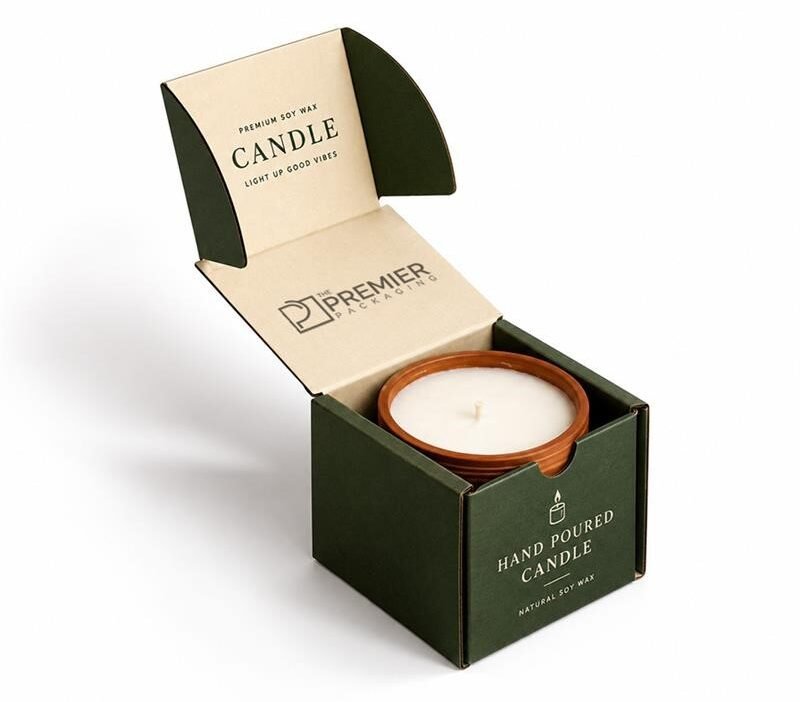
Drop a round jar into a rectangular box and you’ve basically created dead space in the corners — which, of course, is exactly where the jar ends up sliding. A box cut to match the candle’s footprint instead holds it in place from every direction. This is a big reason more brands have started moving toward a custom Cube Designed Candle Box for square or compact candles. All the sides are equal, pressure spreads evenly across them, and the jar just doesn’t have anywhere to go.
Cubes stack nicely too, on a shelf and inside a shipping carton alike. Less wasted space means less filler, and it can even shave down the dimensional weight charge from UPS, FedEx, or USPS.
Inserts and Cushioning
Even a well-shaped box still needs something to actually hold the jar inside it. Die-cut cardboard dividers that grip the neck or base work well for this. Molded pulp cradles do too — they’re recyclable, and shaped right to the candle. So do corrugated sleeves wrapped around the glass. Kraft paper crinkle is fine as a top-up layer, but I wouldn’t lean on it as the only thing holding the jar in place. And skip loose plastic peanuts if you can — they shift around, compress over time, and customers generally hate them.
Whatever you end up using, do the shake test. Close the box up and give it a solid shake. If you can hear the jar knock around or feel it slide, the fit’s not right yet.
Shipping in Hot Weather
If you’re shipping nationwide, summer needs its own game plan. Get orders out early in the week so they’re not sitting in a warehouse over the weekend baking in heat. Add a “Do Not Leave in Heat” note on the label or as an insert card. Put a paper liner or an air gap between the jar and the outer box. Some sellers switch over to a harder wax blend just for the warm months. And just tell your customers upfront to bring the package inside the moment it shows up.
None of this eliminates every complaint. But it does bring the number down noticeably.
Printing and Presentation
People judge a candle by its box before they ever get close enough to smell it. Matte finishes, soft-touch coating, simple one-color prints, that’s what’s working right now, and all of it looks great on kraft or white board. For scented candles, print the scent name and burn time right on the box, since shoppers are making a decision in a few seconds, whether they’re standing at a shelf or scrolling past it on a screen. For gift candles, skip the window, keep the design clean, and add a ribbon or sticker. It reads as premium without costing you much more.
Sustainability
A lot of US shoppers check the recycling info on a box before they buy anything. Paper inserts, recycled corrugated board, water-based inks, these are all easy ways to cut plastic out of the equation. Foam and plastic wrap are harder to recycle and tend to generate complaints on their own.
Before You Order
Measure the finished candle with the lid and label already on it. Request a sample and actually test it in a real shipment, ideally during a stretch of warm weather. Get the insert, finish, and print details confirmed in writing before production starts. And ask about lead times early, because candle season runs hard from October straight through December.
Packaging doesn’t change what’s sitting in the jar. It just determines whether your customer actually sees the candle the way you intended.