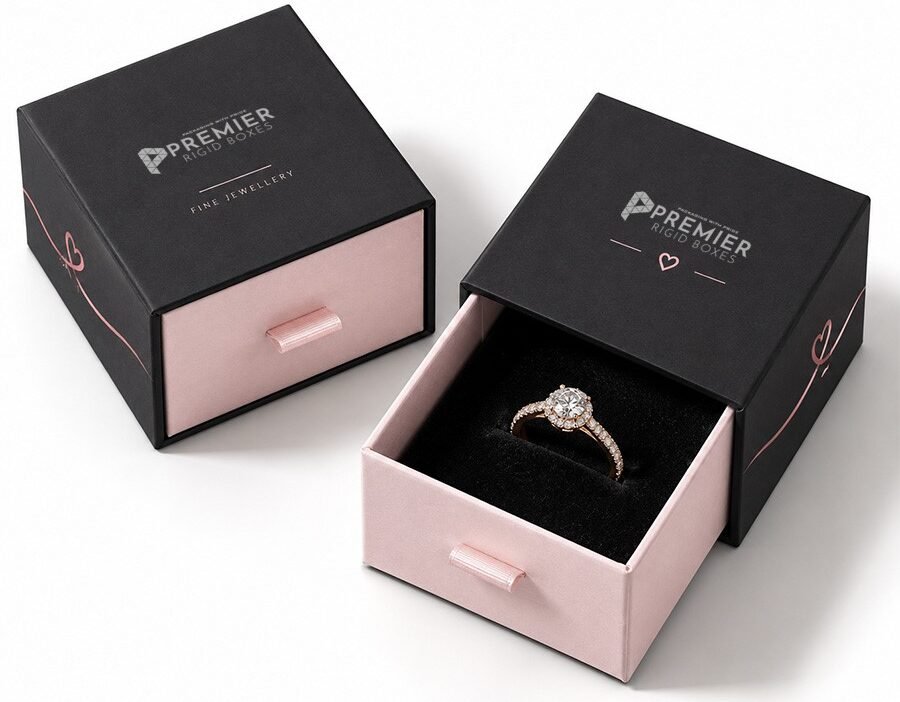
Rings are awkward to pack. They are compact enough to fit through cracks, too weighty to toss about, and valuable enough that if scratched, they will be in demand for a refund. The vast majority of protection comes from an area of the box that people don’t think about very often: the box insert that secures the ring.
How a ring ends up loose
Suppose the ring is slightly smaller than the box. It’s okay if it’s on a shelf. It navigates through all the bumps and turns of a delivery van, a sorting facility, and a mailbox. After repeated knockings a stone setting may loosen and the marks left by metal striking cardboard or other metal surfaces can be seen.
Boxes sold in the US usually travel a long way. A parcel going from Texas to New York may be handled a dozen times. Each handoff is another chance for the ring to move.
Wear is the quieter cause. The foam slit, which was able to maintain a ring before the first few dozen opens and closes, loses its grip after that. Thin paper inserts can also be softened by humid weather. If you sell year-round, test your package in the summer (not a dry office!
What an insert does
A ring insert has one main job: to stop movement, and two side effects that matter just as much. It cushions shock, so a drop doesn’t send the force straight into the ring. It also positions the ring so it’s the first thing the customer sees when the lid comes off.
Presentation counts more than people admit. A ring standing upright in a neat slot looks like part of the plan. A ring lying loose in the corner looks like it was tossed in at the last second.
Insert options at a glance
Here are the types you’ll most often encounter when ordering from US packaging suppliers.
| Insert type | How it holds the ring | Suited to | Main drawback |
| Foam slot | Slit in the foam grips the band | Single rings, retail counters | Loosens with repeated use |
| Velvet or flocked pad | Fabric-covered foam with a ring slot | Engagement and wedding rings | Costs more per box |
| Paperboard insert | Die-cut card with a slit | Budget and recyclable packs | Thin cushioning |
| Molded pulp tray | Pressed fiber shaped to the item | Sustainable brands, large orders | Limited finishes |
| Elastic strap | Stretch band pins the ring down | Mixed jewelry sets | Can mark soft metals if tight |
Price matters in the choice. A seller moving thirty-dollar silver bands in bulk doesn’t need velvet. Someone selling engagement rings probably does, since buyers at that price expect a certain feel.
Where Kraft fits in
Small jewelry brands in the States have been moving away from glossy white and black boxes toward plain brown kraft. The justification is helpful. It is lightweight, strong and easy to recycle and will work well with handmade or minimalist items. Many makers purchase Personalized Kraft Ring Packaging Boxes to add a logo to the packaging without compromising its natural look.
Recycled – Both kraft and paperboard inserts are made of paper, allowing the customer to recycle the entire product. A velvet pad in a kraft shell will work for a softer pad if desired. The difference between the hard exterior and the soft interior is observed.
Ask about the lead time: It’s a slow time of year for weddings and holidays.
Fit problems to catch early
Most fit mistakes come from measuring only the band. Check the setting height too. A tall solitaire needs a deeper slot than a plain band, and a wide band needs a wider one. If the ring sits too high, the lid presses on it. Too low, and it looks lost.
When a sample arrives, close it and give it a shake near your ear. Anything you can hear or feel is movement, and movement is damage waiting to happen. Send it back for a tighter cut.
Also, think about the box’s whole journey. A ring box that looks great on a shelf doesn’t always survive being mailed alone. Many sellers slip it into a padded mailer or small outer carton so the ring box itself doesn’t take any hits.
Why does it pay off for small sellers?
One damaged ring can cost you a refund, a replacement, shipping both ways, and probably the customer. A better insert costs a few cents per box. Compared with that, it’s cheap insurance.
There’s a marketing side as well. Customers film unboxings and post them. A ring nestled snugly in its slot looks good on a phone screen, and one rolling around loose looks careless, even if the ring is perfect.
Stock boxes usually come with a generic insert that fits most rings loosely. Custom packaging lets you set the exact dimensions, choose the insert, and add your branding. Many US suppliers now accept smaller minimum orders, so you can get a proper fit without buying thousands of boxes.
Before you order
- Measure the full ring, including the setting height
- Decide if the box will be handed over or mailed
- Request a physical sample and test it
- Make sure any recycling claims match the materials
- Ask about lead times, since the holidays and spring wedding season slow things down
Final Words
Compliments go to the outer box, and the inner box is used to protect. If you select one that complements your rings, matches your budget, and will hold up to the mail, you will have few of the ring-selling complaints that follow.