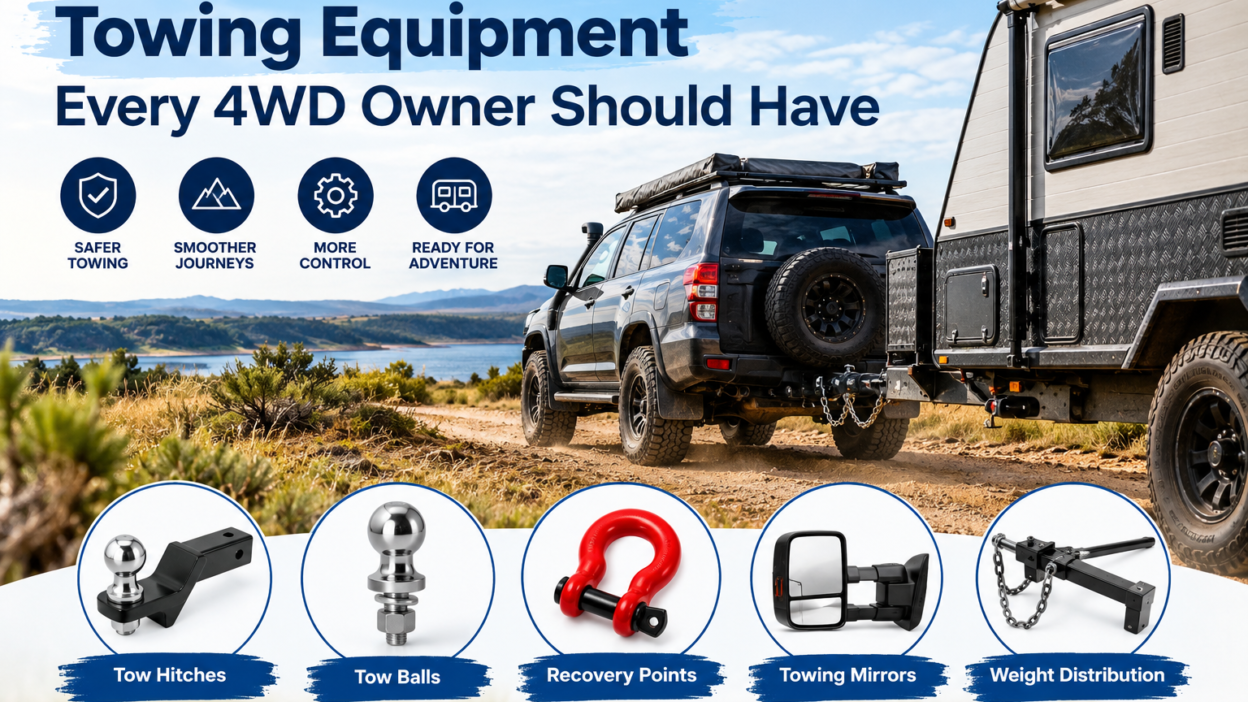
Owning a 4WD opens up a world of adventure. You can tow a camper to the coast, haul a boat to the lake, or drag a trailer full of firewood home. But towing is only fun when it is safe.
Safe towing starts with the right equipment. The gear connecting your 4WD to your trailer does a huge job. It carries the weight, keeps everything steady, and holds on tight over every bump in the road.
So what do you actually need? That is what this guide is all about. We will walk through each piece of towing equipment, what it does, and why it belongs in your setup. No confusing jargon, just plain and simple explanations.
The Trailer Hitch: Where It All Begins
Every towing setup starts with a trailer hitch. This is the strong steel frame that bolts to the back of your 4WD. Everything else connects to it, so it is the single most important piece of towing gear you will own.
A good trailer hitch does one simple job. It gives your trailer a solid, secure point to hold onto. Without it, you are not towing anything.
Hitches come in different classes based on how much weight they can handle. Class 3 hitches suit most mid-size 4WDs and can tow around 3,500 kg. Class 4 and 5 hitches are for serious loads like big caravans and heavy machinery.
Here is the golden rule. Your trailer tow hitch must be rated for more than the weight you plan to tow. Check the rating stamped on the hitch and the towing limit in your vehicle’s handbook. The lower of the two numbers is your real limit. Never guess this part.
Tow Balls and Ball Mounts
The tow ball is the shiny round knob the trailer coupling clamps onto. It looks simple, but size matters a lot here.
Tow balls come in a few common sizes, like 50 mm in Australia or 2 inches in the United States. The ball size must match the trailer coupling exactly. A coupling on the wrong size ball can pop off on a bumpy road. Always check both before you drive.
The ball mount is the piece that slides into your hitch and holds the tow ball. Mounts come with different amounts of drop or rise. This lets you adjust the height so your trailer sits level behind your 4WD.
Why does level matter? A nose-down trailer pushes too much weight onto the back of your vehicle. A nose-up trailer can sway from side to side at speed. A level trailer tows straight, brakes evenly, and keeps you in control.
Safety Chains and Shackles
Think of safety chains as your backup plan. If the coupling ever lets go of the tow ball, the chains keep the trailer attached to your 4WD instead of rolling free down the road.
Use chains that are rated for your trailer’s weight. The rating is stamped right on the chain links. Worn, rusty, or stretched chains should be replaced straight away.
Cross the chains under the coupling in an X shape. If the trailer drops, the crossed chains form a cradle that catches the drawbar before it hits the road.
The shackles that connect the chains matter too. Use rated D-shackles, not cheap hardware store ones. In many places, unrated shackles are actually illegal for towing. They cost only a few dollars more, so there is no reason to cut corners here.
Weight Distribution Hitch for Heavy Loads
Towing a big caravan or camper trailer? Then a weight distribution hitch deserves a spot on your list. Many owners simply call it a camper hitch because it is so popular with caravan and camper folk.
Here is the problem it solves. A heavy trailer presses down hard on the back of your 4WD. The rear sags, the front lifts, your headlights point at the sky, and your steering feels light and floaty. That is a scary way to drive.
A weight distribution hitch uses long spring bars to spread that heavy tongue weight across all the wheels of your 4WD and the trailer. The vehicle sits level again. Steering feels normal. Braking improves too.
As a rough guide, if your trailer’s tongue weight is more than about 10 to 15 percent of your vehicle’s weight, a camper hitch will make a clear difference. For big caravans, many drivers will not tow without one.
Brake Controller and Trailer Wiring
A heavy trailer needs its own brakes. In most places, any trailer over about 750 kg must have them by law. But trailer brakes cannot think for themselves. They need a brake controller.
A brake controller is a small box mounted near your steering wheel. When you press your brake pedal, it tells the trailer brakes to work too. You can adjust how strongly they grip, so the trailer slows smoothly with your 4WD instead of pushing it from behind.
Then there is the wiring. A trailer plug connects your 4WD’s electrics to the trailer. It powers the brake lights, indicators, and running lights. Without it, drivers behind you have no idea when you are stopping or turning.
Check the plug and wiring before every trip. Wiggle the connector, look for cracked wires, and have someone confirm the lights flash while you test them. It takes two minutes and prevents fines and accidents.
Towing Mirrors
A caravan or wide trailer hides everything behind you. Your normal side mirrors simply cannot see past it. That blind spot is where trouble hides.
Towing mirrors fix this. They clip or strap onto your existing mirrors and stretch out wider, letting you see right down both sides of the trailer. You can watch cars overtaking, check your trailer wheels, and reverse with far more confidence.
In many countries, towing mirrors are required by law whenever your trailer is wider than your vehicle. Even where they are not required, they are one of the cheapest safety upgrades you can buy.
Pick mirrors that fit your 4WD model snugly and do not vibrate at highway speed. A blurry, shaking mirror is almost as bad as no mirror at all.
Handy Extras That Save the Day
The big items above do the heavy lifting. But a few small extras make towing life much easier. Keep these in your 4WD and you will thank yourself later.
Wheel chocks. These little wedges stop your trailer rolling away when it is unhitched. Slip them behind the wheels every time you park on a slope.
A jockey wheel. This small wheel bolts to the trailer drawbar and lets you move and lift the trailer by hand. Hitching up becomes a one-person job instead of a back-breaking struggle.
A hitch lock. It stops thieves from simply hitching your trailer to their own car and driving off. Cheap insurance for an expensive camper.
Recovery gear. A rated snatch strap, a shovel, and a pair of traction boards can get you out of mud or sand. When you tow off the beaten track, getting stuck is a matter of when, not if.
Spare parts. Carry a spare trailer wheel, a wheel brace that fits it, and some spare plug fuses. Trailers always seem to get flat tires in the worst spots.
Final Thoughts
Towing does not have to be stressful. With the right gear, it becomes just another easy part of your adventure.
Start with the basics. A properly rated trailer tow hitch, the right size tow ball, and crossed safety chains cover the essentials. Add a brake controller and good wiring so your trailer can stop and signal. Clip on towing mirrors so you can see everything around you.
Towing something big like a caravan? A weight distribution hitch keeps your 4WD level and steady. And those little extras, like chocks, a jockey wheel, and recovery gear, turn roadside problems into quick fixes.
One last tip before every trip. Walk around your setup and check everything. Coupling locked, chains crossed, lights working, tires inflated. It takes five minutes, and it is the cheapest safety gear of all.