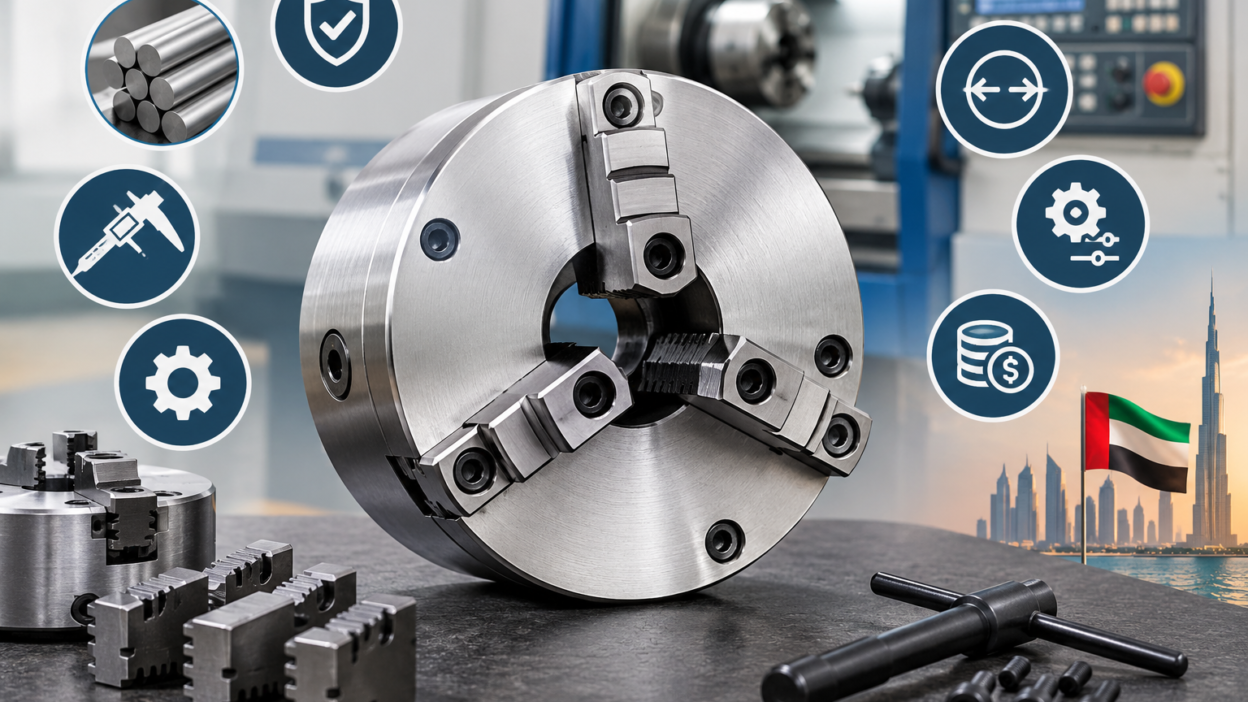
A 3 jaw lathe chuck is an essential workholding accessory used in conventional and CNC turning operations. It holds cylindrical and suitable hexagonal workpieces securely while allowing quick and convenient centering. However, the 3 jaw lathe chuck price UAE can vary depending on chuck size, material quality, accuracy, jaw configuration, brand, and mounting compatibility.
For industrial buyers, understanding these factors makes it easier to compare supplier quotations and choose a chuck that meets workshop requirements. Khokhawala Trading LLC helps buyers explore industrial tooling options, including workholding accessories for machining applications.
Table of Contents
- What Is a 3 Jaw Lathe Chuck?
- Key Factors That Affect 3 Jaw Lathe Chuck Prices
- How to Choose the Right Lathe Chuck
- Tips for Comparing Supplier Quotations
- Frequently Asked Questions
- Conclusion and Call to Action
1. What Is a 3 Jaw Lathe Chuck?
A 3 jaw lathe chuck is a self-centering workholding device in which three jaws move together to grip a workpiece. It is commonly used for holding round bars, pipes, and suitable hexagonal materials during turning operations.
Its self-centering mechanism makes setup faster and more convenient for repetitive machining tasks. The chuck is available in different sizes, jaw arrangements, mounting styles, and accuracy specifications to suit various lathe machines.
2. Key Factors That Affect 3 Jaw Lathe Chuck Prices
Chuck Size and Diameter
Chuck size is one of the primary factors affecting price. Larger chucks generally require more material and may have greater manufacturing requirements.
Before purchasing, consider the workpiece diameter, machine capacity, spindle specifications, and available clearance. Choosing a chuck that is too large can create unnecessary costs and compatibility problems.
Material and Construction Quality
The materials and manufacturing quality influence durability, rigidity, and resistance to wear. A well-manufactured chuck with properly finished components can provide reliable performance under suitable operating conditions.
Construction quality is particularly important for workshops that use their machines regularly or perform demanding turning operations.
Accuracy and Self-Centering Performance
Chuck accuracy affects how consistently a workpiece is positioned. Higher-precision models may cost more because of tighter manufacturing and inspection requirements.
Buyers should compare documented runout specifications and understand the conditions under which accuracy is measured. Jaw condition, mounting quality, and workpiece preparation also influence actual machining results.
Jaw Design and Configuration
The jaw arrangement affects the type of workpieces a chuck can hold. Some models include reversible jaws, while others use separate internal and external jaw sets. Specialised or replacement jaw systems may increase the overall purchase cost.
Consider the gripping range, jaw travel, contact area, and availability of replacement jaws before selecting a model.
Mounting Type and Compatibility
A lathe chuck must match the machine’s spindle nose or use a compatible mounting plate or adapter. Different mounting arrangements can affect the final purchase cost.
Check the following details:
- Lathe machine make and model
- Spindle nose type
- Mounting dimensions
- Chuck diameter
- Through-hole capacity
- Required adapter or backplate
A chuck that requires additional mounting components may have a higher total installation cost than its listed price suggests.
Brand and Manufacturer
Manufacturer reputation, quality control, product specifications, and technical support can influence pricing. Established brands may charge more for models offering documented performance and consistent manufacturing standards.
However, the most expensive chuck is not necessarily the best option. Match the product specifications to your actual machining requirements.
Order Quantity and Availability
The quantity ordered can influence the quoted unit price. Bulk purchases may offer better commercial terms, depending on stock and supplier policies.
Availability also matters. A readily available model may have different delivery conditions from a specialised or imported chuck.
3. How to Choose the Right Lathe Chuck
Before purchasing, evaluate your machine and the workpieces you plan to machine.
Identify Your Workpiece Requirements
Consider the material, shape, diameter, and length of the components. A 3 jaw self-centering chuck is generally suitable for round and compatible hexagonal workpieces.
For square, irregular, or eccentric components, a 4 jaw independent chuck may be more appropriate.
Check the Required Gripping Capacity
Compare the chuck’s external and internal gripping ranges with your regular workpiece dimensions. Also check the usable gripping length and jaw position to ensure secure workholding.
Consider Operating Speed
Confirm that the chuck’s maximum permitted speed is suitable for your lathe. Follow the manufacturer’s specifications for jaw configuration, clamping conditions, and safe operation.
Evaluate Long-Term Value
Do not compare products by purchase price alone. Consider durability, replacement jaw availability, maintenance requirements, mounting accessories, and expected service life.
4. Tips for Comparing Supplier Quotations
When requesting quotations, provide accurate product information to receive relevant offers.
- Specify the required chuck diameter and model.
- Share your lathe machine and spindle nose details.
- Confirm jaw type and gripping capacity.
- Ask whether mounting accessories are included.
- Check stock availability and delivery time.
- Compare warranty and after-sales support.
- Confirm whether the quoted price includes applicable additional charges.
If your workshop also needs milling workholding equipment, you can separately explore options to buy vertex milling machine vice dubai. A milling vice and a lathe chuck perform different workholding functions, so each should be selected according to its machine and application.
5. Frequently Asked Questions
Q1. What affects the 3 jaw lathe chuck price in the UAE?
The main factors include chuck diameter, construction quality, accuracy, jaw configuration, brand, mounting type, and availability.
Q2. What is the main advantage of a 3 jaw lathe chuck?
Its self-centering mechanism allows all three jaws to move together, making it convenient for quickly gripping round and suitable hexagonal workpieces.
Q3. How do I choose the correct chuck size?
Check your lathe’s permitted chuck size, spindle mounting, workpiece dimensions, gripping range, through-hole capacity, and operating requirements.
Q4. Is a 3 jaw chuck suitable for every workpiece?
No. It is generally suitable for round and compatible hexagonal components. Irregular, square, and eccentric workpieces may require a 4 jaw independent chuck or another workholding solution.
Q5. What information should I provide when requesting a quotation?
Provide the chuck diameter, machine model, spindle nose type, jaw configuration, required quantity, and any preferred brand or accuracy specifications.
6. Conclusion and Call to Action
The 3 jaw lathe chuck price UAE depends on several factors, including size, material quality, accuracy, jaw design, mounting compatibility, and manufacturer. Comparing these specifications carefully helps industrial buyers select a suitable chuck without unnecessary spending.
Khokhawala Trading LLC can help you explore industrial tooling and workholding requirements for your workshop. Contact the team with your machine specifications and purchasing requirements to discuss suitable options and request a quotation.