
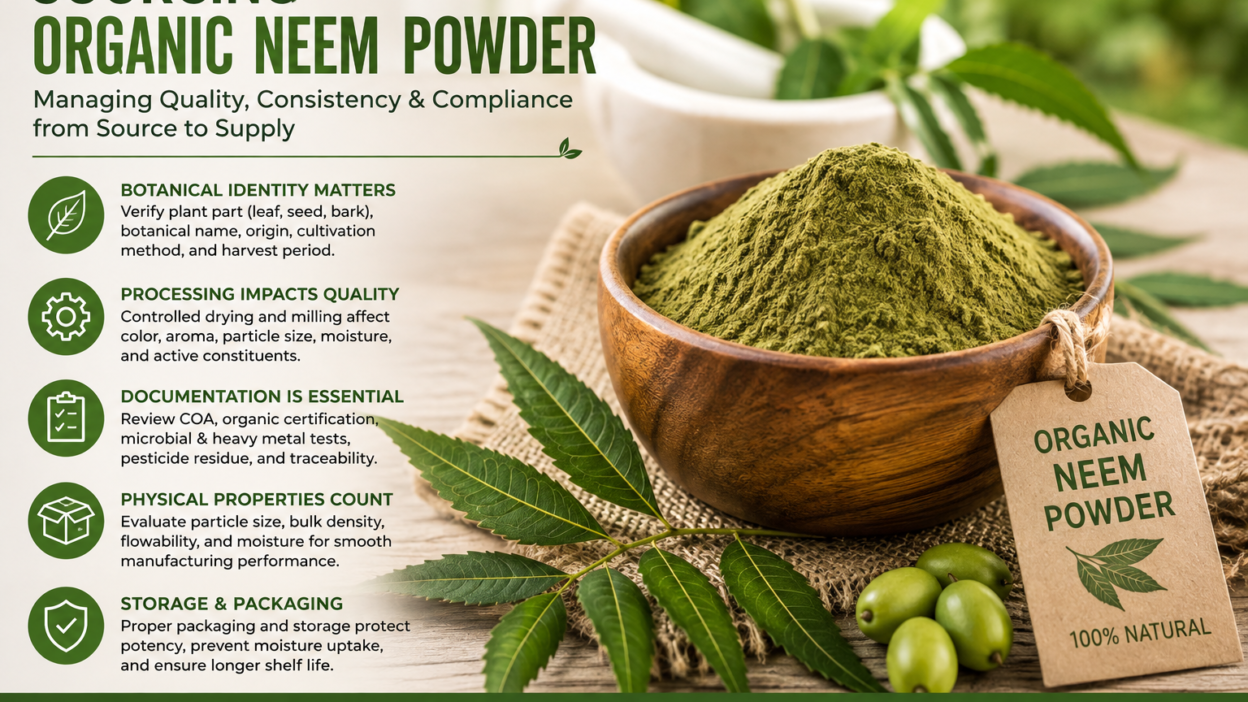
One of the recurring challenges in botanical procurement is that a raw material can pass an initial quality review and still behave differently when the next commercial lot arrives. Organic Neem Powder is a good example. Differences in leaf maturity, growing region, drying conditions, milling, moisture, and storage can influence the finished powder, even when two lots carry the same product name.
For procurement managers, formulators, and R&D teams, sourcing neem at scale is therefore less about finding a compliant ingredient and more about controlling the variables that matter to the finished formulation.
Start With the Plant Material
Neem, botanically known as Azadirachta indica, is widely cultivated across India and other tropical and subtropical regions. Commercial neem powder can be produced from different plant parts, including leaves, bark, seeds, or other specified material. These should not be treated as interchangeable ingredients.
For buyers, the first sourcing question should be straightforward: what plant part is actually being supplied? The botanical identity, growing region, cultivation method, harvest timing, and processing location should also be established.
For Organic Neem Powder, certification needs to match the supplied material and relevant supply chain. Procurement teams should review current organic documentation alongside traceability records rather than treating an organic claim as sufficient evidence.
Regional and seasonal variation can affect color, aroma, moisture, and composition. A supplier changing its raw-material source may still meet the stated specification, but the resulting powder could behave differently in a sensitive formulation.
Processing Can Influence Physical and Chemical Characteristics
Neem leaves and other plant materials contain naturally occurring limonoids, flavonoids, polyphenols, proteins, fiber, minerals, and other botanical constituents. Their relative levels can vary according to plant part, maturity, cultivation conditions, and processing.
Drying is particularly important because excessive heat or prolonged exposure can influence color, aroma, and constituent retention. Inadequate drying, meanwhile, can create moisture and microbial-control concerns.
Milling determines particle size, bulk density, and flow behavior. These properties become important when neem powder is incorporated into capsules, tablets, dry blends, or other manufactured products.
One issue we often see is that a powder may meet its basic identity and microbiological specifications but still require process adjustments because of changes in particle size or bulk density. That is why physical testing should be considered alongside the COA.
Application Determines the Right Neem Specification
Organic Neem Powder may be used in botanical formulations, personal-care preparations, agricultural products, and selected food or nutraceutical applications where the intended regulatory framework permits its use.
The plant part matters significantly. Leaf powder, seed powder, and bark powder have different compositional profiles and should be specified separately. A procurement team sourcing “neem powder” without defining the plant part leaves considerable room for inconsistency.
Formulators should also determine whether they need a whole botanical powder or a more concentrated extract. These formats serve different technical purposes and should not be compared solely on cost per kilogram.
The appropriate specification should reflect the finished product, including particle size, moisture limits, microbiological requirements, and any relevant compositional parameters.
What to Check When Buying Organic Neem Powder Bulk
When sourcing Organic Neem Powder Bulk, documentation should include the COA and, where relevant, organic certification, botanical identity testing, microbiological results, pesticide-residue analysis, heavy-metal testing, allergen information, country-of-origin documentation, and applicable quality or food-safety certifications.
But paperwork is only part of the evaluation.
Before approving a recurring bulk supplier, it is useful to compare multiple lots. Examine color, aroma, particle size, moisture, bulk density, flowability, and general physical consistency. If the material will enter a particular manufacturing process, pilot-scale testing can reveal behavior that a laboratory inspection may miss.
Packaging and storage deserve equal attention. Botanical powders can absorb moisture during transportation and warehousing. Inadequate moisture protection can result in caking, reduced flow, and handling difficulties.
For international procurement, buyers should also consider transit time, climate exposure, packaging barrier properties, and warehouse conditions between the processing site and the final manufacturing facility.
Building a Reliable Bulk-Sourcing Specification
For recurring Organic Neem Powder Bulk purchases, specifications should be built around measurable production requirements rather than a generic product description. Depending on the application, buyers may define acceptable ranges for moisture, particle size, bulk density, microbiological parameters, and relevant compositional attributes.
Retaining a reference sample from an approved lot can help quality teams compare future deliveries. It is also useful to establish a supplier change-notification process covering raw-material origin, plant part, harvest period, drying method, milling process, and manufacturing location.
These controls do not remove natural agricultural variation, but they make it easier to identify meaningful changes before they affect production.
Ultimately, reliable neem sourcing begins with understanding exactly what is being purchased and how it was produced. For companies buying Organic Neem Powder Bulk, connecting botanical identity, agricultural origin, processing, analytical documentation, physical properties, and storage conditions gives procurement and R&D teams a much clearer basis for maintaining consistency at commercial scale.