A common sourcing mistake with botanical ingredients is approving a supplier after testing one attractive sample. The powder may have the expected aroma, color, and texture, yet a later shipment can behave differently during blending or storage. Organic Peppermint Leaf Powder is a good example because the ingredient is agricultural in origin and remains sensitive to cultivation, harvest, drying, milling, packaging, and storage conditions.
For procurement managers and formulation teams, reliable sourcing starts with understanding which variables can affect commercial consistency.
Start With the Leaf, Not the Label
Organic peppermint leaf powder is produced from dried peppermint leaves, generally from Mentha × piperita. Commercial supplies can come from different growing regions, and regional differences in climate, soil, cultivar, harvest timing, and agricultural practices may influence the final material.
In most sourcing scenarios, a country-of-origin statement is useful but incomplete. Buyers should establish the botanical identity, growing region where available, cultivation method, harvest period, drying process, and manufacturing location.
Organic certification should also be verified as part of the procurement review. The certificate should apply to the relevant ingredient and supply chain, with documentation that supports traceability rather than simply stating that the product is organic.
Processing Can Change the Ingredient’s Behavior
Peppermint leaves naturally contain volatile oils, including menthol and menthone, as well as polyphenols, chlorophyll, fiber, and other plant constituents. Because some components are sensitive to processing and storage, the way the leaves are dried and handled can affect the finished powder.
Drying conditions deserve particular attention. Excessive heat can influence the sensory profile and color, while insufficient drying can create moisture-related stability and storage issues. Milling determines particle-size distribution and can affect bulk density, flowability, and blending.
For formulators, these physical characteristics can become important during scale-up. A powder that blends well at laboratory scale may behave differently in a high-capacity mixer if its particle size or bulk density changes. Moisture variation can also contribute to caking and inconsistent feeding through production equipment.
This is one reason a COA should be viewed as a baseline rather than the complete technical picture.
Applications Should Shape the Specification
Manufacturers use Organic Peppermint Leaf Powder in a variety of food, beverage, nutraceutical, and botanical formulations. Food applications may include herbal blends, dry mixes, confectionery products, seasonings, and other products where powdered leaf material is suitable.
Nutraceutical manufacturers may use it in capsules, tablets, sachets, and botanical blends. Functional beverage producers may incorporate peppermint powder into powdered drink systems when its aroma, particle size, dispersion, and compatibility fit the process.
A key sourcing decision is whether the application actually requires leaf powder or a peppermint extract. Whole-leaf powder represents the broader dried botanical material, while an extract is generally chosen when a more concentrated or controlled constituent profile is required.
Making that distinction early prevents procurement teams from comparing ingredients that may appear similar but serve different formulation purposes.
What to Check When Buying Organic Peppermint Leaf Powder Bulk
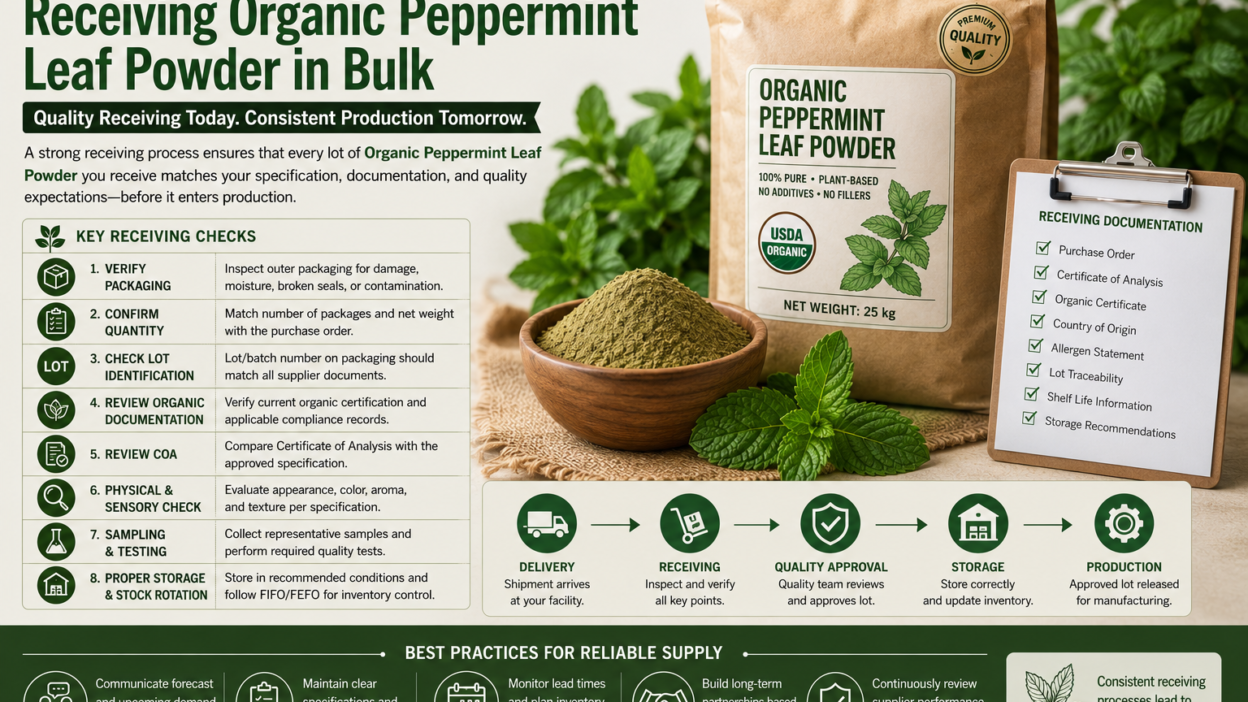
For Organic Peppermint Leaf Powder Bulk, procurement teams should review documentation such as the COA, organic certificate, botanical identity information, microbiological results, pesticide-residue testing, heavy-metal data where applicable, allergen information, country-of-origin records, and relevant food-safety certifications.
But one real-world sourcing observation is worth emphasizing: aroma and physical appearance can reveal lot variation that paperwork may not capture.
For a commercial approval process, it can be useful to compare samples from multiple production lots. Evaluate aroma intensity, color, moisture, particle size, bulk density, flowability, and dispersion. If the ingredient is going into a finished formulation, testing it under representative production conditions provides a more useful assessment than examining the raw powder alone.
Packaging is another hidden variable. Peppermint’s aromatic constituents can be affected by prolonged exposure to unsuitable storage conditions. Moisture can also affect powder flow and contribute to caking. Barrier packaging, controlled warehouse conditions, and clear storage requirements should therefore be part of the sourcing discussion.
Managing Variation Before It Becomes a Production Issue
When purchasing Organic Peppermint Leaf Powder Bulk, the best specifications focus on characteristics that actually affect manufacturing. Depending on the application, buyers may establish acceptable ranges for moisture, particle size, bulk density, microbiological parameters, and relevant compositional attributes.
Retaining an approved reference sample is another simple way to compare future lots. Procurement teams should also clarify how suppliers communicate changes in growing region, harvest season, drying method, milling equipment, or manufacturing location.
These changes do not automatically mean a material is unsuitable. They do, however, provide a reason to reassess whether the ingredient will continue to behave as expected.
Ultimately, successful peppermint powder sourcing is less about finding a supplier with the right label and more about controlling the variables behind the ingredient. For procurement, quality, and R&D teams, understanding agricultural variation, processing conditions, physical properties, and storage requirements creates a more realistic foundation for dependable bulk purchasing.