
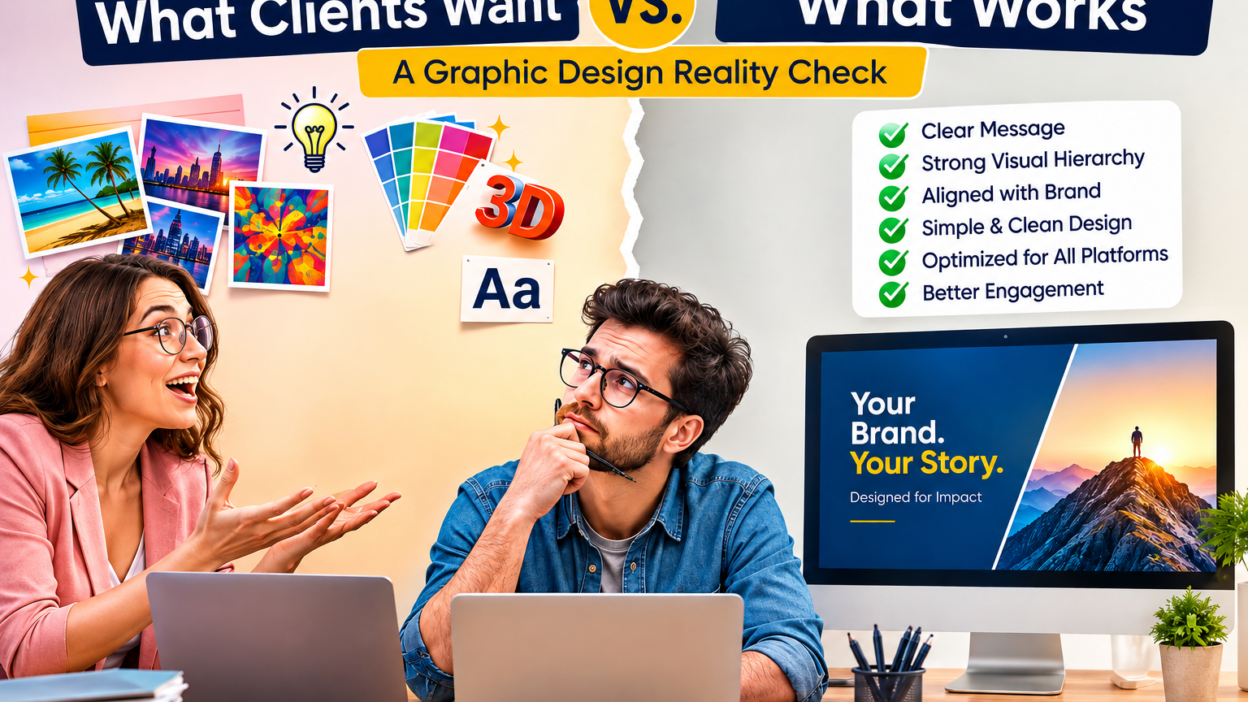
If I had a dollar for every time a client told me, “Can we make it pop?”, I’d probably be retired by now. Instead, after years in graphic design, I’ve learned to smile, nod, and ask the more important question: What exactly do you want it to do? The question matters when you’re looking for branding and graphic design services in the Bay Area. You may know you want something bold, modern, or eye-catching, but explaining that to a designer can feel like ordering coffee in a language you barely speak. Here’s where things get interesting in expectation of client vs design reality.
The “Make It Pop” Problem
Usually, “make it pop” doesn’t mean you actually want a giant drop shadow attacking your logo. You want people to notice it.
Good designers solve that with hierarchy, spacing, scale, contrast, and color. Adding effects just for the sake of adding effects can make a design noisy rather than memorable.
And yes, that neon bevel from 2004 can stay where it belongs—in the past.
The 12-Slide Carousel Trap
“Should we make this Instagram post with 12 slides?”
Sure. But should we?
More content doesn’t automatically mean better content. If every slide contains three paragraphs, six icons, and a motivational quote, your audience may quietly disappear around slide four.
The better approach is to identify the key message and build the design around it. A designer should help you decide what deserves attention, not simply squeeze everything onto the canvas.
Welcome to the Font Circus
One font for the headline. Another for the subheading. A script font for the CTA. Maybe Comic Sans for emotional support.
Please. No.
Typography needs hierarchy and consistency. Adobe recommends keeping typefaces limited and prioritizing readability, hierarchy, and scalability over style.
So, if you’re looking for branding and graphic design services in Santa Clara, California, ask how the designer plans to create a consistent visual system, not just a pretty one.
The Neon Glitch Has Entered the Chat
Neon, glitch effects, gradients, and futuristic grids can look fantastic. They can also make your accounting firm look like it sells cyberpunk caffeine beverages.
Trends aren’t bad. Blindly following them is.
A good designer asks whether a trend fits your audience, industry, and brand personality. This matters even more when you’re producing designs regularly. Consistency keeps your brand recognizable while giving you room to experiment. That’s what a designer basically goes through in a client vs design reality.
Copa Design, for example, describes its approach as understanding a client’s mission, goals, and vision before developing creative work. That philosophy is worth remembering regardless of who you hire.
What Should You Actually Ask Your Designer?
Here’s my veteran-designer cheat sheet:
| Instead of saying… | Try saying… |
| “Make it pop.” | “I want it to grab attention.” |
| “Make it modern.” | “I want it to feel fresh and current.” |
| “Use more colors.” | “It feels flat. Can we create more energy?” |
| “Make everything bigger.” | “The main message isn’t standing out.” |
| “Copy this trend.” | “Can we explore this style while keeping our brand?” |
See the difference? You’re giving the designer the problem, not prescribing the solution. That makes the creative process much smoother.
Good Design Isn’t About Winning Arguments
I’ve worked long enough to know that the best client-designer relationships aren’t about one person always being right. You know your business. Your designer knows visual communication. The magic happens somewhere in the middle.
Whether you’re looking for an affordable graphic design service or ongoing creative support, look for a team that asks questions before opening Photoshop.
A graphic design subscription service in Santa Clara can also make sense when your business needs a steady stream of social graphics, campaigns, presentations, and other creative work. For instance, Copa Design’s Breeze subscription is built around ongoing requests, a dedicated creative team, and consistent on-brand output.
One Last Thing: Make It Work, Not Just “Pop”
Good design should attract attention, but that’s only the beginning. It should communicate clearly, fit your brand, and make life easier for the person looking at it.
Even accessibility matters. The W3C recommends a 4.5:1 contrast ratio, at least, for normal text, showing that effective design isn’t purely about aesthetics.
So, when you’re discussing event graphic design in Santa Clara, a new website, or your next social campaign, don’t worry about knowing every design term.
Tell your designer what you want people to feel, notice, and do. Then let the designer worry about making it pop.
FAQs:
- What does a graphic designer actually do for a brand?
A graphic designer translates your business goals into clear visual communication. Rather than just making things look pretty, they establish visual hierarchy, choose functional typography, and build cohesive design systems that capture attention, convey your message, and drive real audience engagement.
- How do I choose between hiring a freelance designer or a graphic design agency?
Freelancers work well for one-off projects, but full-service agencies like Copa Design provide comprehensive strategic vision and ongoing creative support. Their team collaborates closely to understand your brand’s mission, offering reliable visual identity, graphic design, and print services.
- How can poor design choices hurt your business brand?
Overloading designs with too much text, competing fonts, or flashy trends confuses viewers and drives potential clients away. Impractical visual hierarchy makes key details hard to find, while poor color contrast harms accessibility, ultimately eroding trust and reducing your brand’s overall effectiveness.



[…] rise of Islam in the 7th century brought about a brand new era of art, culture, and building design. During the first few centuries of Islamic history, early Muslims built magnificent structures that […]