
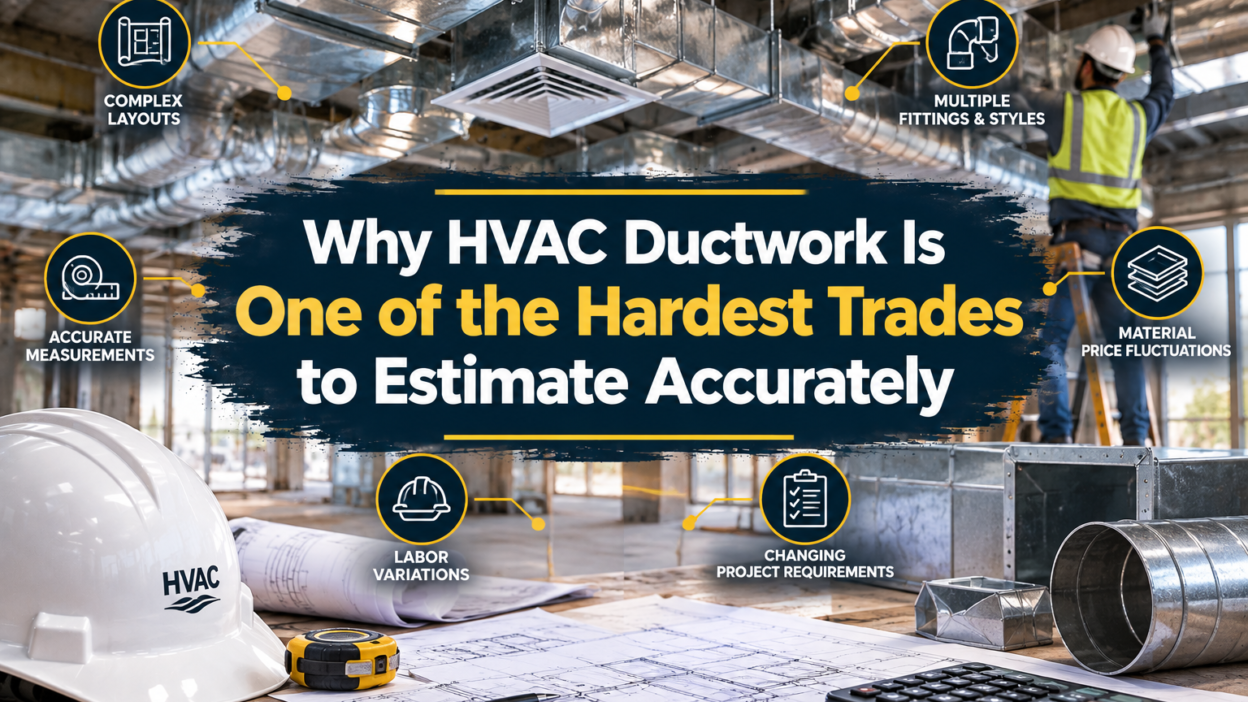
Ask any mechanical contractor what part of an HVAC bid keeps them up at night, and ductwork usually comes up before equipment selection or piping. Ducts don’t come in one shape or size; they twist through ceilings, split into branches, change direction, and pick up hangers, dampers, and transitions along the way. Miscount any of it, and a bid that looked solid on paper turns into a losing job once fabrication starts.
Unlike more standardized trades, ductwork estimating rewards precision and punishes shortcuts. A contractor who treats it as a rough square-footage calculation is usually the one eating change orders three weeks into the project.
Ductwork Isn’t Just Pipe It’s a System of Parts
New estimators sometimes assume duct takeoff means counting linear feet of sheet metal and calling it done. In reality, a single system might include rectangular runs, round branches, oval transitions, elbows at multiple angles, reducers, tees, eyes, end caps, and a full set of dampers, volume, fire, and smoke each with its own material and labor cost. Add hangers, trapeze supports, and diffusers, and the component list for even a modest commercial building can run into the hundreds of line items.
Missing even a handful of these components doesn’t just shrink the material budget, it throws off labor hours too, since installation time varies significantly between a straight run and a custom transition fitting.
Why Gauge and Pressure Class Change Everything
Two ducts can look identical on a drawing and still require completely different sheet metal gauges once pressure class and reinforcement requirements are factored in. Estimators who don’t reference SMACNA construction standards when assigning gauge thickness and seal class often underestimate material weight which means underestimating cost. This is a detail that separates a takeoff done by someone with genuine duct experience from one done by a generalist trying to cover every trade at once.
The Real Cost of a Rushed Duct Takeoff
A duct takeoff that’s rushed or handled without the right software tends to produce numbers that look reasonable but don’t hold up once fabrication drawings are finalized. The contractor either finds out too late that they’ve underbid the sheet metal, or they discover mid-project that dampers and hangers were never counted at all. Both scenarios eat into margin and put the schedule at risk.
Software Alone Doesn’t Guarantee Accuracy
Plenty of firms have access to takeoff software like PlanSwift or Trimble, but the software is only as good as the person operating it. Digitizing a duct run still requires someone who understands duct design methods equal friction, velocity reduction, static regain well enough to know when a quantity looks wrong. Relying on software without that underlying trade knowledge is how errors slip through unnoticed.
Why Specialization Matters More Than General Estimating Experience
HVAC ductwork sits in an odd spot in the estimating world. It’s technical enough that a general construction estimator without sheet metal experience can easily miss details, but specific enough that it usually needs someone who lives in duct systems day to day. Contractors who outsource this piece of the bid to specialists rather than folding it into a broader MEP estimate tend to see fewer surprises once the project breaks ground.
What to Look for in a Duct Estimating Partner
The difference between an adequate duct takeoff and a genuinely reliable one usually comes down to a few things: whether the estimator references current industry standards for gauge and pressure class, whether every component down to the smallest fitting is counted, and whether the deliverable is organized enough for procurement and bidding to actually use it. Contractors who want that level of detail on sheet metal, fittings, and accessories often turn to dedicated duct takeoff services built specifically around HVAC ductwork rather than general mechanical estimating.
Final Thoughts
Ductwork estimating punishes anyone who treats it as a simple linear-footage exercise. Between the sheer variety of components, the code-driven gauge and pressure requirements, and the labor variability between duct types, this is a trade where accuracy has to be built in from the first takeoff not corrected after the crew is already on-site. Contractors who invest in getting it right at the bidding stage consistently come out ahead on both margin and schedule.