
Talk to someone who just bought a bangle online and ask what made the whole thing feel special. Nine times out of ten, they won’t bring up the product photo. They’ll bring up the box. There’s something about bangles that makes them harder to package well than most jewelry – the shape is rigid, it’s round, and it refuses to lie flat the way a ring or a pendant naturally does. Many brands never really solve this problem. They just grab whatever box was already sitting in the storeroom for rings or bracelets and hope nobody notices. People notice.
Why a Regular Jewelry Box Doesn’t Work for Bangles
A bangle will maintain its roundness regardless of what happens, so the box has to be designed round from the beginning, rather than a flat bangle insert or similar with a slot cut in it later. If placed in a bangle or necklace box, or inside a pair of earrings, there is a pretty good chance the bangle will get dropped, slide around in the box, hit the sides, and end up with one or two scuff marks.
This is the exact spot where many small jewelry sellers trip up. They lean on generic boxes early on because it’s cheaper and there’s one less decision to make, and it isn’t until later that they realize the packaging has been quietly working against them the whole time. A bangle that arrives with a scratch, or one that looks like it got wedged into a box it never quite fit, takes something away from the experience of buying a nice piece in the first place.
The Things That Actually Make a Bangle Box Good
None of this is complicated once you break it down. It mostly comes down to a few practical calls.
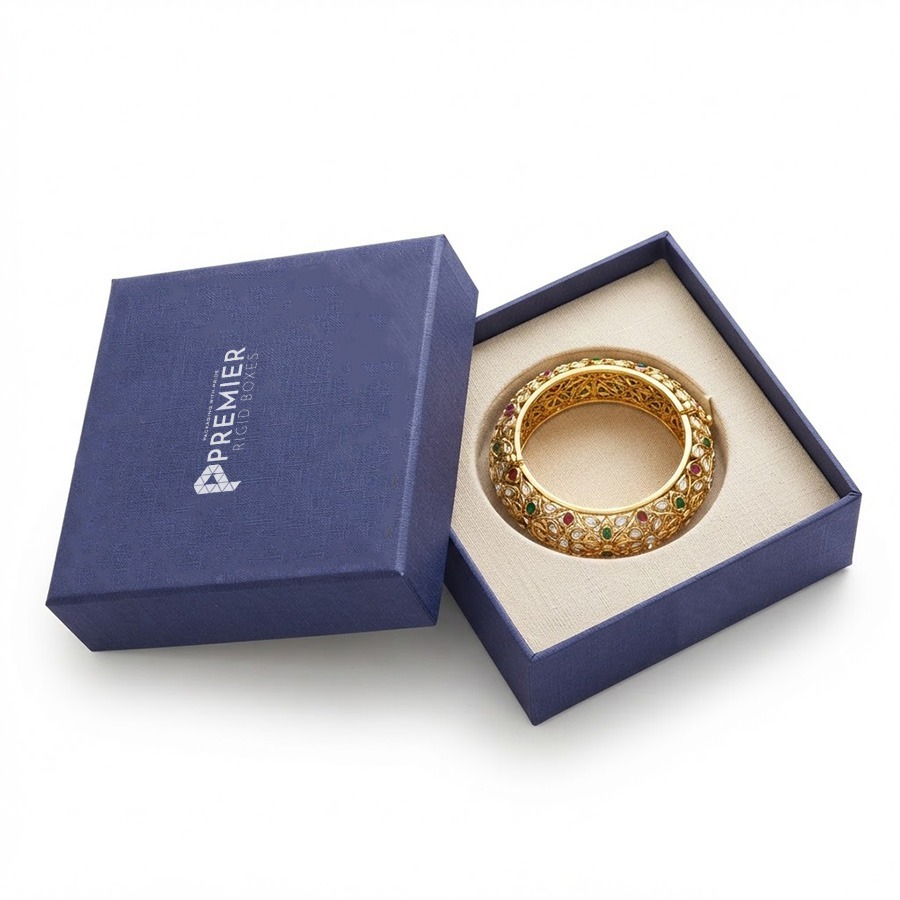
Fit is probably the one that matters most. Whatever’s holding the bangle in place – a round foam or velvet cutout shaped to the exact diameter, or a small raised stand the bangle rests over like a mini display – needs to keep it from moving without making it a struggle to lift out. Too loose and it rattles around in the mail. Too tight, and customers end up wrestling with their own jewelry box.
The interior lining does more work than people give it credit for, too. Velvet, satin, or a soft flocked material helps protect the bangle’s finish from scratches, which counts for a lot on polished or plated pieces. Color plays into this as well – a deep navy or black lining tends to make metal and gemstones pop in a way that plain white just doesn’t.
A quick comparison of how these choices typically stack up:
| Design Element | Budget-Friendly Option | Premium Option | Main Trade-Off |
| Insert/fit | Foam cutout | Molded velvet insert | Foam is cheaper but wears out faster |
| Box material | Thin cardboard | Rigid board | Rigid board costs more but protects better |
| Interior lining | Plain white flocking | Colored velvet or satin | Colored lining shows off metal/stones more |
| Opening mechanism | Lift-off lid | Magnetic closure | Magnetic adds cost but feels sturdier |
| Branding | Printed exterior | Foil-stamped/embossed logo | Embossing costs more but reads as higher-end |
Branding: Less Usually Works Better
When there is spare space to fill with logos and taglines, it’s always tempting but rarely a good idea for bangle boxes. The goal of the box is that it shouldn’t be the center of focus, it’s the jewelry’s! Tight logos on the lid (stamped or embossed), limited colors, and/or limited text seem more costly than a box that is fully branded all around.
That’s even more important when you consider the number of bangles sold as gifts. The person who opens that box desires it to be about him/her rather than the store from which the gift came. Soothing branding is more effective at sticking in a consumer’s mind than any loud branding ever could.
That restraint matters even more when you consider how many bangles get bought as gifts. Whoever’s opening that box wants the moment to feel like it’s about them, not about which store the gift came from. A quieter design does more to make a brand stick in someone’s memory than loud branding ever manages.
Custom Packaging or Buying Off the Shelf?
Sooner or later, most jewelry brands that regularly sell bangles hit the same fork in the road: keep buying generic boxes or switch to Custom Bangle Boxes for Jewelry Packaging tailored to their specific pieces. Off-the-shelf boxes are cheaper and easier to order in small quantities, which is fine for a brand still figuring things out. But they come with real limitations too – sizing that’s close but not exact, interiors that don’t match the brand’s look, and no space for the small details that make packaging memorable.
Custom boxes solve those problems, but they usually come with a minimum order and a longer wait, since they’re made to spec instead of pulled off a shelf. For brands selling bangles at any real volume, that investment tends to pay for itself pretty quickly. Customers remember packaging that felt made specifically for what they bought, and that memory sticks around longer than most brands expect – especially when it shows up in a review or gets posted online.
Choosing a Manufacturer Who Actually Handles Rigid Boxes Well
Not every packaging supplier is equipped to properly construct rigid boxes, and rigid is usually what a bangle needs, given how much protection the shape requires. It’s worth seeking out a manufacturer that specializes in rigid boxes specifically, rather than one that lists them as just another option among a dozen formats.
A company like Premier Rigid Boxes, for example, focuses on exactly this kind of construction, which usually means more consistent board thickness, sturdier corners, and a lid that actually fits right – the small details that go wrong with a less specialized supplier. Whoever you end up working with, ask for physical samples before committing to a full order. Photos don’t show how a box actually feels in someone’s hands, or whether it can withstand a bangle’s weight with repeated opening and closing.
Where This Leaves You
None of this requires reinventing anything. Get the fit right, use materials sturdy enough to genuinely protect the piece, keep the branding restrained, and pick a manufacturer that knows rigid construction inside and out. Handle those four things and the box stops being an afterthought in the customer’s mind. It becomes part of the reason the jewelry felt worth what they paid for it.