
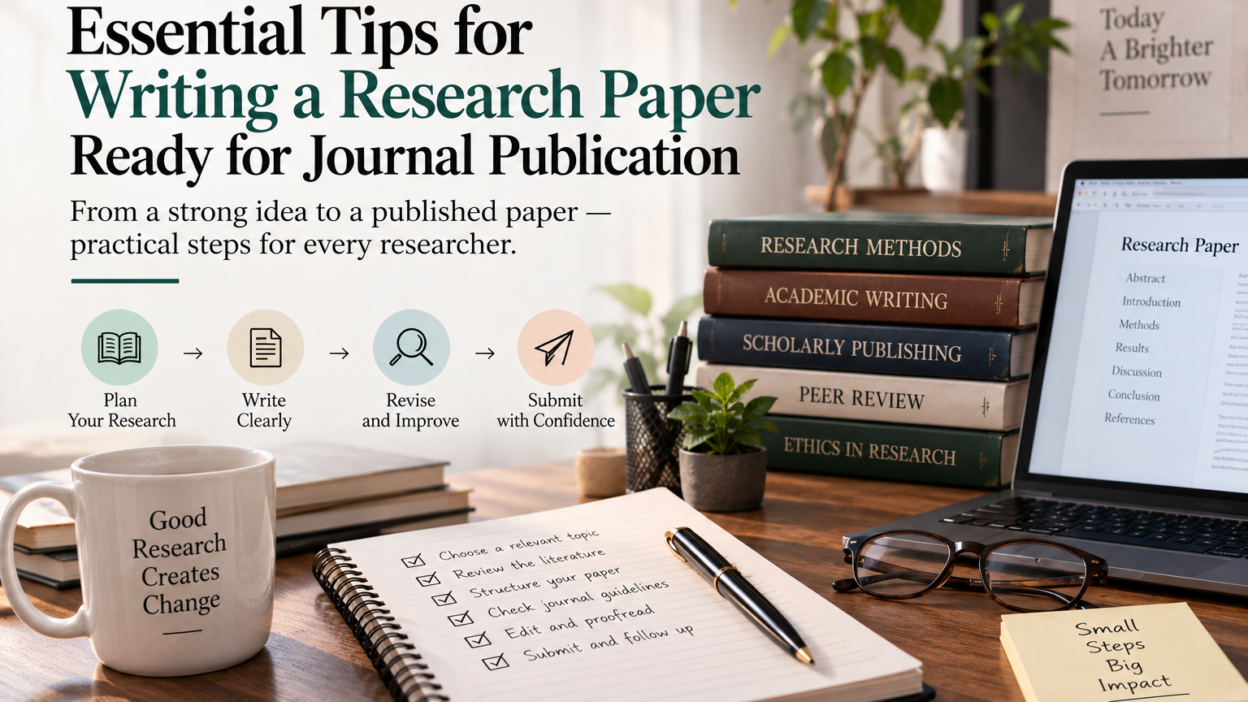
Not only is academic language needed for a research paper that is to be published in a scientific journal. The manuscript for publishability should be well focused, well designed, and should present relevant evidence to assist in answering the research question and be an important contribution to what is already known. Many researchers fail to succeed with their research because they give too much attention to writing and pay less attention to their journal requirements, structure, and presentation. A more effective way of doing this is to consider yourself a researcher and a reader.
Does the study aim have a clear and easily understood task? Do the methods used in the research or teaching approach make sense? Are the results in line with the results? Are the directions and guidelines for the manuscript adhered to for the target journal? It is helpful to answer these questions before submitting a paper so that there are no delays and the quality of the paper can be enhanced. With proper preparation, the peer review process goes more smoothly as the reviewers can concentrate on the research, instead of presentation issues.
Start a study by posing a focused research question
A good paper is based on a problem and not a general subject. State your current understanding, the problem that you face, and your contribution to the study.
You don’t always need to make a complete difference in a field with your contribution. It could present evidence in a different context, explore an undiscussed topic, interpret a familiar technique in a new way, or interpret different evidence.
If you can’t articulate the purpose of your study in a couple of clearly stated sentences, you need to work on the research question some more before proceeding.
Develop an organization for a Logical Manuscript
Journal papers should be continuous lines of reasoning. The problem and research gap are given in the introduction. Methods: These describe the way in which the study is carried out. The results will provide the evidence, and the discussion will explain and interpret this evidence and its significance.
For original research, the ICMJE guidelines suggest the following structure of the article (Introduction, Methods, Results and Discussion) and recommend that authors adopt appropriate reporting guidelines. (icmje.org)
Explain Your Methodology
The methodology is as important as the research question and can even compromise the credibility of an interesting research question.
Write a justification for the selection of data, participants, materials or sources. Explain methods used and methods of data analysis. Readers should have an understanding of what you did, and why you did it that way.
Recognise also any significant constraints. It is clear to show weaknesses suggests you’re aware of the limitations of your findings.
It’s best to review Journal Requirements Early
Make sure to read the Journal submission guidelines when you first begin writing.
Review word limits, formatting, referencing style, figures, tables, abstract requirements/format, declarations and supporting documents. These requirements should not be relied upon by researchers who are interested in publishing, as they should check these requirements themselves, as the author is still responsible for submitting the article.
All items required to complete the submission are checked, in keeping with individual journal requirements, and ICMJE recommends doing so. (icmje.org)
Develop Skills for Evidence & Presentation
All key claims should be supported with suitable evidence. Check for citations and eliminate citations that do not help to support your argument.
Tables and figures should help to explain, clarify results and not just provide visual material. The results need to be presented in a logical manner, and not repetitively in the text and tables.
By supporting students with challenging academic demands, academic journal publication services can help them manage their demands and requirements (BAW 2022). Helpful editing and/or guidance may be used by the researchers to help them edit their manuscript but should not take away from the authors’ responsibility for the research and findings.
To edit as a reviewer
Don’t correct when it comes to grammar. Please read the manuscript in the same manner as a stranger.
Do you think that the question is clearly stated? Does each section contribute to the argument? Do the results of the research lead to the conclusions drawn? Eliminate repetition, shorten long sentences, and use specific words instead of words that are too vague.
Wherever possible, have a colleague read the manuscript. A new reader will be able to see the places where the author may not have been aware of the gaps.
Properly prepare for submissions
Make sure to check the most recent journal guidelines before submitting—check the full manuscript against the guidelines. Review author information and references, figures, declarations, funding information, permissions, and supplementary files.
If you are looking into academic publication services, select a company that will provide you with clear editing and/or submission instructions, but won’t guarantee your article will be accepted. Finally, it is the Editor and the Reviewers who are making the decision on whether a manuscript can be published or not.
Conclusion
The elements of a well-prepared and well-presented journal-ready research paper are: thorough research and clear communication. A well-written question, a clearly defined methodology, evidence that is relevant to that question, a logical structure, and accurate formatting can enhance a manuscript prior to peer review. It is also important for researchers not to forget that professional support in presentation does not take the place of researchers’ responsibility to carry out the research work, but can only enhance the presentation process.
Sometimes problems can be spotted during the manuscript review process much more easily by reading the manuscript from the reader’s point of view than by reading it during the drafting process. Researchers can revise and prepare work for scholarly evaluation, making it more credible and clear in light of journal requirements, with thoughtful revision.