
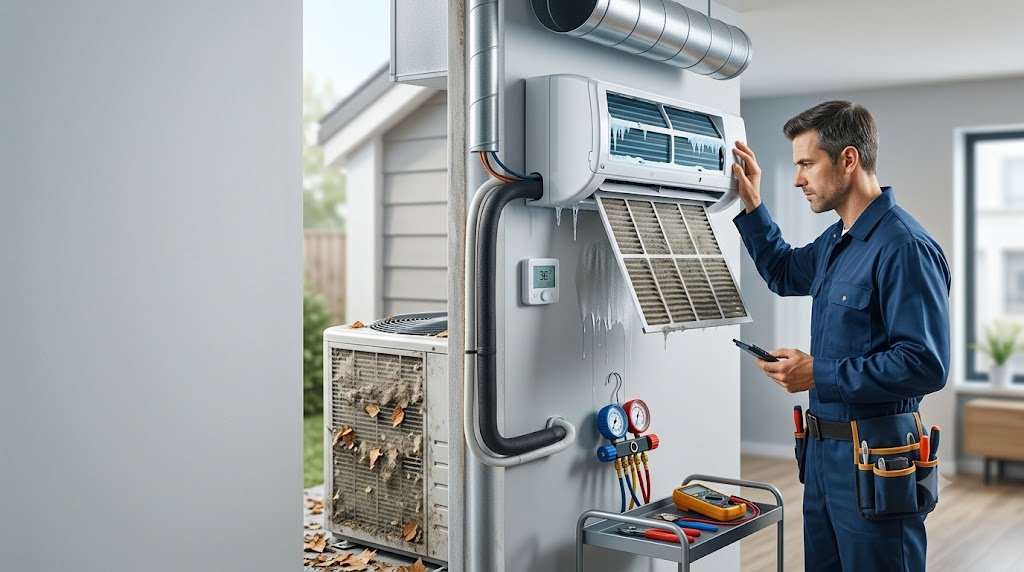
Most residential and commercial heating, ventilation, and air conditioning (HVAC) failures stem from neglected maintenance, restricted airflow, worn mechanical components, or miscalibrated controls. An unexpected breakdown during extreme summer heatwaves or freezing winter storms compromises indoor air quality and spikes monthly utility costs.
Implementing proactive maintenance intervals safeguards mechanical longevity and preserves baseline thermal comfort. Contracting businesses and certified mechanical technicians regularly outline diagnostic procedures, seasonal maintenance checklists, and emergency booking options through a modern WordPress HVAC theme, giving property owners instant access to expert troubleshooting resources across desktop and mobile devices.
1. Clogged Air Filters Restricting System Airflow
Clogged air filters choke return airflow, forcing blower motors to draw excessive amperage and causing heat exchangers to overheat or evaporator coils to freeze. Airborne particulate matter, pet dander, and dust settle onto pleated filter media during daily circulation cycles.
Technicians prevent restricted airflow damage through strict maintenance practices:
- Inspect Monthly: Check filter surfaces every 30 days during peak heating and cooling seasons. Replace standard 1-inch fiberglass or pleated filters at least every 90 days.
- Match MERV Ratings: Select filters rated between Minimum Efficiency Reporting Value (MERV) 8 and 11. Higher residential ratings balance particle capture with low static pressure drop.
- Clean Reusable Media: Wash and completely dry permanent electrostatic filters before reinstallation to prevent mold colonization inside the return plenum.
Contractors publish seasonal filter-replacement reminders and airflow diagnostic guides through an informative HVAC premium theme, helping homeowners spot early airflow drops before compressors overheat.
2. Frozen Evaporator Coils and Refrigerant Leaks
Evaporator coils freeze into solid blocks of ice when suboptimal airflow or low refrigerant charge drops the system saturation temperature below freezing. When refrigerant levels fall below manufacturer specifications, the chemical cannot absorb sufficient latent heat from indoor return air.
HVAC specialists protect evaporator coils through systematic checks:
- Detect Pin-Hole Leaks: Use electronic halogen sniffer tools or ultraviolet dye injection to pinpoint micro-cracks along copper coils and brazed joints.
- Maintain Clean Fin Surfaces: Spray non-acid, self-rinsing foaming coil cleaners over aluminum fins to dissolve insulating dirt and dust films.
- Verify Static Pressure: Measure external static pressure across the air handler to ensure supply and return duct runs meet recommended cubic feet per minute (CFM) volumes.
Homeowners should shut down freezing systems immediately to prevent liquid refrigerant from migrating back to the compressor housing and causing fatal hydro-lock failure.
3. Blocked Condensate Drain Lines and Water Leaks
Air conditioning condensate lines clog when airborne dust mixes with moist drain pan runoff, cultivating thick algae and slime colonies that block PVC drainage pipes. A backed-up drain pan triggers secondary float switches that shut down the unit, or worse, overflows into surrounding ceilings and drywall.
Technicians eliminate condensate overflow risks with routine plumbing care:
- Flush With Vinegar Solutions: Pour a cup of distilled white vinegar into the drain line access tee every month to dissolve nascent bacterial sludge.
- Install Secondary Float Switches: Wire mechanical float switches directly into the 24V control circuit to cut condenser power automatically if water rises.
- Vacuum Drain Traps: Clear trapped sediment from external drain exit points using a portable wet-dry vacuum fitted with a rubber adapter.
HVAC service companies frequently showcase routine drainage inspections and float switch upgrades on portals designed with an accessible air conditioning WordPress theme, educating property managers on preventable water damage.
4. Thermostat Calibration Errors and Sensor Drift
Thermostats malfunction when dirty bimetallic sensors, low battery voltage, or poor room placement cause the device to read ambient temperatures incorrectly. A thermostat installed in direct sunlight or adjacent to drafty exterior doorways triggers erratic short-cycling that strains mechanical relays.
Reliable temperature regulation requires strategic calibration steps:
- Relocate Draft-Exposed Units: Mount thermostats on interior walls away from direct sunlight, supply registers, kitchens, and drafty windows.
- Upgrade to Smart Programmable Controls: Install modern smart thermostats featuring remote room sensors that balance temperatures across multiple living zones.
- Recalibrate Internal Thermistors: Use a precision digital thermometer to verify readout accuracy, recalibrating circuit offsets if readings deviate by more than one degree.
Technicians often walk homeowners through smart thermostat integration and wiring basics using an intuitive heating and cooling website template, helping clients maximize energy efficiency with automated schedules.
5. Malfunctioning Capacitors and Worn Electrical Contactors
Run capacitors, start capacitors, and magnetic contactors degrade over time due to high operating voltage, high ambient heat, and repeated electrical arcing. A swollen or leaking capacitor fails to deliver the phase-shifted voltage boost required to spin the compressor and condenser fan motors.
Electrical preventive maintenance involves clear diagnostic protocols:
- Measure Microfarad (µF) Tolerances: Test capacitor capacitance with a digital multimeter during annual tune-ups, replacing any unit reading 5% below its rated label.
- Inspect Contactor Points: Examine copper contactor points for pitting, carbon charring, or insect debris that prevent smooth electrical circuit closure.
- Check Wiring Terminals: Tighten loose wire lugs and replace brittle terminal insulation that has degraded from thermal stress.
Licensed technicians handle these high-voltage components with insulated tools, safely discharging stored electrical energy before beginning physical replacements.
6. Dirty Outdoor Condenser Coils and Fins
Outdoor condenser coils struggle to reject absorbed heat into ambient air when lawn clippings, tree leaves, and road grime pack into the exterior fin matrix. Trapped heat elevates compressor head pressure and operating temperatures, shortening compressor motor lifespan and driving up electric bills.
Clearing exterior condenser units requires consistent exterior maintenance:
- Establish Clearances: Cut back bushes, tall weeds, and ornamental landscaping to maintain at least two feet of unobstructed airflow around the perimeter.
- Straighten Bent Fins: Use specialized fin combs matching the unit’s fin count to realign flattened aluminum louvers and restore unrestricted airflow.
- Low-Pressure Coil Washing: Wash away stubborn grime using gentle garden hose pressure from the inside out to avoid bending delicate aluminum fins.
Contractors publish springtime outdoor preparation tips on modern platforms styled with an efficient HVAC contractor WordPress template, showing homeowners how simple perimeter cleanup lowers operational wear.
7. Furnace Ignition Failures and Dirty Flame Sensors
Gas furnaces fail to light or shut down seconds after ignition when carbon deposits coat the flame rectification sensor rod. If the furnace control board fails to detect the microamp electrical current produced by a burning flame, it shuts off gas flow to prevent explosive unburned gas buildup.
Heating technicians resolve ignition problems through targeted winter servicing:
- Clean Flame Sensor Rods: Remove the flame sensor and gently polish away non-conductive carbon oxidation using fine-grit emery cloth or steel wool.
- Inspect Hot Surface Igniters: Test silicon nitride igniters for hairline resistance cracks that prevent the element from reaching glowing ignition temperatures.
- Clear Burner Ports: Clean clogged burner ports with compressed air or wire brushes to ensure uniform, stable blue flames across the entire manifold.
Annual pre-winter combustion diagnostics ensure furnaces ignite reliably on freezing nights while keeping carbon monoxide levels safely contained.
8. Blower Motor Wear and Belt Degradation
Blower assembly failures occur when unlubricated bearings seize, dust blankets the motor housing, or rubber drive belts fray and lose rotational tension. Restricted blower wheels cannot move conditioned air past the heat exchanger or cooling coil, leading to premature thermal tripping.
Technicians keep blower assemblies operating smoothly using core mechanical steps:
- Check Belt Tension and Alignment: Inspect rubber drive belts on older systems for dry rot, glazing, and proper 0.5-inch deflection tension.
- Lubricate Motor Ports: Apply a few drops of non-detergent 20-weight motor oil to oil ports on non-sealed motors every twelve months.
- Clean Squirrel-Cage Fan Blades: Remove built-up lint and dust crust from curved blower fan blades to restore full centrifugal air delivery.
Facility managers regularly check mechanical preventive checklists and motor maintenance protocols on informative portals built with an intuitive ventilation services theme, verifying equipment operational readiness.
9. Leaky, Unsealed, or Uninsulated Air Ductwork
Cracked seams, disconnected joints, and deteriorated flex ducts inside unconditioned attics or crawlspaces can lose up to 30% of conditioned air before it reaches living spaces. Duct leaks draw humid air, attic insulation dust, and fiberglass particles straight into the supply air stream.
Mitigating duct leakage involves proven sealing strategies:
- Seal Joints With Mastic: Apply thick water-based mastic sealant paired with embedded fiberglass mesh tape across all sheet-metal joints and elbow seams.
- Avoid Standard Cloth Tape: Replace old cloth duct tape, which quickly degrades under attic thermal cycles, with UL 181-approved foil-faced tape.
- Insulate Exposed Duct Runs: Wrap unconditioned attic duct runs in R-6 or R-8 fiberglass insulation to eliminate thermal transfer and summer duct sweating.
Sealing supply and return ducts stabilizes indoor pressures, reduces hot and cold spots across rooms, and lowers monthly cooling overhead.
10. Failing Compressor and Thermal Overload
Compressor failure represents the most expensive HVAC breakdown, usually resulting from years of unaddressed sub-cooling problems, acid contamination, or electrical overload. When internal motor windings overheat or pistons suffer mechanical damage, the entire refrigeration cycle stops functioning.
HVAC technicians protect the compressor core through protective maintenance:
- Install Hard-Start Kits: Wire start capacitors and potential relays to assist older compressors during initial startup, reducing peak starting amperage.
- Conduct Acid Oil Tests: Test compressor oil samples for corrosive hydrochloric and hydrofluoric acids that form after internal moisture exposure.
- Verify Superheat and Sub-cooling: Adjust refrigerant charge to precise manufacturer target values using digital manifold gauges to guarantee adequate motor cooling.
When an aging compressor suffers an internal electrical burnout, replacing the condenser unit or installing a complete modern heat pump often proves more economical than rebuilding the damaged component.
Sustaining Year-Round Indoor Comfort Through Preventative Care
Maintaining dependable heating and cooling performance demands proactive equipment servicing rather than reactive crisis repairs. By replacing filters regularly, cleaning outdoor coils, clearing condensate lines, and conducting professional annual tune-ups, property owners avoid disruptive breakdowns and expensive emergency service calls.
Educating clients on proper mechanical care requires clear, responsive digital communication. Implementing an authoritative, high-performance HVAC WordPress theme allows contractors and service agencies to publish seasonal maintenance tips, schedule diagnostic appointments, and showcase transparent repair pricing. Proactive HVAC care extends equipment life, protects property investments, and ensures indoor environments remain comfortable throughout the year.