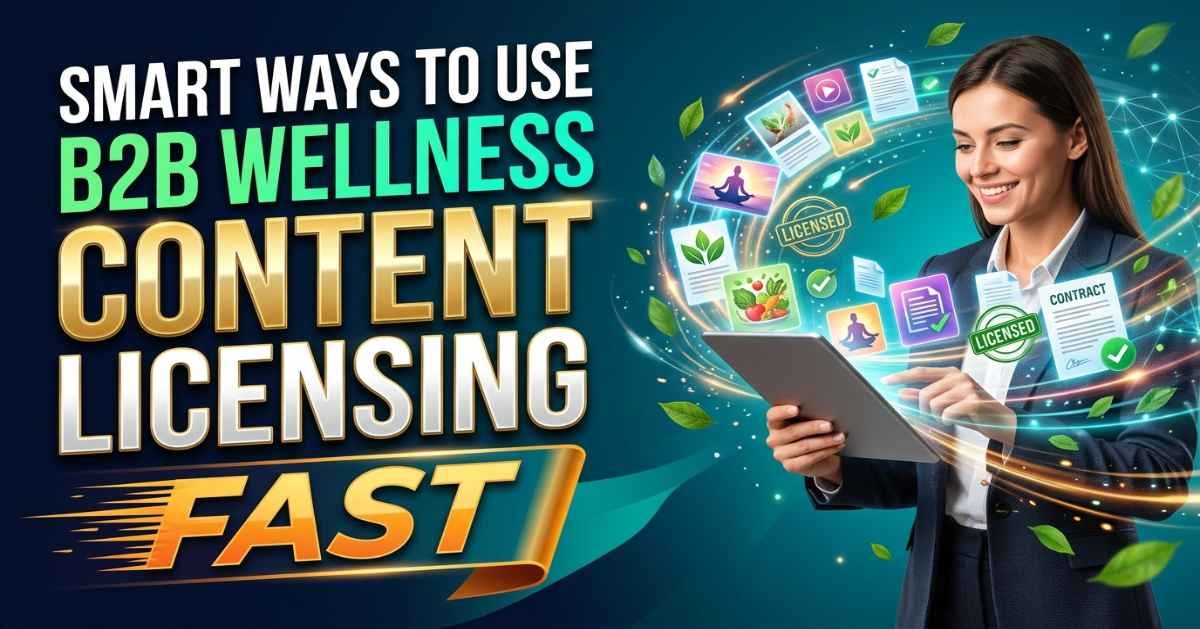
Speed to market has become the decisive competitive moat in the digital health, corporate employee benefits, and wellness software-as-a-service (SaaS) sectors. Enterprise human resources leaders and benefits brokers expect prospective software vendors to demonstrate rich, interactive on-demand video libraries during live product demos—not six months later on a post-sale roadmap. Yet building a custom media catalog from scratch through internal studio shoots routinely traps software organizations in lengthy production cycles, spiraling capital expenditure, and stalled engineering sprints.
Commercial content licensing eliminates physical filming bottlenecks entirely, giving product managers, founders, and RevOps teams a turnkey shortcut to launch enterprise-ready wellness experiences in days rather than quarters. By treating licensed video modules as modular software assets rather than traditional media productions, technology companies can populate new verticals, close high-value B2B pilots, and boost daily user retention without diverting core engineering talent away from platform innovation.
1. Launch Minimum Viable Wellness Products (MVPs) in Days
When validating a new digital health vertical or preparing an enterprise pilot for a prospective corporate client, waiting four to six months to audition trainers, lease studio space, and edit raw footage can cost you the contract. Early-stage product teams need real user engagement telemetry immediately to test onboarding flows, measure session completion rates, and refine subscription tiers.
Deploying turnkey white label fitness content allows software founders to bypass physical studio production completely and populate a production-grade video catalog within a single two-week development sprint. Because the footage arrives professionally lit, audio-mastered, and cleared for commercial distribution, engineering teams can focus strictly on user interface polish, wearable telemetry integration, and payment workflows—putting a polished, revenue-ready application in front of buyers while competitors are still scouting filming locations.
2. Power Targeted Corporate Wellness Challenges and Seasonal Campaigns
Even well-established employee wellness portals suffer from engagement decay when users log in every Monday to find the exact same static grid of workouts. Corporate HR administrators judge vendor ROI on active monthly participation, and stagnant content libraries quickly lead to declining login frequency and non-renewals at contract anniversary dates.
Smart customer success and product marketing teams use licensed media to run structured, time-bound workplace challenges—such as a “30-Day Desk Posture Reset,” a “Q1 Stress & Mindfulness Sprint,” or a “15-Minute Midday Energy Booster” series. By packaging existing video modules into curated weekly tracks paired with push notifications and team leaderboards, platforms spark recurring daily habits without filming a single new frame.
Deployment Playbook: Fast-Track Content Execution Across Teams
Aligning licensed media assets with specific departmental goals helps digital health companies extract immediate commercial value across product, sales, and customer success.
| Business Objective | Fast-Track Licensing Tactic | Primary Operational Impact |
|---|---|---|
| Rapid MVP & Feature Launch | Bulk-ingest pre-tagged video modules into native player containers. | Compresses go-to-market timeline from months to days. |
| Enterprise Sales Enablement | Spin up industry-specific demo portals tailored to HR buyers. | Accelerates pilot approvals and multi-year B2B deal velocity. |
| Subscriber Retention | Deploy monthly themed challenges and micro-break playlists. | Increases weekly active users and lowers enterprise churn. |
| Global Market Expansion | Wrap unbranded videos in localized UI overlays and captions. | Enters new regions without costly international reshooting. |
3. Automate Bulk CMS Ingestion Using Pre-Formatted Metadata
Acquiring hundreds of raw video files without structured data creates an immediate operational bottleneck: someone on your team must manually watch every video, write summaries, assign muscle-group tags, and configure duration filters. Manual data entry slows down product releases and introduces inconsistent search taxonomy across your application.
Connecting your platform to a structured fitness and wellness video library B2B streamlines backend engineering by delivering standardized metadata files—typically in CSV or JSON format—alongside high-definition MP4 streams. Product and DevOps teams can map attributes like workout category, intensity level, equipment requirements, and exact runtime directly into their Content Management System (CMS) or database schema via automated scripts. Your platform’s search filters and recommendation algorithms immediately index the new catalog without tedious manual tagging.
4. Build Custom Industry Demo Portals to Close Enterprise Deals
Enterprise procurement committees rarely buy generic software; they want to see how your platform solves the specific ergonomic and mental health challenges of their workforce. A logistics enterprise with warehouse staff needs joint mobility and safe lifting warmups, whereas a remote software company prioritizes neck-and-shoulder desk stretches and midday stress decompression.
Because licensed media libraries span diverse movement modalities, solutions engineers can assemble custom, industry-tailored demo environments in hours. By filtering your catalog to showcase relevant programming inside a branded client sandbox, your sales team proves immediate contextual fit during executive pitches—shortening enterprise evaluation cycles and differentiating your platform from rigid one-size-fits-all competitors.
5. Embed Micro-Wellness Breaks Directly Into Daily Workflows
One of the biggest barriers to employee wellness adoption is friction: busy professionals rarely have forty-five spare minutes during the workday to change clothes, roll out a mat, and complete an intense gym session. Platforms that rely exclusively on long-form workouts miss the massive daily engagement window happening right at the employee’s workstation.
Integrating concise licensed fitness and wellness videos—specifically 3-to-10-minute desk stretches, eye-strain resets, and guided breathing breaks—enables platforms to trigger timely micro-interventions between calendar meetings. Whether delivered via Slack/Microsoft Teams nudges, desktop browser widgets, or mobile notifications, short-format video modules drive high daily completion rates across sedentary office populations that otherwise ignore traditional fitness apps.
6. Expand Into New Geographic Markets Without Reshooting
Taking a digital health or corporate wellness platform international traditionally requires exorbitant regional production budgets to film local talent and adapt visual branding. Commercial white-label media solves this localization bottleneck by separating visual movement instruction from on-screen brand elements.
Because unbranded video modules arrive completely free of baked-in third-party logos, lower-third graphics, or studio watermarks, your product team retains full control over the presentation layer. You can rapidly localize titles, program descriptions, closed captions, and player controls into multiple languages while streaming the exact same high-definition video files through your global Content Delivery Network (CDN)—enabling fast international expansion with minimal incremental media cost.
7. Enrich Telehealth, Rehab, and Wearables Ecosystems
Beyond standalone corporate fitness apps, licensed wellness videos act as a high-margin value multiplier for adjacent digital platforms—including telehealth networks, physical therapy portals, insurance wellness incentives, and wearable device companion apps. Instead of sending patients or members static text PDFs after a consultation, platforms can prescribe guided movement routines directly inside the patient’s mobile dashboard.
Pairing clean, unbranded exercise videos with heart-rate telemetry, streak tracking, or post-session feedback prompts transforms passive video playback into an interactive clinical or coaching experience. Platforms increase perceived software value, unlock higher enterprise tier pricing, and keep users anchored inside their proprietary ecosystem rather than losing traffic to free public video sites.
4-Step Fast-Track Implementation Checklist for Product Teams
To move from initial licensing agreement to live production streaming in under two weeks, follow this streamlined deployment sequence:
- Step 1 — Audit Use Cases & Filter Core Categories: Select 100 to 300 high-priority modules matching your primary user personas (e.g., desk mobility, beginner strength, stress relief) rather than dumping an uncurated catalog all at once.
- Step 2 — Map Metadata Schemas to Your CMS: Align the provider’s CSV/JSON taxonomy fields (duration, intensity, equipment, body focus) with your existing database attributes for automated bulk ingestion.
- Step 3 — Configure CDN & Native Player Overlays: Upload adaptive-bitrate video assets to your cloud storage bucket and wrap playback inside your branded UI player with custom progress tracking.
- Step 4 — Launch a Flagship 14-Day Challenge: Pair your catalog launch with an automated email and in-app onboarding sequence guiding new users through their first three completed sessions.
Frequently Asked Questions (FAQs)
1. How quickly can a SaaS platform integrate licensed wellness videos into production?
Most digital health and employee benefits platforms can ingest, tag, and launch a licensed video catalog within 5 to 14 business days. Because the videos arrive fully edited, mastered in high definition, and paired with structured metadata files, engineering teams only need to map the bulk import into their CMS and configure CDN streaming.
2. Do white-label fitness videos allow us to use our own branding and UI controls?
Yes. Enterprise white-label video files are supplied completely clean without third-party logos, watermarks, or studio intro slates. Your product team can embed them inside your proprietary video player, overlay custom timers or biometric data, and organize them under your own branded program names.
3. What video categories drive the highest engagement in B2B corporate wellness portals?
Short, accessible modules consistently generate the highest completion rates among corporate employees. Specifically, 5-to-10-minute desk posture resets, neck and shoulder mobility routines, guided stress-reduction breathwork, and 15-minute equipment-free full-body workouts outperform long, high-intensity gym sessions across diverse workforces.
4. How does commercial content licensing compare financially to hiring an in-house video crew?
Commercial licensing eliminates upfront capital expenditures for studio leases, camera rigs, certified trainer retainers, liability insurance, and post-production editing—converting unpredictable production overhead into a fixed, predictable operational cost while delivering immediate catalog scale.
Conclusion: Turning Speed Into Sustainable Platform Growth
In a crowded digital health and workplace benefits market, the platforms that win enterprise contracts are those that ship faster, personalize effortlessly, and deliver inclusive wellness experiences across entire workforces. By leveraging commercial content licensing to bypass studio production bottlenecks, automate CMS ingestion, and power targeted workplace challenges, your organization can focus its capital and engineering talent on core product differentiation. Treating licensed media as a fast-deploying growth layer allows you to scale user engagement, shorten B2B sales cycles, and protect gross margins at every stage of expansion.