
If your income doesn’t come from a steady paycheck, getting approved for a mortgage can feel like fighting an uphill battle. Retirees pulling from investment accounts, self-employed people whose tax returns are full of deductions, and real estate investors with money tied up across several properties all run into the same wall with conventional lenders. An asset based mortgage lender solves this by looking at what you actually own instead of what shows up on a pay stub.
That said, not every lender offering this product works the same way, and picking the wrong one can cost you time, money, or both. Here’s what actually matters when you’re comparing options.
How Asset-Based Mortgages Work
Instead of verifying income the usual way, these lenders total up your liquid assets savings, brokerage accounts, retirement funds, and similar holdings and divide that figure over a loan term, sometimes as long as 360 months. Whatever number comes out the other end becomes your “qualifying income” for underwriting purposes.
It sounds simple on paper, but the details vary a lot from one lender to the next, which is exactly why shopping around matters here more than it does with a standard 30-year fixed.
Who Actually Uses These Loans
A few types of borrowers tend to end up going this route:
- Retirees living off 401(k)s or brokerage accounts rather than a salary
- Self-employed borrowers whose write-offs make their reported income look smaller than their real cash flow
- High-net-worth individuals sitting on assets that don’t translate into W-2 income
- Landlords and investors trying to grow a portfolio without getting bogged down in traditional income underwriting
That last group deserves its own conversation, because it connects to something a lot of investors overlook when they’re loan shopping.
Where This Overlaps With Loans for Landlords
Investors scaling a rental portfolio often end up looking at a loan for landlords, and there’s real overlap with asset-based lending here, particularly with DSCR loans, which qualify a borrower based on a property’s rental income rather than personal income. It’s a similar philosophy: look at what the money is actually doing, not just what’s on a W-2.
In practice, a lot of landlords end up mixing approaches maybe using asset-based qualification to buy a primary residence, then switching to landlord-specific financing for individual rental units. If you’re in that position, it’s worth asking a lender upfront whether they handle both. A lender who only knows one side of this will slow you down, or worse, steer you toward a product that doesn’t actually fit what you’re trying to do.
What to Look at Before Choosing a Lender
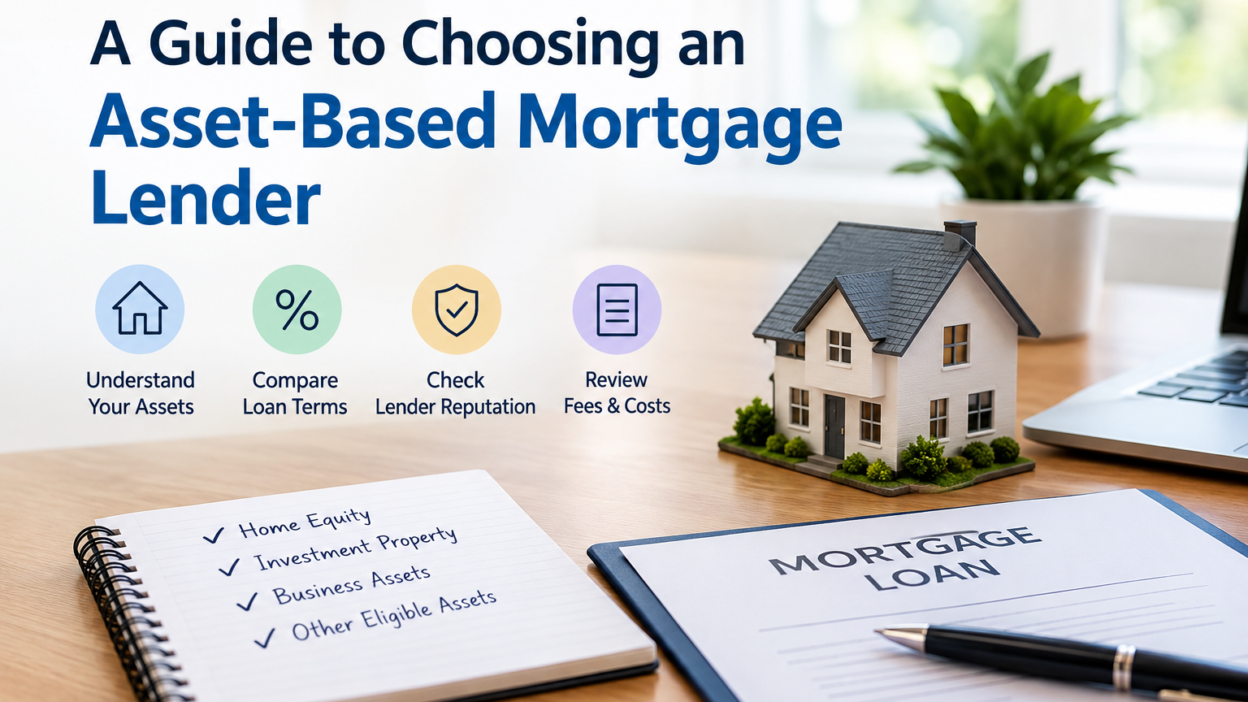
Which assets count, and how they’re weighted. Cash usually counts at full value. Retirement accounts often get discounted because of early-withdrawal penalties and tax hits. Ask for specifics rather than assuming.
Rates and terms. Expect to pay more than you would on a conventional loan that’s the trade-off for skipping income verification. But the gap between lenders on this can be bigger than people expect, so get more than one quote before deciding anything.
Down payment size. These loans typically call for 20-30% down, sometimes more. Know this number early so it doesn’t blow up your plans halfway through the process.
Whether the lender actually specializes in this. A lot of banks technically offer asset-based or non-QM products but rarely originate them. You want someone who does this regularly, not someone dusting off a program they used twice last year.
Track record. Look up reviews, ask how long they’ve run this program, and if possible, talk to someone who’s actually closed a loan with them.
How they communicate. These files are more complicated than a standard mortgage application. You want a lender who explains things clearly instead of burying you in paperwork with no context.
Questions Worth Asking Upfront
Before you commit to anyone, get straight answers on:
- Which assets qualify, and how are they weighted?
- How exactly do you calculate my qualifying income?
- What down payment should I expect?
- Do you also offer landlord or DSCR loans, in case I need one down the line?
- What documentation are you actually going to need from me?
- How long does underwriting usually take on files like mine?
Getting these answers early saves you from surprises three weeks into the process.
The Trade-Offs, Honestly
There’s real upside here no income documentation, a faster path for people who are asset-rich but income-light, and flexibility that traditional mortgages just don’t offer. But it’s not free. Rates run higher, down payments are bigger, and because fewer lenders offer this product, you don’t have as many options to compare as you would with a standard mortgage.
Neither side of that trade-off is a dealbreaker on its own it just depends on what your finances actually look like.
Bottom Line
The right asset-based mortgage lender is the one who understands your specific situation, not just the general concept of asset-based lending. Get quotes from at least two or three lenders, compare their down payment requirements and how they weigh different asset types, and if you’re building a rental portfolio, ask about their loans for landlords too having both options with one lender can make financing a lot less of a headache as you grow.
A short call with a lender who actually works in this space will tell you more than any article can. It’s worth the twenty minutes before you commit to anything.
Whether you’re refinancing a primary residence, buying your next home in retirement, or expanding a rental portfolio, working with the right asset based mortgage lender one who also understands loan for landlords products puts you in a much stronger position than going in blind. Take the time to compare a few, ask the right questions, and choose the one who fits how your finances actually work, not just the standard checklist.