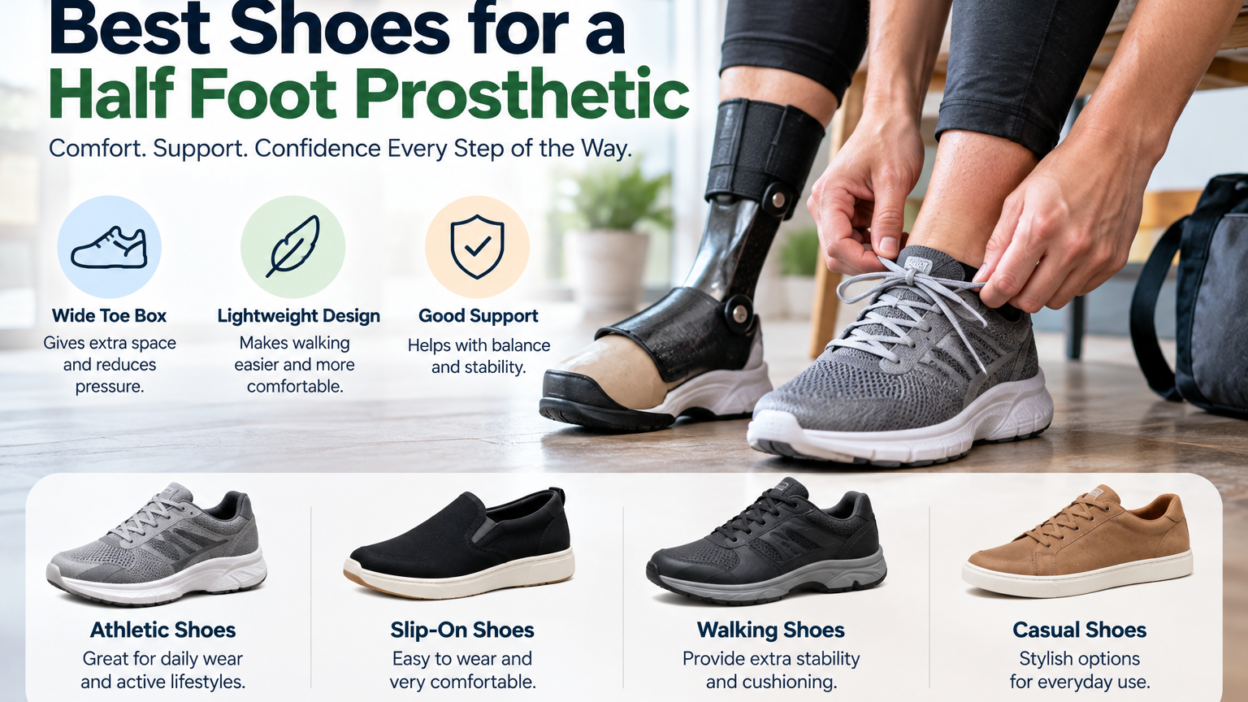
Choosing shoes after a partial foot amputation is about more than appearance. The right footwear can affect comfort, stability, fit, and how your custom prosthetic functions during everyday activities.
A half foot prosthetic may replace or support part of the foot, depending on the level of amputation and the individual’s needs. Because every residual foot is different, there isn’t one shoe that works for everyone.
In general, look for shoes that provide enough room for the prosthetic, secure the foot properly, have a stable sole, and match the setup of your prosthesis. Your prosthetist can also help you check whether a particular shoe works with your device.
What Makes a Good Shoe for a Half Foot Prosthetic?
A good shoe should work with your prosthesis rather than interfere with it.
Important features include:
- Adequate toe-box space
- Secure fastening
- Stable sole
- Appropriate heel height
- Lightweight construction
- Good traction
- Enough depth for the prosthetic
- Removable insoles when additional space is needed
- Comfortable materials that don’t create pressure points
The exact requirements depend on your amputation level, prosthetic design, activity level, and foot shape.
1. Athletic Shoes
Athletic shoes are often a practical everyday option because they tend to combine cushioning, stability, and secure fastening.
Look for:
- Lace-up or adjustable closures
- A firm, supportive sole
- Adequate interior space
- Good traction
- A comfortable fit around the residual foot
A lace-up shoe can also make it easier to secure the foot and prosthesis in place. Ottobock notes that people beginning prosthetic training are often advised to use a lace-up shoe with a rubber sole, although individual recommendations vary.
Athletic shoes can be especially useful for walking, errands, and other daily activities.
2. Walking Shoes
Walking shoes can be a good choice if you spend a lot of time on your feet.
Look for a shoe that feels stable when standing and walking. Avoid shoes that are excessively soft or flexible if they don’t provide enough support for your particular prosthetic setup.
A comfortable walking shoe should also leave enough room for your custom prosthetic without squeezing the residual foot.
3. Wide or Extra-Depth Shoes
Some people using partial foot prostheses need additional room inside the shoe.
Extra-depth footwear may provide more space for a prosthetic insert, toe filler, orthotic, or other component.
However, more room isn’t automatically better. A shoe that is too loose can allow excessive movement and reduce stability.
The goal is a secure fit without pressure on the residual foot.
4. Shoes With Adjustable Closures
Laces, straps, and other adjustable closures can make fitting easier.
They allow you to make small adjustments throughout the day and can accommodate changes in foot volume.
Adjustable footwear can be particularly useful if your residual foot changes size during the day.
5. Low-Heeled Boots
A sturdy, low-heeled boot may work for some prosthetic users, particularly during colder weather.
Look for:
- A stable sole
- Secure fastening
- Adequate interior space
- Good traction
- A heel height compatible with your prosthetic setup
Avoid assuming that every boot will work simply because it fits your natural foot. The shoe’s heel-to-toe geometry can affect how the prosthesis functions.
6. Casual Shoes
Casual shoes can work well for everyday activities if they provide sufficient stability and space.
Before buying a pair, check:
- How easy they are to put on
- Whether the opening is wide enough
- Whether the shoe holds the foot securely
- Whether the sole provides adequate traction
- Whether the shoe creates pressure against the prosthesis
Try the shoes while wearing your prosthesis rather than judging the fit from the shoe alone.
Why Heel Height Matters
Heel height is one of the most important factors when selecting footwear for a lower-limb prosthesis.
A prosthesis is aligned based on specific footwear characteristics. Changing to shoes with a substantially different heel-to-sole relationship can alter the alignment and potentially affect balance and comfort.
This means you shouldn’t simply switch from a flat shoe to a shoe with a significantly higher heel without checking with your prosthetist.
Some prosthetic feet are designed to accommodate changes in heel height. For example, certain adjustable prosthetic feet allow users to change the heel height for different footwear.
If your prosthesis isn’t designed for that adjustment, your prosthetist may recommend another solution.
What About Running Shoes?
Running shoes can be appropriate for some people, but the right choice depends on the prosthesis and activity.
If you plan to run, jog, or participate in sports, discuss your footwear with your prosthetist before increasing activity.
The shoe should provide:
- Secure fit
- Appropriate cushioning
- Stable contact with the ground
- Suitable traction
- Compatibility with your prosthetic components
A shoe designed for running isn’t automatically suitable for every prosthetic user.
What Shoes Should You Avoid?
There isn’t a universal list of shoes that every person with a half foot prosthetic must avoid. However, certain styles can create fitting or stability challenges.
Use caution with:
- Very high heels
- Extremely flexible shoes
- Shoes with unstable soles
- Very narrow toe boxes
- Shoes that are too loose
- Shoes that compress the prosthesis
- Shoes with significantly different heel heights
A shoe may look comfortable but still change how the prosthesis contacts the ground.
How to Choose Shoes for a Custom Prosthetic
When you receive a custom prosthetic, bring the shoes you normally wear to your fitting appointments when possible.
This gives your prosthetist an opportunity to consider the footwear during fitting and alignment.
If you want to wear several different types of shoes, tell your prosthetist before the final setup.
For example, you may regularly use:
- Athletic shoes
- Work shoes
- Casual shoes
- Boots
- Dress shoes
Different footwear can have different heel heights and sole shapes. Your prosthetist can help determine what options are compatible with your prosthesis.
What Is a Prosthetic Feet Hook?
The phrase prosthetic feet hook can be confusing because prosthetic feet and hook-style terminal devices generally refer to different prosthetic components.
A prosthetic foot is associated with lower-limb prostheses. A hook-style terminal device is generally associated with upper-limb prostheses.
If you’re researching footwear for a half foot prosthetic, your primary concern is the compatibility between the shoe and your partial-foot prosthesis or foot component.
If you encounter the term “prosthetic feet hook” while researching prosthetic components, confirm exactly which device is being discussed before choosing footwear or equipment.
Shoe Selection Checklist
| Feature | What to Look For |
| Fit | Secure without excessive pressure |
| Toe box | Enough room for the prosthetic |
| Sole | Stable and appropriately supportive |
| Heel | Compatible with prosthetic alignment |
| Closure | Laces, straps, or another secure system |
| Traction | Suitable grip for your activities |
| Weight | Comfortable for regular use |
| Interior | Enough depth for the prosthetic |
| Adjustability | Useful for changes in foot volume |
How to Try on Shoes With a Prosthesis
Follow a simple process:
Wear your prosthesis
↓
Put on the shoe
↓
Check pressure points
↓
Stand and walk
↓
Check balance and comfort
↓
Compare with your usual footwear
↓
Ask your prosthetist if unsure
Don’t judge a shoe only while sitting. Walking and standing can reveal pressure or balance problems that aren’t obvious when you’re seated.
Signs Your Shoes May Not Be Working
Pay attention if you notice:
- New pressure areas
- Skin irritation
- Blisters
- Increased discomfort
- Changes in balance
- Difficulty walking
- Excessive movement inside the shoe
- Your prosthesis feeling different from usual
If a new pair of shoes causes problems, stop using them until you can determine whether the issue is the footwear, prosthetic fit, or another factor.
Changes in footwear can affect prosthetic alignment, so persistent problems should be discussed with your prosthetist.
Can You Wear Different Shoes Every Day?
Possibly, but it depends on your prosthetic design.
Some prosthetic feet have fixed geometry and are intended for a particular heel height. Others are designed to accommodate a wider range of footwear. Research has also found that footwear can affect the mechanical behavior of prosthetic feet.
If you want to switch between sneakers, flats, boots, and dress shoes, discuss your footwear needs during prosthetic fitting.
Final Thoughts
The best shoes for a half foot prosthetic are the ones that provide a secure, comfortable fit while working properly with your prosthetic setup.
Athletic shoes, walking shoes, extra-depth footwear, adjustable shoes, and some low-heeled boots may all be options. The right choice depends on your individual anatomy, prosthesis, activity level, and alignment.
When using a custom prosthetic, don’t make major footwear changes without checking compatibility. Heel height and shoe geometry can affect alignment, balance, and comfort.
If you’re unsure whether a particular shoe will work, take the shoe and your prosthesis to your prosthetist for evaluation.
FAQs
What type of shoes are best for a half foot prosthetic?
Supportive athletic and walking shoes are often practical options because they can provide stability, cushioning, and adjustable fit. The best choice depends on your prosthesis and individual needs.
Can I wear regular shoes with a half foot prosthetic?
In many cases, regular shoes may be possible if they provide enough room and work with the prosthetic. Your prosthetist can check the fit and compatibility.
Do I need special shoes for a custom prosthetic?
Not necessarily. Some people can use standard footwear, while others may benefit from extra-depth or specially modified shoes.
Can I wear high heels with a prosthetic?
It depends on the prosthetic design and alignment. Changing heel height can affect prosthetic alignment and balance, so discuss significant changes with your prosthetist first.
Should prosthetic shoes be loose?
No. The shoe should provide enough room for the prosthesis without allowing excessive movement. A secure fit is important for stability and comfort.
What should I do if my new shoes cause pain?
Stop using the shoes if they create significant pressure or discomfort and contact your prosthetist. The problem may involve the shoe, prosthetic fit, alignment, or another factor.
Is “prosthetic feet hook” related to shoes for a half foot prosthetic?
Usually, these terms refer to different prosthetic components. A prosthetic foot is associated with lower-limb prostheses, while a hook-style terminal device is generally associated with upper-limb prostheses.