
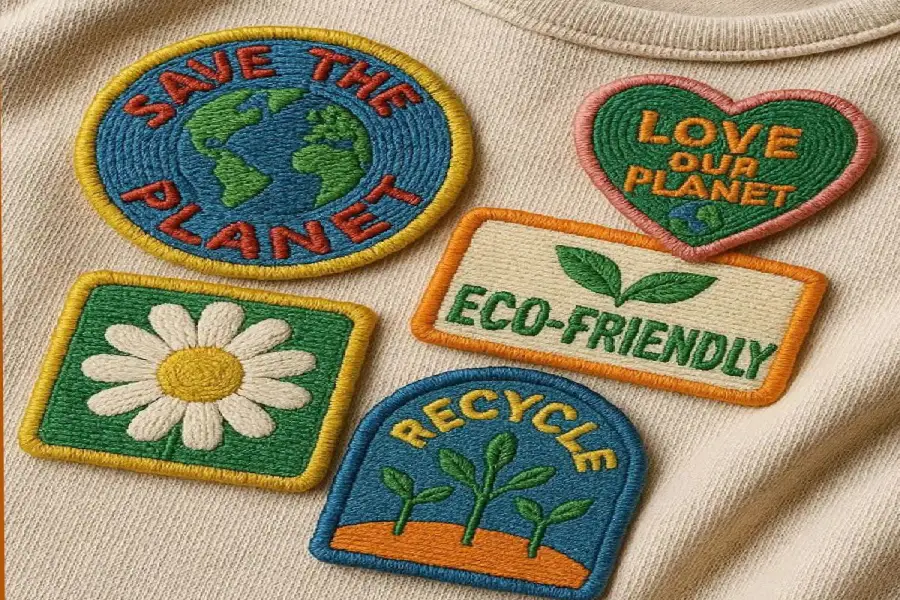
Yes, patches can be made more sustainably. However, using recycled thread and a brown paper envelope is insufficient. A good patch must be durable, make efficient use of resources, and not end up like the countless forgotten items sitting in the back of drawers.
Though a patch fits into the palm of your hand, a surprisingly large number of resources are used in making one. Fabric. Thread. Glue. Backing. Packaging. It then travels hundreds of miles before ending up in your hands. Curious about its environmental impact? Just flip it over. That is where the real truth lies.
What Lies Behind a Patch?
From the outside, an embroidered patch seems quite simple. Behind its design, base fabric, backing, thread, stitching frame, glue, and other layers can be found. Each of those layers plays a role in producing the patch. Each also requires a certain resource.
Not mentioned are all the unseen processes behind the production of the patch. Power required by the machine. Threads cut off. A flawed patch sent to the trash bin. Afterwards, the patches will be packaged and shipped to the consumer.
So, here are four straightforward questions to ask. What material does the patch consist of? How has it been manufactured? How long-lasting is the product? And what will happen to the patch once nobody needs it anymore? The green badge won’t give you an answer to any of these questions.
Is There Anything Sustainable about Recycled Material?
It is usually considered that using recycled polyester thread to create your own custom Velcro patch is more environmentally friendly compared to new thread of this kind. In addition, using recycled materials means giving them another chance to be useful. There are various standards like the Recycled Claim Standard or the Global Recycled Standard that could prove the authenticity of recycled material.
What Questions Should You Ask about the Materials?
There is one basic question to start with. Which material of the patch is recycled? It may be only the thread, and there will be no recycling concerning the fabric itself, the backing of the patch, glue, and even packaging. Even if there is an organic cotton base with synthetic thread stitched on it, it is better than nothing.
Can a Less Detailed Design Contribute to a Small Environmental Footprint?
Think of fitting a slogan, date, logo, cityscape, and six stars into a two-inch embroidered patch. An embroidery machine may handle it. However, the outcome may turn out to be cluttered, inflexible, and barely legible. In addition, all those unnecessary details require more threads and more time.
An uncluttered design will need fewer materials and yet look more elegant. Exclude unnecessary details which cannot be seen once the patch reaches its final size. Opt for fewer colours in case two of them are similar. Ensure that the lettering is big enough to be readable while saving on the stitches.
But do not exclude too many things since this may weaken the patch. Thin borders tend to fray. Poor stitching gets worn out fast. Saving just a bit of thread is no use if the whole patch has to be replaced in several months anyway.
Does Manufacturing in a Locally Located Workshop Equally Reduce the Impact?
A locally located workshop may help save transportation time since the patches would be delivered over a shorter distance. Furthermore, it allows inspection of samples and communication with the manufacturer directly. Local production does not always mean local materials.
Customers evaluating the USA-made embroidery patches must check whether anything was really made in the USA. Is it embroidered in the country? Was the patch only packed or processed in the USA? What about the materials used in production? Truth is more important than any flag in that case.
When Does a Batch Order Turn into Wastage?
Ordering a bigger batch is efficient since the machine needs one set-up and all materials are shipped at once. So, you see the discounted price and think, “What’s wrong with another 200?” However, the extra patches will have to find their way.
While ordering custom patches in bulk, decide how many patches you’ll be able to use. Logo changes, events get cancelled, and employees depart. Do not forget to approve a sample first. The worst wastage is an impeccable patch that no one wants.
Can the Backing Make the Patches Last Long?
Backing material dictates whether the patches can be placed on different surfaces and whether they can be reused. The heat adhesive backing is fast, but its removal may damage the clothes. Sew-on backing requires more time for applying, though the stitches may be easily undone.
If you make your own custom Velcro patch, consider its future journey from one jacket, bag, uniform, or piece of equipment to another. One such patch can substitute for several permanently placed ones. It gives the extra backing some practical sense.
There is no universal solution for every type of patch. The school badge should be permanently affixed for an entire year. But the name or team patches are frequently changing. Select your backing according to actual use of your patch, not according to how it sounds in the description.
How Can You Tell If a Green Statement Says Nothing?
Many companies are selling their products with beige paper, leaves, and beautiful words like “green,” “conscious,” and “planet-friendly.” It all sounds great with a cup of tea. But is there anything behind all this pretty packaging? No, usually not.
FTC recommends that companies avoid general statements about environmental benefits that cannot be verified. Specific facts are preferable. “The thread is made of 100% recycled polyester” can be proved. The same goes for “custom logo patches in bulk packed without individual plastic bags.”
Ask for proof, but do not expect perfection. A maker may admit that the thread is recycled while the backing is not. That answer is more useful than pretending the whole patch has no impact. Real improvement sounds specific because it has nothing to hide.
Question That May Interest You
Are Recycled Threads Always the Best Option?
This is not always true. Make sure that you know what proportion of recycled materials the thread is made of, its origin, certification, and quality. A bad-quality recycled thread can lead to breakage, fading, and fraying of the patch, which will reduce its lifespan and increase the volume of waste.
Can Embroidered Patches Be Reused in Household Recycling?
This is unlikely as they consist of fabric, polyester threads, glue, stabilizers and backing that cannot be sorted out at home. The patch can be reused for its intended purpose, mended, exchanged, or repurposed.
Is a Removable Patch More Sustainable?
It is more sustainable, but only if the patch is really going to be reused in another jacket or bag, for example. Hook-and-loop backing is additional material that can be used only when the patch is going to be removed.
The Bottom Line
The most environmentally friendly patch is not necessarily the one with the greatest promise. The patch should be well thought out, produced in appropriate quantities, used over a long period, and accurately depicted. Recycling may make a difference, but it is important to think about durability, reasonable order size, lighter packaging, and fewer unnecessary parts. Think beyond the face. Investigate the content, take a sample, and find an appropriate backing depending on the way you will use the patch. One patch cannot save the planet, but thousands of better patches can.