
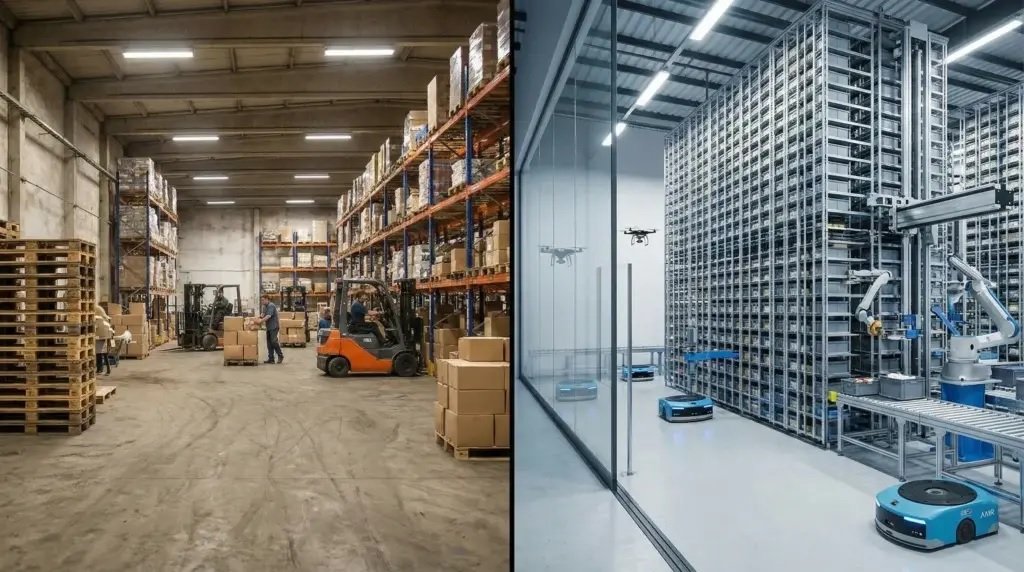
Micro-fulfilment centres (MFCs) are growing in significance as retailers react to the expansion of e-commerce and quicker local delivery. Warehouse space is costly, labour availability can be erratic, and customer demand can fluctuate throughout the day in crowded urban markets in the United States. Compact systems are necessary for accurate fulfilment and effective storage due to these limitations.
These needs are met by an automated storage retrieval system (ASRS), which combines software, storage hardware, and automated movement into a small space. This facilitates organised handling of frequent orders for urban facilities.
Making Better Use of Limited Urban Space
One of the most significant challenges in micro-fulfilment centres is space. Often, facilities may be situated closer to the end-user; therefore, the cost of land and limited floor area may render conventional warehouse systems infeasible.
The solutions offered by ASRS include the use of vertical storage and an organised way of storing products. This ensures that the maximum amount of goods can be stored in a minimal amount of space. For MFCs close to retail establishments, where every square metre counts, this is helpful.
Accelerating Order Fulfilment
Urban consumers are putting more and more pressure on fulfilment operations to process orders quickly because they want same-day or next-day delivery. When order volumes increase or when numerous small orders arrive at once, manual picking may become challenging to scale.
An ASRS can transport necessary goods to specified picking or packing locations by automating storage and retrieval. This facilitates quicker order processing and lessens needless walking. By minimising manual retrieval movements, automated workflows can increase consistency.
Supporting High SKU Variety
The MFC could potentially distribute thousands of items based on the needs of the locality. Such distribution involves the need for accurate location of the inventory items as well as easy accessibility of each item.
An automated storage retrieval system can help in organising the products based on certain storage policies and retrieval policies. Inventory locations, movements, and stock availability can all be tracked by software. This is important in situations where demand is erratic and delivery windows are brief.
This lowers manual locating errors while assisting teams in adapting to shifting order patterns.
Connecting Robotics With Fulfilment Workflows
Automated systems within MFCs don’t necessarily require only one type of automation technology. Autonomous Mobile Robots (AMR) can work together with automated storage systems to transfer totes, cartons, or any other items from one zone to another.
Such integration results in a more efficient workflow. With storage solutions managing access to inventory, the mobile robots will be able to facilitate transport through different operational areas. Coordination can keep order flowing continuously and minimise manual transportation.
Improving Flexibility During Demand Changes
The demand for cities can vary depending on promotions, season, weather, and behaviour. It is important that MFCs have technology that can easily adapt without undergoing major modifications in the physical setting.
The Role of Addverb in MFC Automation
By using software to change retrieval priorities, automated storage can promote flexibility. As volumes rise, more robotic capacity can also be added. Because routes and tasks can be coordinated in accordance with operational needs, autonomous mobile robots are especially helpful when material movement requirements change throughout the day.
Integrated warehouse technologies can enable operators to integrate storage, transportation, and software systems in smaller fulfilment facilities. Addverb provides solutions for automated storage, material handling and fulfilment processes, which makes its solutions relevant for the operational needs of micro-fulfilment centres.
Conclusion
Urban delivery is being revolutionised by micro fulfilment centres, which involve the closer positioning of inventories to end users. Such success is dependent on the effective utilisation of constrained space while at the same time ensuring high speed, accuracy and flexibility.
ASRS systems have the advantage of a highly structured automated storage retrieval system, while mobile robots can link the storage process with subsequent fulfilment processes. When combined, these technologies can help urban facilities adapt to shifting demand and create more effective fulfilment operations without completely depending on traditional warehouse models.