
Dr. Farida Al-Qasimi had been running a private endocrinology practice in Muscat for nine years when she noticed a pattern that her appointment data confirmed but that she had been observing intuitively for longer. Her patients with type 2 diabetes who were achieving the best HbA1c outcomes weren’t necessarily the ones with the most severe cases or the most complicated medication regimens. They were the ones who communicated with her between appointments. Not through elaborate means: a brief message asking whether a specific food was affecting their readings, a photograph of a meal they were unsure about, a question about whether a mild symptom warranted changing their injection timing. Those interactions, brief and informational in themselves, kept patients connected to their care management in the weeks between structured appointments, and that connection was the variable that most reliably separated patients who were improving from those who were drifting. The problem was that her practice had no mechanism for those interactions that didn’t involve her front desk team managing a phone line, taking messages, routing them to her, and relaying responses through the same chain. Each brief clinical exchange consumed administrative time that was disproportionate to its clinical content, and the friction of the process meant that many patients who would have reached out simply didn’t. When she engaged a Healthcare App Development company to build a patient engagement platform for her practice, the first feature she specified wasn’t appointment scheduling or medical records access. It was secure asynchronous messaging that allowed patients to send a question and expect a response within 24 hours without anyone having to answer a phone. Everything else was secondary to that. The platform that launched seven months later had thirteen features. The one that changed patient outcomes was the one she had specified first, because it was the one that addressed the actual gap in her patients’ care experience rather than the gaps in her administrative workflow. This blog examines how healthcare application development supports patient engagement at the clinical level rather than the operational one, and what the design choices that produce that clinical impact actually look like.
What Patient Engagement Actually Means Clinically
Patient engagement is used loosely enough in healthcare that it encompasses everything from a patient who shows up for their appointment to a patient who actively participates in managing a complex chronic condition through daily self-monitoring, dietary adjustment, and regular clinical communication. Those two patients are engaged in clinically different ways, and the applications that improve outcomes in one category don’t necessarily serve the other.
For Dr. Farida’s patient population, managing type 2 diabetes and thyroid conditions that require ongoing monitoring and medication titration, the clinically significant engagement is the kind that keeps patients connected to their clinical team during the periods between appointments when the decisions that affect their outcomes are actually being made. A patient with diabetes is making multiple food and activity decisions every day that collectively determine whether their HbA1c improves, holds, or deteriorates by the time they appear at their next quarterly appointment. Clinical guidance that reaches them at the point of those decisions is qualitatively more impactful than clinical guidance delivered during a 20-minute consultation that covers those decisions in the abstract.
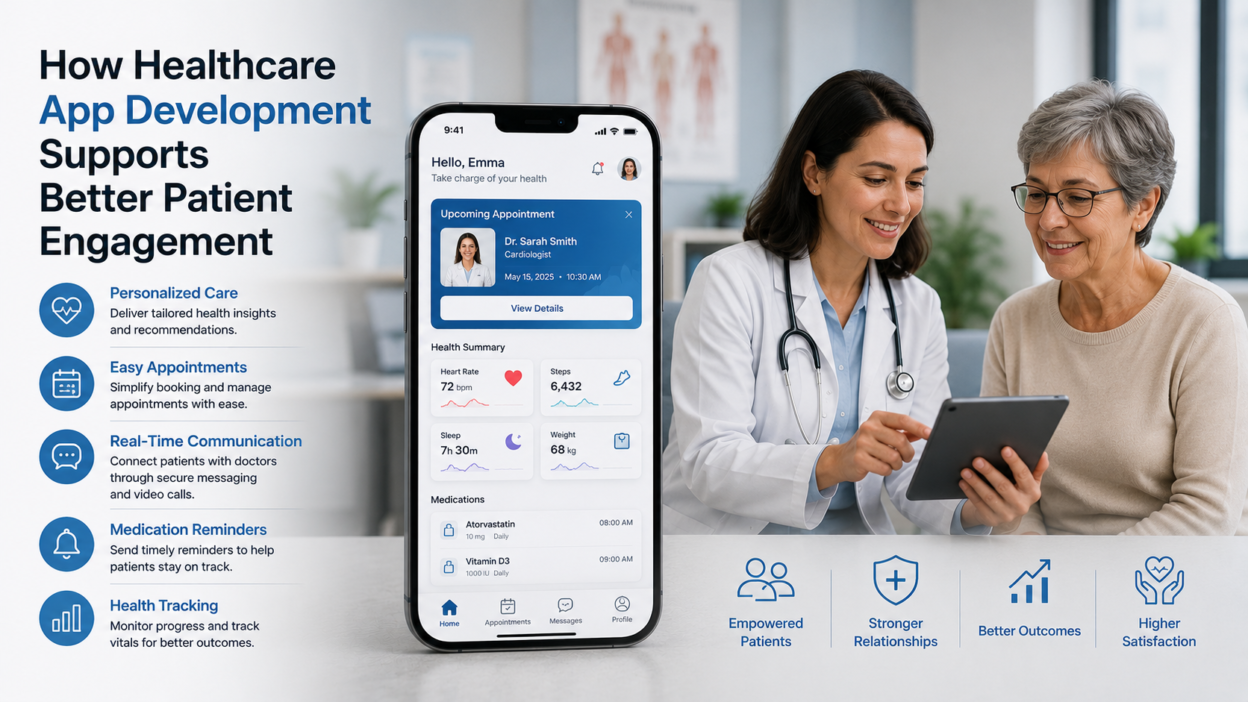
Healthcare applications that support this kind of engagement are not glorified appointment schedulers. They are clinical communication platforms that extend the reach of the care team into the patient’s daily life in ways that improve the quality of the decisions the patient makes without requiring proportional increases in clinical team workload. The distinction matters for how the application is designed, what features it prioritizes, and how its success is measured.
Secure Messaging and the Communication Architecture
The secure messaging feature that Dr. Farida specified first is the most versatile and the most consistently impactful feature in patient engagement applications across specialty types, because it addresses the fundamental structural gap in how most healthcare delivery is organized: care happens at appointments, but patients live between them.
HIPAA-compliant secure messaging in a healthcare application differs from commercial messaging applications in its data security requirements, its audit logging obligations, and its requirement that communications be associated with a patient’s clinical record in a way that supports continuity of care rather than existing as isolated exchanges. A message exchange about a patient’s blood glucose readings that is not linked to that patient’s clinical record is a communication that could benefit the patient in the moment and create a documentation gap that creates risk for the care team and the patient at every subsequent clinical interaction.
Well-designed secure messaging in healthcare applications also includes a triage layer that routes messages based on urgency and clinical content, ensuring that a message describing chest pain reaches the care team immediately while a question about dietary choices is queued for a clinician response during the next available review period. That triage function, whether automated or human-managed, determines whether the messaging feature creates a sustainable clinical workflow or an unsustainable on-call burden.
For Dr. Farida’s practice, the 24-hour response commitment she built into the platform’s expectation-setting was the design decision that made the messaging feature clinically useful. Patients who knew they would receive a substantive response within 24 hours sent messages that were appropriately considered rather than urgent-feeling. Patients who had no expectation would either send nothing or attempt to contact the practice through emergency channels for questions that were not emergencies. Setting the expectation calibrated the patient’s behavior in a way that made the feature sustainable for the clinical team.
Remote Monitoring and the Continuous Data Layer
For chronic conditions that are managed through physiological monitoring, the integration of remote patient monitoring data with the patient engagement application creates a clinical capability that structured appointments alone cannot provide. A patient with hypertension whose home blood pressure device transmits readings to the application, a diabetic patient whose continuous glucose monitor feeds data to the clinical team in real time, and a cardiac patient whose wearable ECG patch uploads rhythm data between clinic visits all provide their care team with a longitudinal physiological record that changes the clinical picture available at each interaction.
The clinical value of that continuous data is highest when the application provides the analytical layer that makes it actionable. Raw data streaming from a home blood pressure device is not itself clinically useful unless the application identifies the readings that represent a clinically significant change from the patient’s established baseline and surfaces those specific readings to the clinical team’s attention rather than requiring manual review of every data point. Automated alerting based on patient-specific thresholds, trend identification that identifies gradual changes not visible in any single reading, and data visualization that presents a month of home readings in the context of medication changes and reported symptoms are all features that transform remote monitoring data from a data stream into a clinical tool.
Dr. Farida’s diabetic patients who integrated their continuous glucose monitors with the application reduced their time in hypoglycemia by 23% on average in the first three months, measured against their pre-platform baseline from their device’s own data history. The clinical team’s ability to see glucose trends in context alongside the patient’s food diary entries, which the application collected through a structured logging feature, allowed medication titration decisions to be made between appointments based on actual physiological evidence rather than waiting for the next scheduled review.
Appointment Management and the Friction Reduction Effect
Appointment management is the least clinically differentiated feature in patient engagement applications but the one with the most consistent impact on the fundamental engagement metric of whether a patient shows up at all. The no-show rates that diminish practice efficiency and compromise care continuity are driven in large part by the friction of the conventional appointment management process: the phone call that is missed, the reminder that arrives through a channel the patient doesn’t monitor, and the rescheduling process that requires another phone call to initiate.
Mobile appointment management with push notification reminders, one-tap confirmation responses, and self-service rescheduling that doesn’t require phone interaction addresses all three friction points simultaneously. A patient who can reschedule at 11 PM on a Sunday without calling anyone is more likely to reschedule than to simply not show up, which is the outcome the practice needs.
The data from Dr. Farida’s practice showed no-show rates declining from 28% before the platform to 11% eighteen months after launch, with the largest single factor being the self-service rescheduling feature rather than the reminder improvements. Patients were not forgetting their appointments at the prior rate. They were encountering scheduling conflicts and defaulting to not attending because the path to rescheduling was sufficiently inconvenient that they deferred it until it was too late to do anything other than miss the appointment.
Health Education and Condition Literacy
Patients who understand their condition make better decisions about it. That proposition is well-supported by health outcomes research and widely acknowledged in clinical practice, but the practical delivery of condition-relevant health education to patients between appointments has historically been left to whatever materials the care team can distribute during the consultation itself.
Mobile health applications create a content delivery channel that can provide condition-specific education when the patient is in a state to engage with it, rather than during the clinical encounter when the patient may be anxious, processing other information, and has limited time and attention for educational content. A patient newly diagnosed with type 2 diabetes who receives a structured education pathway through the application, covering the condition’s mechanism, the relationship between diet and glucose levels, the role of their specific medication, and the importance of the monitoring parameters their care team is tracking, arrives at their second appointment with a level of condition literacy that changes the quality of the clinical conversation they can have.
Personalized education content that adapts to the patient’s stage of condition management, their demonstrated level of health literacy through prior interactions, and their specific medication regimen and monitoring requirements is more effective than generic condition information distributed uniformly. The application’s knowledge of the patient’s clinical context, drawn from the care team’s use of the platform, is what enables that personalization.
Selecting the Right Development Partner
For clinicians and healthcare organizations evaluating investment in a patient engagement application, the question of how to choose the right Healthcare App Development Company is as significant as the question of what features to build. The healthcare application development space attracts generalist mobile development firms who may underestimate the regulatory and clinical workflow complexity of healthcare products alongside specialist firms whose deep healthcare expertise makes them capable partners for exactly the kind of clinical functionality Dr. Farida’s practice needed.
The portfolio signals that distinguish capable healthcare application developers from generalists who have done one healthcare project include regulatory compliance documentation for previous products, evidence of clinical workflow consultation in previous engagements, the presence of HIPAA-compliant data architecture in previous applications, and the ability to describe specifically how previous applications were validated against clinical requirements rather than just functional ones. A development firm that cannot describe how a previous healthcare application was tested for the clinical accuracy of its alerting logic or validated against the data protection requirements of the applicable regulatory framework is revealing something important about how they approach healthcare development.
Reference checks with previous healthcare clients should focus not on satisfaction with the development process but on whether the application changed anything clinically. An application that functions well and is used by patients without changing any clinical outcome is a product quality achievement and a healthcare investment failure. The question worth asking is: what is different about how you deliver care because this application exists?
What Changed for Dr. Farida’s Practice
Eighteen months after the platform launch, Dr. Farida’s HbA1c outcomes across her type 2 diabetes cohort improved by an average of 0.8 percentage points, measured against the cohort’s baseline at the time of platform launch. Her no-show rate dropped from 28% to 11%. Her administrative team’s inbound phone volume dropped by 41%, freeing capacity for the complex insurance and referral coordination work that requires human judgment rather than the appointment confirmations and clinical message routing that the application absorbed.
The feature she specified first, secure asynchronous messaging, accounted for the majority of the clinical outcome improvement according to the patient survey she conducted at the twelve-month mark. Patients who had used the messaging feature most frequently showed the largest HbA1c improvements. The correlation was not causal by itself, but it was consistent with the intuition that had motivated the investment: patients who stayed connected to their care management between appointments were the ones whose outcomes were improving, and the application had made that connection available to patients who previously hadn’t had a practical mechanism for maintaining it.


