An offshore company in the UAE can be a useful structure for entrepreneurs, international investors, and business owners who want to manage overseas investments, hold assets, or conduct permitted international activities through a UAE-registered entity. However, an offshore company is different from a mainland or free zone operating company, and choosing the wrong structure can create banking, licensing, and tax complications.
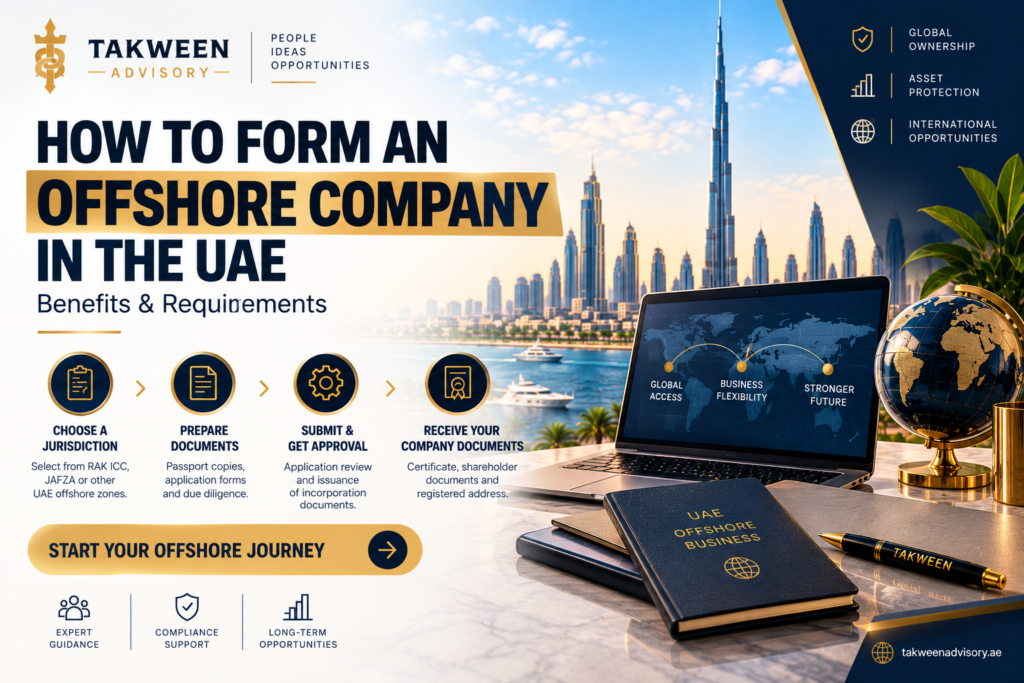
Offshore Company Setup Dubai is particularly relevant for investors considering structures such as Jebel Ali Free Zone (JAFZA) offshore companies. Another option is the Ras Al Khaimah International Corporate Centre (RAK ICC), which offers international company registration services.
Before registering, it is important to understand which activities an offshore company can undertake, what documents are required, how the registration process works, and which tax and compliance obligations may apply.
This guide explains the main benefits and requirements of establishing an offshore company in the UAE.
What Is an Offshore Company in the UAE?
An offshore company is a legal entity generally established for international business activities, investment holding, or asset ownership rather than ordinary commercial operations within the UAE domestic market.
For example, an entrepreneur who owns investments in several countries may consider an offshore company to hold certain eligible assets under a single legal structure. Similarly, an international business owner may use an offshore entity for permitted transactions involving overseas investments or group ownership.
The precise activities an offshore company can undertake depend on the relevant registration authority and applicable regulations.
Unlike a mainland company, an offshore company generally cannot operate freely as an ordinary UAE business selling goods or services to local customers. It also does not normally provide the same operating licence, office facilities, or residence visa options available through mainland and many free zone company structures.
This distinction is important because an offshore company should be selected for a suitable international purpose, not simply because it appears to offer a cheaper route to establish a UAE presence.
Where Can You Register an Offshore Company in the UAE?
Entrepreneurs considering an offshore structure commonly compare JAFZA and RAK ICC.
1. JAFZA Offshore Company
Jebel Ali Free Zone Authority, commonly known as JAFZA, offers an offshore company registration route in Dubai.
JAFZA offshore companies may be suitable for permitted international business activities, holding investments, and certain asset ownership arrangements. The authority requires applicants to use a registered agent for offshore company registration and related formalities.
The registered agent coordinates the application, prepares or arranges the required documents, and communicates with the relevant JAFZA offshore registration department.
JAFZA is worth considering if you specifically want an offshore entity registered in Dubai. However, confirm that the proposed activities are permitted under the applicable JAFZA offshore regulations before starting the application.
2. RAK ICC Offshore Company
RAK ICC is another UAE jurisdiction used for international company registration. It can be relevant for investors seeking an entity for permitted international activities, investment holding, or ownership arrangements.
The applicable formation requirements, registered agent arrangements, documentation, and ongoing compliance obligations should be reviewed before choosing this jurisdiction.
Neither JAFZA nor RAK ICC is automatically the best option for every investor. Compare the intended use of the company, asset ownership plans, banking needs, documentation requirements, and ongoing costs.
What Are the Benefits of Offshore Company Setup in Dubai?
An offshore structure can offer several advantages when it matches the investor’s actual requirements.
1. International Business Flexibility
An offshore company may be used for permitted international activities, including certain cross-border investment and holding arrangements.
For example, an investor with eligible overseas assets may want a legal entity through which to organise ownership and manage those investments. The suitability of the structure depends on the relevant laws in the UAE and the countries where the assets or counterparties are located.
An offshore company does not automatically give its owner permission to undertake every international business activity. Its permitted purposes and transactions must remain within the applicable rules.
2. Asset Holding and Ownership
An offshore company may be suitable for holding certain assets, investments, shares, or other property where the relevant authority and applicable laws allow it.
A holding structure can help organise ownership separately from the individual investor or other operating businesses. However, it does not automatically protect assets from every claim, eliminate inheritance considerations, or prevent creditors from enforcing valid legal rights.
Before transferring assets into an offshore company, review the tax, ownership, reporting, and legal consequences in every relevant jurisdiction.
3. Foreign Ownership
Offshore company structures are generally designed for international investors and may be wholly owned by eligible foreign shareholders, subject to the selected jurisdiction’s regulations.
This makes them worth considering for entrepreneurs who want to establish a UAE-registered entity without bringing in a local business partner solely because of their nationality.
Ownership eligibility does not remove the need to disclose relevant beneficial ownership information or comply with applicable verification requirements.
4. A Separate Legal Entity
Depending on the chosen structure, an offshore company has a legal identity separate from its shareholders. This can help formalise ownership and manage eligible investments through the company.
However, the actual protection provided depends on the company’s legal structure, applicable laws, corporate governance, and the circumstances of a particular dispute.
Shareholders should maintain proper company records and avoid treating company assets as if they were automatically their personal assets.
5. Potentially Suitable for Holding Companies
An offshore company may be considered as part of a wider group structure for holding shares or eligible investments in other companies.
For instance, an international entrepreneur with several businesses may explore whether a holding entity can help organise group ownership.
Such a structure should be assessed carefully. The location of the underlying businesses, tax residence, management arrangements, reporting requirements, and any applicable double taxation agreements can affect the overall result.
Who Should Consider an Offshore Company in Dubai?
An offshore company may be worth considering for investors who need an international holding structure rather than a business licence for day-to-day UAE operations.
It may suit investors planning to hold eligible overseas assets, organise share ownership, or conduct other permitted international activities through a UAE-registered entity.
However, it may not be the right choice for an entrepreneur who wants to open a restaurant, operate a consultancy serving UAE customers, hire staff through an ordinary operating company, or run a local retail business.
Those activities may require a mainland company or an appropriately licensed free zone company instead.
If you need to live in the UAE through a company-sponsored residence visa, check the available structures carefully. An offshore registration generally does not provide the same residence visa options as an eligible operating company.
What Are the Requirements for Offshore Company Setup in Dubai?
The exact requirements depend on the chosen registration authority, the shareholder structure, and the proposed activities. Applicants should prepare the following information and documents where applicable.
1. Passport and Shareholder Details
Individual shareholders and relevant company officers will generally need to provide valid identification documents, such as passport copies, together with the information requested by the registration agent.
The authority or registered agent may also request a residential address, contact details, professional background, specimen signature, or other supporting information.
All documents should be clear and consistent. Any differences in names, addresses, or identification details should be resolved before the application is submitted.
2. Company Name
You will need to select a company name that complies with the chosen jurisdiction’s naming requirements.
The registration authority may reject names that conflict with existing registrations or contain restricted wording. Prepare alternative names in case your first choice is unavailable.
A company name reservation also does not automatically grant trademark protection. If the brand is important to your business, consider whether separate intellectual property registration is appropriate.
3. Memorandum and Articles of Association
The Memorandum and Articles of Association establish important details about the company’s structure and governance, including matters relating to shareholders, directors, and the company’s permitted purposes.
These documents must be prepared and submitted according to the requirements of the relevant registration authority.
The registered agent generally coordinates the necessary offshore incorporation documents and explains the required signing process.
4. Registered Agent
For a JAFZA offshore company, registration must be processed through a JAFZA-registered agent.
The agent helps coordinate the application, required legal documents, and communication with the authority. Before appointing an agent, confirm its registration status, service scope, and total fees.
The precise agent requirements and appointment procedures should be checked with the relevant jurisdiction.
5. Corporate Shareholder Documents
If an existing company will own shares in the proposed offshore entity, additional documentation may be required.
Depending on the jurisdiction and ownership structure, this may include a certificate of incorporation, certificate of good standing, memorandum and articles of association, board resolution, incumbency certificate, or power of attorney.
Foreign-issued documents may need notarisation, attestation, or other authentication. Confirm the applicable requirements before arranging the paperwork to avoid delays.
6. Beneficial Ownership Information
Applicants must provide the information required to identify the company’s relevant beneficial owners and comply with applicable transparency requirements.
The registered agent or authority may request ownership charts, identity documents, and details explaining how the company is controlled.
Complex ownership structures may require additional information. Businesses should ensure that the information provided is accurate and complete.
Step-by-Step Process for Offshore Company Registration
Step 1: Define the Purpose of the Company
Start by deciding what the offshore company will do. Determine whether it will hold investments, own eligible assets, or undertake another permitted international activity.
This is important because the purpose of the company affects jurisdiction selection, supporting documents, banking requirements, and tax considerations.
Step 2: Choose the Registration Jurisdiction
Compare JAFZA and RAK ICC based on their rules, permitted activities, documentation requirements, registered agent arrangements, and ongoing obligations.
Do not choose a jurisdiction based only on an advertised formation fee. Make sure it supports your actual plans.
Step 3: Appoint the Required Registered Agent
For JAFZA offshore registration, appoint a registered agent authorised to handle the application.
The agent can confirm which forms and supporting documents are needed and explain whether the application requires additional legalisation or verification.
Step 4: Submit the Application and Documents
Provide the completed application, shareholder and officer details, identification documents, constitutional documents, and any additional evidence requested by the authority.
The authority may request further information during its review. Responding promptly helps avoid unnecessary delays.
Step 5: Pay the Applicable Fees
Pay the registration and agent fees according to the agreed terms and the authority’s payment instructions.
Before proceeding, request a breakdown of initial costs and recurring expenses, including any registered agent charges, annual renewal fees, and required compliance services.
Step 6: Receive the Incorporation Documents
Once the application is approved and the necessary formalities are complete, the authority issues the relevant incorporation documents.
Keep these records securely, as you may need them for banking applications, asset ownership arrangements, corporate transactions, or future compliance procedures.
Incorporation does not automatically guarantee a bank account, permission to carry out regulated activities, or tax exemption.
How Much Does Offshore Company Setup in Dubai Cost?
The overall cost depends on the registration jurisdiction, the registered agent’s services, the complexity of the shareholder structure, and any additional requirements.
Potential expenses include the registration fee, agent fees, document preparation, notarisation or attestation, annual renewal, and other applicable administrative or compliance services.
Applicants with corporate shareholders or several layers of ownership may incur additional document preparation and authentication costs.
Ask for a written quotation covering both the initial setup and ongoing annual expenses. You should also confirm whether the quotation includes the mandatory registered agent service and any authority charges.
Because fees and service packages can change, verify the latest amounts directly with the relevant authority or registered agent before making a decision.
Does an Offshore Company in the UAE Pay Corporate Tax?
An offshore company should not automatically be treated as exempt from UAE Corporate Tax.
The tax treatment depends on the company’s legal status, where it is incorporated or recognised, the nature and source of its income, and the provisions of the UAE Corporate Tax Law that apply to it.
The standard UAE Corporate Tax rates are generally 0% on taxable income up to AED 375,000 and 9% on the portion of taxable income above AED 375,000, subject to the applicable rules. Whether a particular offshore entity falls within the Corporate Tax regime, must register, or qualifies for any exemption requires a case-specific assessment.
The company may also have obligations in other countries where it holds assets, earns income, conducts activities, or is managed. A foreign tax authority may consider the company’s place of effective management, permanent establishment, or other relevant factors.
Before incorporating, obtain tax advice that covers the UAE and every relevant overseas jurisdiction. Do not establish an offshore company on the assumption that registration alone eliminates taxes.
Can an Offshore Company Open a Corporate Bank Account in Dubai?
An offshore company may be able to apply for a UAE corporate bank account, but approval is not guaranteed.
Banks carry out their own due diligence and assess the company’s legal documents, beneficial ownership, source of funds, intended transactions, and business purpose.
You may need to provide incorporation documents, identification for shareholders and directors, proof of address, ownership information, and evidence of the company’s proposed activities.
Some banks may have restrictions on offshore entities or may require additional documentation. Contact the bank before finalising your registration if a UAE bank account is essential to your plans.
It is also important to understand that opening an offshore company does not automatically establish a personal residence visa or guarantee access to every UAE banking service.
How Takween Advisory Can Help
Choosing an offshore structure requires careful planning, particularly when the company will hold assets, own shares in other businesses, or interact with banks and tax authorities across different countries.
Takween Advisory supports entrepreneurs exploring business setup and advisory services in Dubai and across the UAE. Businesses considering offshore incorporation should clarify their intended activities, compare suitable jurisdictions, and identify the applicable documentation and compliance requirements before proceeding.
For questions involving asset transfers, international tax exposure, beneficial ownership, or overseas investment structures, obtain advice from qualified legal and tax professionals who understand the relevant jurisdictions.
Frequently Asked Questions
1. Can a foreigner establish an offshore company in Dubai?
Eligible foreign individuals and corporate shareholders can generally apply to establish an offshore company, subject to the selected jurisdiction’s requirements, permitted activities, and verification procedures.
2. Can an offshore company conduct business in the UAE mainland?
An offshore company generally cannot operate as an ordinary mainland trading or service business merely because it is registered in the UAE. Its permitted activities are restricted by the applicable offshore regulations. A business intending to serve the local market should review whether a separate operating licence or another compliant structure is required.
3. Does an offshore company provide a UAE residence visa?
Offshore incorporation generally does not provide the same company-sponsored residence visa options available through eligible mainland or free zone operating companies. Confirm the visa route separately if residency is one of your objectives.
4. Can an offshore company own property in Dubai?
An offshore company may be able to own eligible property if the applicable property rules and registration authority permit it. Requirements can depend on the ownership structure, property location, and relevant approvals. Confirm eligibility with the appropriate property authority before transferring or purchasing property.
5. Is an offshore company automatically exempt from UAE Corporate Tax?
No. The company’s Corporate Tax obligations must be assessed under the applicable law. Registration, exemption, taxable income, and filing requirements depend on the entity’s circumstances and the rules in force.
6. How long does offshore company registration take?
The timeline depends on the jurisdiction, completeness of the documents, shareholder structure, and any additional checks. JAFZA’s published new offshore company guide lists a processing time of approximately five to seven working days for its stated process, but individual applications may take longer.
7. Can I open a bank account with an offshore company?
You may apply, but banks assess offshore entities according to their own eligibility and due diligence policies. Prepare the incorporation documents, beneficial ownership information, and a clear explanation of the company’s business purpose.
Conclusion
Offshore Company Setup Dubai can be useful for investors and entrepreneurs who need a UAE-registered entity for permitted international activities, eligible asset holding, or investment structures. JAFZA and RAK ICC are two jurisdictions worth comparing before making a decision.
The right approach is to define the purpose of the company, check the permitted activities, prepare the necessary shareholder documents, appoint the required registered agent, and understand the ongoing costs and tax obligations.
An offshore company is not a substitute for a mainland or free zone operating licence when you intend to conduct ordinary business in the UAE. By choosing a structure that matches your actual objectives and taking professional advice on cross-border tax and legal matters, you can establish the company on a more reliable foundation.