A logistics company launches a model that predicts delivery delays. In testing, it catches most late shipments a day in advance, and dispatchers love it. Nine months later, a major carrier changes its routing, a new warehouse opens, and fuel surcharges shift customer ordering patterns. Nobody updates the model. Its warnings grow less accurate, dispatchers stop trusting them, and the tool quietly falls out of use. The project that looked like a success at launch has become shelfware.
This is the normal life of a machine learning model without a plan for what comes after release. A model is trained on data from the past and then asked to make predictions about a future that keeps changing. It starts depreciating the day it ships. For that reason, machine learning development services should be judged less on first-release accuracy and more on what they commit to in year two: drift monitoring, retraining triggers, and clear ownership of the data pipelines that feed the model.
Why Models Lose Value After Launch
Several forces erode model performance over time.
Data drift. The inputs change. Customer demographics shift, new products appear, or sensors are recalibrated. The model sees patterns it did not learn from.
Concept drift. The relationship between inputs and outcomes changes. A fraud pattern that once signaled risk may become common and harmless, while new fraud schemes look normal to the model.
Upstream changes. A source system renames a field, changes a unit of measure, or stops sending a column. The pipeline may keep running while feeding the model bad values.
Feedback loops. The model’s own decisions change the data it later learns from. A credit model that declines certain applicants never sees how those applicants would have performed.
Seasonality and shocks. Holidays, weather events, supply disruptions, and economic changes shift behavior in ways a model trained on normal periods cannot anticipate.
Business and regulatory change. New pricing policies, product rules, or regulations can make a model’s logic outdated or noncompliant.
None of these problems announce themselves. Without monitoring, a model can degrade for months before anyone notices.
The Cost of Ignoring Post-Launch Work
The consequences go beyond a single model. Data problems are one of the main reasons AI projects fail. A Gartner survey on AI-ready data found that 63% of organizations either lack or are unsure they have the right data management practices for AI, and Gartner predicts that through 2026, organizations will abandon 60% of AI projects unsupported by AI-ready data. Post-launch data quality is part of that readiness.
Scaling adds pressure. According to McKinsey’s State of AI research, nearly two-thirds of organizations have not yet begun scaling AI across the enterprise. Companies that cannot keep existing models healthy struggle to add new ones, because every new model adds to a maintenance load that nobody planned for.
The business cost is often hidden. Degraded models make slightly worse decisions every day: a few more stockouts, a few more missed fraud cases, a few more poorly targeted offers. Users lose confidence and start overriding the model, which removes whatever value remained.
What a Post-Launch Plan in Machine Learning Development Services Includes
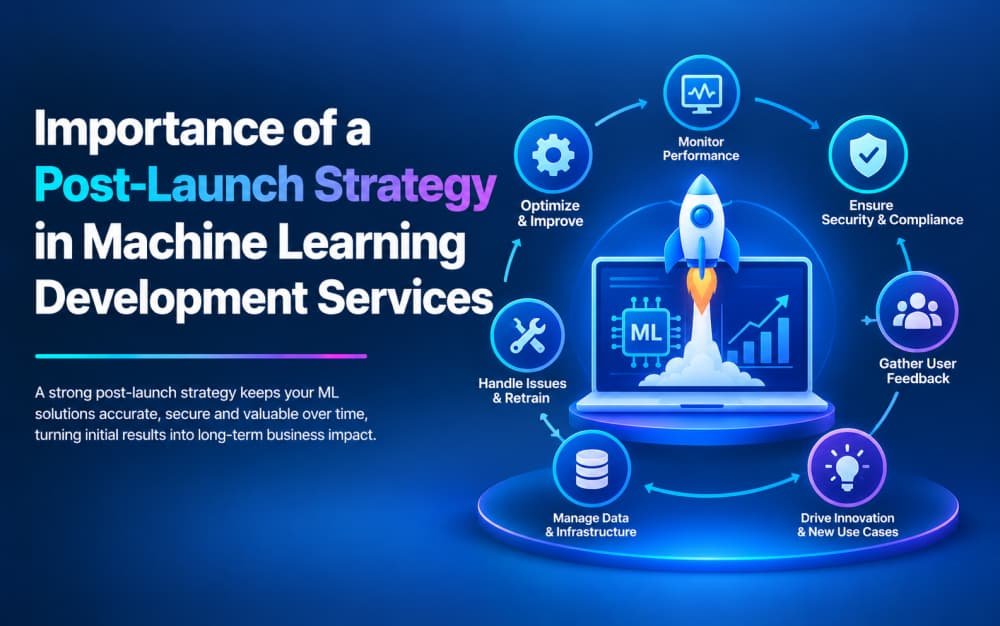
A complete post-launch strategy has six parts. Each should be designed before the model goes live.
- Monitoring
Monitoring tracks several layers:
- Data quality: missing values, out-of-range inputs, schema changes, and volume drops.
- Input drift: changes in the distribution of key features compared with the training data.
- Prediction drift: changes in the distribution of model outputs.
- Performance: accuracy, precision, recall, or error measures once actual outcomes are known.
- Business impact: the operating metric the model is meant to improve, such as fraud losses or forecast-driven inventory levels.
Performance often cannot be measured right away, because outcomes arrive later. A loan default may take months to occur. Drift and data quality monitoring provide early warnings in the meantime.
- Retraining Triggers
Retraining triggers define when a model gets updated. Common approaches include:
- Scheduled retraining: monthly or quarterly, regardless of drift.
- Threshold-based retraining: when drift or performance measures cross agreed limits.
- Event-based retraining: after known changes, such as a new product line, a policy change, or a major market event.
Most production systems combine these. The thresholds should be written down, agreed with the business owner, and reviewed as experience builds.
- Retraining Pipeline
A retraining trigger is only useful if retraining is fast and safe. A good pipeline pulls fresh data, rebuilds features, trains candidate models, evaluates them against the current model, and deploys the winner with approval. Champion-challenger testing, where a new model runs alongside the current one before replacing it, reduces risk.
- Data-Pipeline Ownership
Models depend on pipelines that pull data from many systems. Each pipeline needs a named owner who is notified when upstream systems change and who fixes breaks quickly. Without clear ownership, pipeline failures fall between teams.
- Incident Response
When a model misbehaves, the team needs a playbook: who is alerted, how the model is rolled back or switched to a fallback rule, how affected decisions are reviewed, and how the root cause is fixed.
- Documentation and Governance
Each model should have current documentation of its purpose, data, features, performance, limits, and change history. Regulated industries require this, and it helps any team that inherits the model later.
Who Does What After Launch
Post-launch plans fail most often on ownership. A simple responsibility map, agreed before go-live, prevents gaps.
- Business owner: accountable for the decision the model supports and the operating metric. Approves thresholds and major retraining.
- Model owner: responsible for model performance, monitoring review, and retraining. Usually a data scientist or ML engineer.
- Pipeline owners: responsible for each data feed, including notification of upstream changes and repair of breaks.
- Platform team: responsible for serving infrastructure, monitoring tools, and deployment pipelines.
- Risk and compliance: responsible for validation standards, documentation, and periodic independent review.
When a provider runs the model under contract, the map should show which of these roles sit with the provider and which stay with the client. Every role needs a named person, not just a team.
A Representative Year-Two Review
Return to the delivery delay model from the opening, this time with a post-launch plan in place. Monitoring flags input drift in the second month after the new warehouse opens, because shipment origins no longer match the training data. The alert goes to the model owner, who confirms the change with the operations lead.
An event-based retraining trigger fires. The pipeline pulls three months of fresh data, trains a challenger model, and runs it alongside the current model for two weeks. The challenger performs better on the new routes, so the business owner approves the switch. When the carrier changes its routing later in the year, the same process runs again.
At the year-two review, the model’s accuracy sits close to its launch level, dispatcher overrides remain low, and the team has a documented history of every change. The model has aged well because someone planned for it to age.
Judging ML Development Services on Year-Two Commitments
Most proposals for ML development services focus on the build: data preparation, feature engineering, model training, and deployment. They highlight accuracy on test data. Few say much about year two.
Buyers can change that by asking for specific post-launch commitments in the contract:
- Monitoring scope: which metrics will be tracked, at what frequency, and with what alerting.
- Retraining plan: the schedule, the thresholds, and the event triggers.
- Pipeline ownership: named owners for each data pipeline, on the provider side, the client side, or both.
- Response times: how quickly the provider will investigate alerts and restore performance.
- Performance floor: the minimum acceptable performance, and what happens if it is breached.
- Handoff terms: the documentation, training, and runbooks the client receives if it takes over.
Review cadence: regular reviews of model health with the business owner.
A provider willing to commit to these terms has planned for the model’s real life. A provider that avoids them may be planning only for launch day.
How Post-Launch Work Changes Project Budgets
Post-launch work carries real cost, and it should be budgeted from the start. Monitoring tools, compute for retraining, engineering time for pipeline fixes, and analyst time for reviews all add cost.
A practical approach sets an annual run budget for each production model, covering:
- Infrastructure for serving and monitoring.
- Scheduled retraining and evaluation.
- A reserve for unplanned retraining after major changes.
- Staff time for reviews, incident response, and documentation.
Setting this budget early helps business sponsors understand the full cost of ownership and prevents the common pattern of a well-funded build followed by an unfunded run phase.
Choosing an ML Development Company for the Long Run
When evaluating an ML development company, look for evidence of long-term model care:
- Examples of models the provider has kept in production for two years or more.
- Monitoring dashboards and alerting setups from past projects.
- A standard retraining pipeline design, not a one-off script per project.
- Clear practices for champion-challenger testing and rollback.
- Experience handing models over to client teams with full documentation.
Ask for references who can speak about year two, not only about launch.
Machine learning development solutions built with this mindset treat the model as a product with a life cycle, not a deliverable with an end date.
Governance and Regulatory Expectations
Regulators increasingly expect ongoing oversight of models in production. The EU AI Act requires providers of high-risk AI systems to run post-market monitoring. Model risk management guidance in banking has long expected ongoing monitoring, periodic validation, and documentation of changes. Insurance regulators in the United States are applying similar expectations to AI systems under the NAIC AI Model Bulletin.
A post-launch strategy that includes monitoring, documented thresholds, change logs, and regular reviews meets much of what these frameworks ask for. It also gives auditors a clear view of how the organization manages model risk.
Measuring Post-Launch Success
Useful measures of post-launch health include:
- Time to detect: how quickly drift or data problems are identified after they begin.
- Time to restore: how long it takes to return a model to acceptable performance.
- Retraining frequency: how often models are updated, and whether updates follow the plan.
- Override rate: how often users override model outputs, as a proxy for trust.
- Business metric stability: whether the operating metric the model supports holds steady or improves over time.
Tracking these measures across the model portfolio helps teams identify which models are being maintained well and which need attention. Share the results with business owners in plain language. A stable business metric or a lower override rate may be more meaningful to them than a technical drift score.
Machine learning development services should be assessed by what happens after launch, when models face changing data and real-world use. Drift monitoring, clear retraining triggers, data-pipeline ownership, and a practical incident response plan help keep models useful into year two and beyond. When a proposal emphasizes test accuracy, ask what the model’s performance and maintenance plan will look like twelve months after deployment.