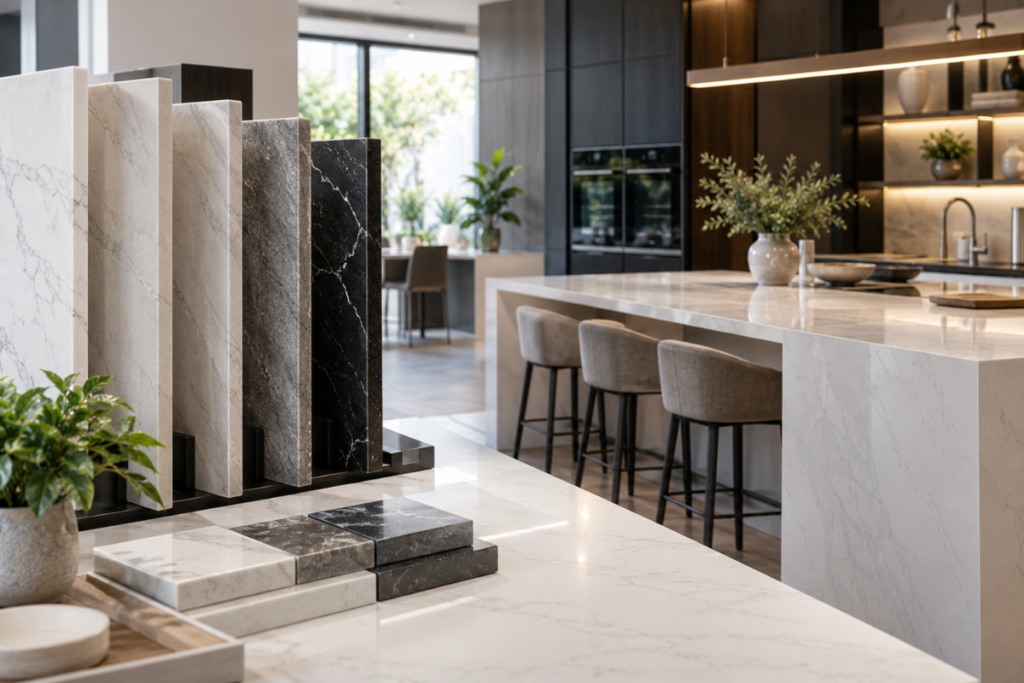
A kitchen worktop needs to combine practical performance with a finish that suits the overall design. It must cope with food preparation, spills, moisture, cleaning, heat, and everyday use while remaining visually appealing. For homeowners planning a renovation, choosing suitable quartz worktop suppliers can be an important part of the process because the supplier may influence the available materials, fabrication options, templating, and installation.
Quartz is an engineered worktop material that combines quartz aggregates with other components to create a consistent surface. It is available in numerous colours, patterns, and finishes, making it suitable for a range of kitchen and bathroom designs.
What Is a Quartz Worktop?
Quartz worktops are engineered surfaces rather than slabs of naturally occurring solid quartz.
This consistency can be useful when a homeowner wants a particular colour or visual effect across a kitchen.
Quartz can also be manufactured in styles inspired by natural materials. Marble-effect patterns, concrete-inspired designs, plain colours, and more heavily patterned surfaces are all available across different collections.
Why Is Quartz Popular for Worktops?
One reason quartz is commonly considered for kitchen and bathroom worktops is its combination of durability and relatively straightforward maintenance.
The non-porous nature of the material can make everyday cleaning easier because liquids are less likely to penetrate the surface.
However, quartz is not completely maintenance-free or indestructible. Appropriate cleaning practices and protection from excessive heat remain important.
How to Compare Quartz Suppliers
When comparing quartz worktop suppliers, it helps to look beyond the number of colours displayed on a website.
Consider whether a supplier provides:
- A broad range of quartz manufacturers
- Physical samples
- Accurate measurements
- Professional templating
- Bespoke fabrication
- Different thickness options
- Multiple edge profiles
- Sink and hob cut-outs
- Installation services
- Clear maintenance guidance
- Transparent quotations
- Warranty information
The availability of these services can make a significant difference to the overall project because the worktop is normally fabricated to suit the precise dimensions of the kitchen.
Look at the Available Quartz Brands
Different manufacturers can offer different colours, textures, patterns, and technical characteristics.
A supplier with access to several manufacturers can give homeowners more opportunities to compare materials rather than limiting the selection to a single collection.
When comparing samples, consider the pattern at full slab scale as well as the small sample. A pattern that looks subtle on a small sample can appear considerably more prominent across a large kitchen island.
Choosing the Right Colour and Pattern
The worktop should be considered alongside the rest of the kitchen.
Factors to look at include:
- Cabinet colour
- Flooring
- Splashbacks
- Wall finishes
- Appliances
- Lighting
- Handles and taps
- Kitchen size
White and light quartz can create a bright appearance, while darker surfaces can provide contrast. Veined designs can create a marble-inspired focal point, while plain finishes can work well in minimalist spaces.
Viewing physical samples in the actual room can be particularly useful because lighting can significantly affect how a colour appears.
Consider Maintenance Requirements
One of quartz’s practical characteristics is that it generally does not require sealing.
However, the surface can still react to certain chemicals. The supplier’s guidance warns that substances such as permanent markers, sodium hydroxide, and paint can affect the surface. It also recommends checking with the supplier before using heavy-duty cleaning products.
Following the manufacturer’s care recommendations is therefore an important part of protecting the worktop.
Think About Heat Exposure
Quartz is resistant to heat, but excessive or repeated direct heat can still affect the surface.
This is an easy precaution to incorporate into a daily kitchen routine.
The position of hobs and cooking appliances should also be considered during the design and templating stages.
Why Templating Matters
Stone and engineered worktops need accurate measurements because the finished slab may contain several custom cut-outs.
These can include openings for:
- Sinks
- Hobs
- Taps
- Sockets
- Appliances
- Corners
- Plumbing
Accurate templating is particularly important for kitchens with unusual layouts, islands, curves, multiple joins, or integrated appliances.
Edge Profiles and Thickness
The thickness and edge treatment can change the overall appearance of a quartz worktop.
A simple square edge may suit a contemporary kitchen, while a more detailed profile can create a different visual effect. Thickness can also influence whether the worktop looks substantial or minimalist.
The available options depend on the material and fabrication process, so these details should be discussed before ordering.
It is also useful to establish whether the quoted price includes fabrication of the selected edge profile or whether it is charged separately.
Kitchen and Bathroom Applications
Quartz is not limited to kitchen worktops. It can also be used for bathroom surfaces.
Bathroom applications can include vanity tops and surfaces around basins. Accurate planning is still necessary for taps, sinks, plumbing, storage units, and other fixtures.
The maintenance requirements should also be confirmed for the specific quartz product selected.
Request Samples Before Making a Decision
Photographs can provide an initial impression, but physical samples can reveal details that are difficult to judge on a screen.
A sample can help you assess:
- Colour
- Surface finish
- Pattern intensity
- Veining
- Texture
- How the material works with cabinet colours
Where possible, compare the sample under both daytime and artificial lighting.
Ask About Installation
The quality of the finished worktop depends not only on the material but also on fabrication and installation.
Before ordering, ask about:
- Site measurement
- Template creation
- Fabrication
- Cut-outs
- Edge finishing
- Transportation
- Installation
- Joins and seams
- Cabinet preparation
- Warranty coverage
Having each stage clearly explained can make it easier to understand what is included in the quotation.
Compare the Total Project Cost
The material price is only one part of a worktop project.
The final cost can be affected by:
- Slab material
- Thickness
- Worktop dimensions
- Number of joins
- Sink cut-outs
- Hob cut-outs
- Edge profiles
- Upstands
- Splashbacks
- Templating
- Delivery
- Installation
Two quotations may therefore appear different even when the headline material seems similar.
Comparing the complete specification rather than just the price per square metre can provide a clearer picture of what each quotation includes.
Questions to Ask Before Ordering
Before choosing a supplier, consider asking:
- Which quartz manufacturers are available?
- Can I see physical samples?
- Is the quoted price for material only or a complete installation?
- Is templating included?
- How are cut-outs priced?
- What edge profiles are available?
- What maintenance does the chosen quartz require?
- Does the product have a warranty?
- How long does fabrication take?
- What happens if the measurements change after templating?
Clear answers can help avoid unexpected costs and misunderstandings later in the project.
Conclusion
Choosrial specifications, samples, fabrication capabilities, templating process, installation arrangements, maintenance guidance, and total project cost. Quartz itself offers a combination of controlled design options, stain resistance, and relatively straightforward care, although it still needs appropriate handling and cleaning. For homeowners researching Quartz Supply, the company states that it provides quartz worktops in Essex, offers materials from several established manufacturers, provides samples, and handles the process from templating through installation. These are descriptions of the company’s own services rather than an independent assessment. A well-specified worktop project should ultimately be based on the needs of the room, the selected material, and the practical requirements of fabrication and installation.