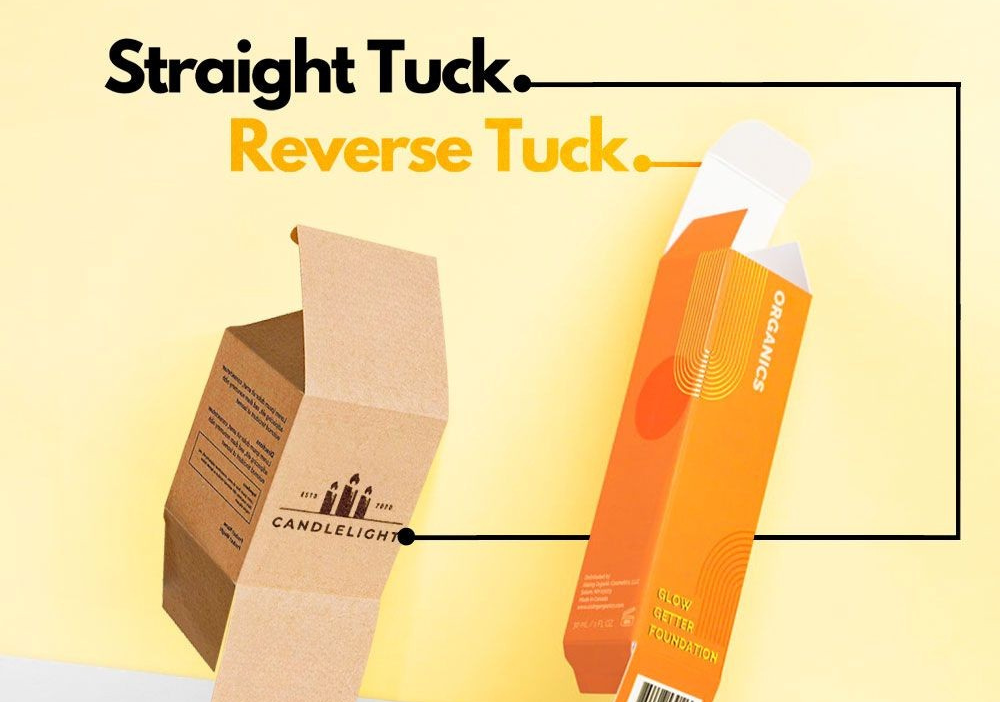
Head to any beauty or pharmacy aisle and you’ll notice tuck boxes all around you: serum bottles, lip products, supplements, snack bars, tiny toys. It is the standard small retail carton simply because they are inexpensive, easy to print, and easy to put together. But if you’ve ever asked for a quote, the salesperson may have asked you a rather silly question: straight tuck or reverse tuck?
It’s not simple. The difference affects the shelf presence of the box, the viability of the box in the box, and the price per box. Here’s what really differentiates the two.
It comes down to the flaps
Two styles are two-piece folding cartons formed from a single sheet, but with one closed end in the bottom of the carton, and the other is from a separate blank. Both styles are flat, one-piece folding cartons that have a top flap and a bottom flap that tuck into the box body to close the carton.
In a straight tuck end (STE) box, the top and bottom flaps tuck in from the same side of the box. In a reverse tuck end (RTE) box, the top flap tucks in from one side and the bottom tucks in from the other side, so the two closures are facing opposite directions.
That’s the entire different structure, but the impact has a kind of propagation.
Straight tuck end: the display-friendly choice
Since both flaps are oriented to the same side, the straight tuck box appears cleaner and more uniform. It’s a popular choice for cosmetics, health & beauty products, and other retail items that consumers don’t necessarily want to have to lift or open up. It’s compatible with window cut-outs, as well, because there’s no tuck flap to work against the transparent film over your product.
Another nice feature is that it will open flat. A straight tuck box opens flat and flat evenly – a welcome feature when someone is grabbing it off a shelf. And if your product should have a hanging feature, a straight tuck box can be ordered with a hang hole in the header.
The trade-offs are worth knowing:
It costs more. Straight tuck layouts only allow for a limited number of boxes per sheet of paperboard, resulting in more waste and more cost to set up.
Some sources state it can pop open under pressure from heavy objects placed on top of it.
Straight tuck boxes don’t stack quite as well as reverse tuck boxes.
Reverse tuck end: the efficient workhorse
Reverse tuck boxes are traditionally fitted with a flipped closing direction, and that returns a handful of benefits. There’s a line efficiency advantage, as the reverse tuck design allows for a greater number of boxes to be printed per sheet – it’s not so great with lower volumes, but it adds up at larger ones. And the opposite flaps provide a tighter lock.
The reason reverse tuck is such a popular choice for products that go in a box, for such things as pharmaceuticals, supplements, food and toys and even one we consider the standby for e-commerce and bulk quantity production. If the product is going to travel directly without a sleeve or outer box, RTE is generally the better choice.
The disadvantages are mostly cosmetic. In some designs, the edges around the flaps appear slightly rougher on the retail-facing side, and the opening is slightly less sleek than a straight tuck.
A brief comparison
| Straight Tuck End | Reverse Tuck End | |
| Flap direction | Same side | Opposite sides |
| Look | Cleaner, more refined | More functional |
| Cost | Higher | Lower |
| Closure security | Good | Stronger |
| Best for | Shelf display, windows, premium retail | E-commerce, high volume, handling and shipping |
How to select
Ask three questions
Who looks at the box first? If the box is on a shelf where the customer is evaluating it, or if there is a window on the box, straight tuck often looks more appealing. If the box goes directly from the warehouse to a shipping carton, it won’t matter.
What’s in it? Lightweight and fragile items will be just as pleased in either. For heavier products or items that will be handled a lot before they reach a buyer, opt for a reverse tuck with a tighter closure.
What’s your quantity? At small volumes, the price gap is modest. As runs get larger, the sheet efficiency of reverse tuck adds up, and it becomes a real budget lever. If you plan to order in bulk, it’s worth asking your printer to quote both versions side by side, particularly when you’re shopping for custom tuck box packaging wholesale.
Don’t forget the details that matter just as much
The decision of whether to use STE or RTE is just the beginning. There are a number of other choices that will determine the end result:
Board thickness. Paperboard ranges from around 14pt for the lighter-weight items to 36pt for the heavier-weight items. Whether flat or folded, a flimsy board looks and feels budget.
Extras for closure. Slit-lock or friction-fit capabilities keep the lid tight and prevent bowing.
Bottom style. If you’re hoping for a flat bottom that will set flush on a shelf, then consider a snap-lock or auto-bottom version-it may be worth paying a little more for.
Material. SBS is the standard for high-end retail cartons, while kraft board is well-suited to natural, earth-friendly brands.
Size. Size your product before the box, and then only make the box slightly bigger to allow your product to slide in with a little bit of play, not a lot.
The bottom line
Straight tuck is the one you choose when display is king: shelf appeal, window, a sharp opening. Reverse tuck is the one you choose when economy and security are king: a cheaper, more durable closure and high volumes. There’s no better, here, only right, depending on how you’re selling, shipping and consuming your product. When in doubt, always ask for physical samples of each, stuffed with the real product, and give them a gentle shake. That will confirm the decision far faster than a spec sheet.