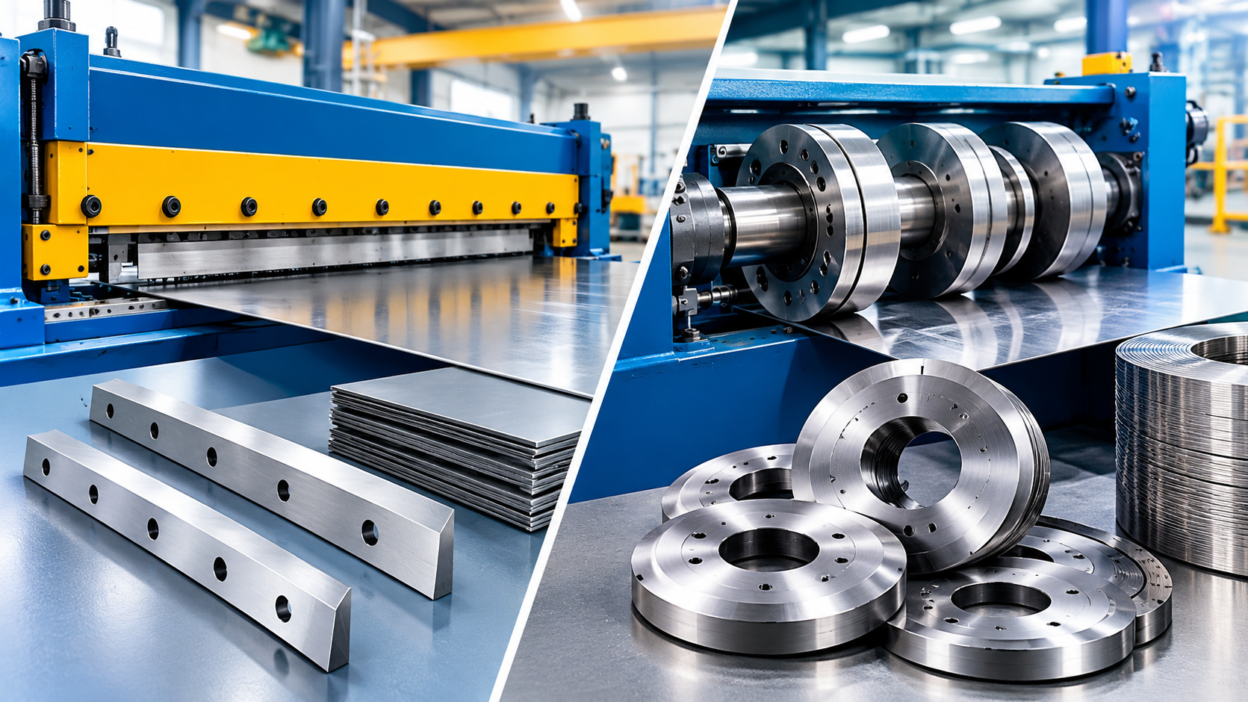
In modern metalworking and manufacturing, selecting the appropriate cutting method is essential for achieving consistent product quality, improving production efficiency, and reducing material waste. Straight shearing and rotary shearing are two widely used processes for cutting metal sheets, strips, and other materials. Although both methods are designed to produce accurate cuts, they differ in their operating principles, cutting mechanics, and tooling requirements.
Understanding these differences helps manufacturers choose suitable Shear blades for their applications, maintain dimensional accuracy, and extend tool service life. From traditional sheet metal fabrication to high-volume coil processing, the right blade configuration can significantly influence production performance.
Understanding Straight Shearing
Straight shearing is a cutting process in which a straight blade moves against another blade to separate a workpiece. The cutting action typically involves a moving upper blade and a stationary lower blade. As the upper blade applies force, the material experiences deformation before separating along the intended cutting line.
This method is commonly used in sheet metal fabrication, metal service centers, manufacturing facilities, and industrial workshops. Straight shearing equipment can process different materials, including carbon steel, stainless steel, aluminum, and other metals, depending on the machine’s capacity and tooling specifications.
The effectiveness of straight shearing depends on several factors, including blade sharpness, blade clearance, cutting angle, material thickness, and machine rigidity. Incorrect settings can cause excessive burr formation, uneven edges, material distortion, and premature tool wear.
Blade Requirements for Straight Shearing
Straight shearing applications require blades that maintain a consistent cutting edge under repeated mechanical loading. Since the cutting force is concentrated along a relatively straight cutting line, the blade must withstand substantial pressure without excessive deformation or chipping.
Several factors influence blade selection:
- Material hardness: Blade material should provide sufficient hardness and wear resistance for the workpiece being processed.
- Cutting-edge geometry: The edge profile must suit the material thickness and the required cut quality.
- Blade clearance: The distance between the upper and lower blades must be appropriate for the material and cutting conditions.
- Dimensional accuracy: Consistent blade thickness, straightness, and parallelism help maintain reliable cutting performance.
- Wear resistance: Proper heat treatment and suitable tool steel can help reduce edge deterioration during repeated operations.
Straight shear blades may be manufactured from high-speed steel, alloy tool steel, or other suitable materials, depending on the machine design, workpiece properties, and production requirements.
Understanding Rotary Shearing
Rotary shearing uses rotating circular knives or disc-shaped cutting tools to slit or separate material continuously. Rather than relying on a straight blade moving across a fixed cutting line, rotary systems use rotating tooling to create a progressive cutting action as material passes through the machine.
This process is particularly useful for coil processing, metal slitting lines, sheet production, and applications requiring continuous cuts at high production rates. Rotary shearing can divide a wide metal coil into narrower strips or produce specific widths according to manufacturing requirements.
The process depends on coordinated rotation, accurate tool positioning, and controlled interaction between the cutting edges. Depending on the application, rotary systems may use overlapping circular knives, matched tooling, or other specialized arrangements.
Because the cutting action occurs continuously, even small variations in blade dimensions, alignment, or edge condition can affect the finished material. Poorly maintained tooling may contribute to burrs, uneven strip widths, edge deformation, or inconsistent slitting quality.
Blade Requirements for Rotary Shearing
Rotary shearing places particular demands on tooling precision. Circular blades must maintain accurate dimensions and consistent cutting-edge geometry throughout their circumference.
Important considerations include:
- Diameter accuracy: Consistent blade diameter helps maintain predictable cutting conditions.
- Thickness tolerance: Accurate thickness supports proper tool spacing and finished strip dimensions.
- Concentricity: The cutting edge should rotate consistently around the blade’s center to reduce runout.
- Edge quality: Smooth, properly finished cutting edges support clean and repeatable slitting.
- Wear resistance: Appropriate tool materials and heat treatment help maintain cutting performance during extended production runs.
- Surface finish: Suitable finishing reduces irregularities that may affect tool installation or cutting consistency.
Manufacturers must also consider spacer dimensions, shaft condition, tool overlap, and side clearance when configuring a rotary slitting system. These elements work together to support accurate and stable cutting.
Straight vs. Rotary Shearing: Key Differences
Although both processes separate materials through mechanical cutting, their tooling requirements reflect different operating conditions.
1. Cutting Mechanism
Straight shearing uses a linear cutting action across the workpiece. The moving blade applies force along a straight edge, making the process suitable for cutting sheets to specified lengths and dimensions.
Rotary shearing uses rotating circular tools to cut material progressively. This configuration is especially suitable for continuous slitting operations in which metal strips are produced from wider coils.
The choice between these processes depends largely on whether the production task requires individual sheet cuts or continuous material separation.
2. Blade Geometry
Straight blades generally have elongated cutting edges designed to match the working width of the machine. Their straightness, edge condition, and mounting accuracy are important for uniform cuts.
Rotary blades have circular cutting edges and require precise control over diameter, thickness, concentricity, and edge geometry. These characteristics directly influence the stability of the rotating cutting system.
Consequently, tooling designed for one process cannot automatically be substituted for tooling intended for the other.
3. Material Compatibility
Both methods can process a range of metals, but the appropriate tooling depends on material strength, hardness, thickness, and surface characteristics.
For example, thicker or stronger materials may require blades with suitable toughness and resistance to edge damage. Softer materials may require particular attention to clearance and edge sharpness to minimize deformation.
Manufacturers should evaluate the material specifications and machine capabilities before selecting tooling for either process.
4. Production Volume and Efficiency
Straight shearing is well suited to cutting individual sheets, trimming edges, and performing repetitive length-cutting operations. It can provide dependable results when the machine and blade configuration match the production task.
Rotary shearing is often advantageous for continuous coil processing and high-volume slitting. Its rotating cutting mechanism supports ongoing production without requiring the same stop-and-cut cycle used in many straight shearing applications.
However, actual productivity depends on machine speed, material handling, setup time, maintenance requirements, and the complexity of the finished product.
Choosing the Right Blade Material
Blade material is a critical consideration in both straight and rotary shearing. The ideal choice balances hardness, toughness, wear resistance, and resistance to edge damage.
High-speed steel is valued for its wear resistance and ability to retain hardness under appropriate operating conditions. It may be suitable for demanding applications where maintaining a sharp cutting edge is important.
Alloy tool steels are also used in industrial cutting tools because their properties can be adjusted through material selection and heat treatment. Depending on the application, these steels may offer a practical balance of strength, toughness, and wear resistance.
The best option depends on the workpiece material, cutting frequency, machine loading, required edge quality, and expected maintenance intervals. Selecting the hardest available material is not always the best solution, since excessive brittleness can increase the risk of chipping under unsuitable operating conditions.
Maintenance Practices That Improve Blade Performance
Even accurately manufactured blades require regular inspection and maintenance. A consistent maintenance program helps manufacturers identify wear early and avoid unnecessary production interruptions.
For straight shearing systems, operators should inspect the cutting edges for chips, cracks, uneven wear, and signs of deformation. Blade clearance and alignment should also be checked according to machine and material specifications.
Rotary shearing systems require additional attention to circular blade dimensions, runout, mounting surfaces, spacers, and shaft alignment. Keeping the tooling assembly clean helps prevent debris from affecting positioning and cutting accuracy.
Other useful practices include:
- Inspecting blades at scheduled intervals.
- Maintaining correct blade clearance and overlap.
- Following approved sharpening and regrinding procedures.
- Using appropriate storage methods to protect cutting edges.
- Recording blade usage and performance across production runs.
- Replacing damaged tooling before it affects product quality.
Monitoring finished edges, burr formation, and strip dimensions can also help identify developing tooling problems before they cause widespread defects.
The Role of Precision Manufacturing
Blade performance depends on more than material selection alone. Accurate machining, controlled heat treatment, precision grinding, and quality inspection all contribute to dependable cutting tools.
Dimensional consistency is particularly important when blades must fit specific industrial machines. Variations in thickness, flatness, hardness, or edge geometry can affect installation, cutting performance, and tool longevity.
Manufacturers seeking reliable industrial tooling should evaluate suppliers based on their ability to meet application-specific tolerances and maintain consistent production standards. Companies such as Maxwell Slitter Industries operate in the industrial cutting-tool sector, where precision and application requirements are important considerations when selecting tooling for manufacturing processes.
Clear communication between the tooling supplier and the production team can help establish the correct specifications, material requirements, and maintenance expectations before a blade enters service.
Conclusion
Straight and rotary shearing serve different but equally important purposes in industrial material processing. Straight shearing is commonly used for sheet cutting and trimming, while rotary shearing supports continuous slitting and coil-processing operations.
Their differences in cutting mechanisms, blade geometry, dimensional tolerances, and operating conditions make application-specific tooling selection essential. Choosing suitable Shear blades, maintaining correct machine settings, and following consistent inspection procedures can improve cut quality, reduce waste, and support reliable production.
By evaluating material properties, production requirements, and tooling specifications together, manufacturers can select the appropriate shearing method and maintain efficient cutting operations. Working with experienced suppliers such as Maxwell Slitter Industries can also help manufacturers identify tooling requirements that align with their equipment and production objectives.