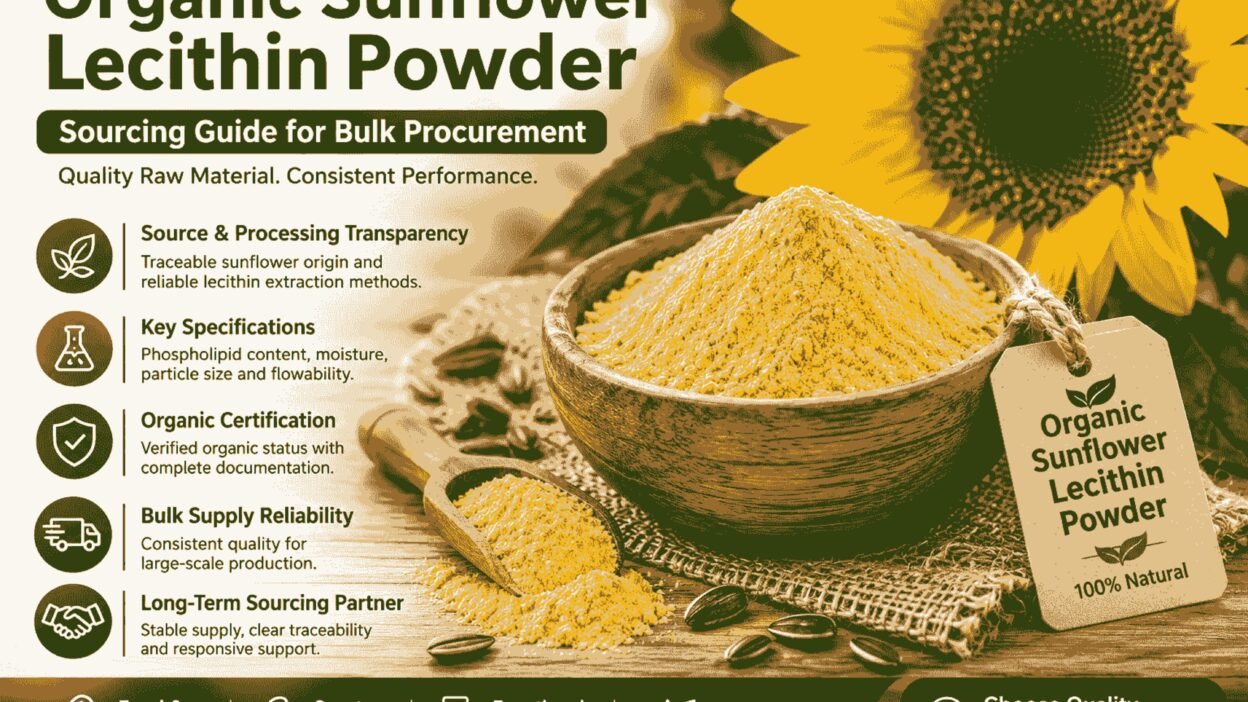
A common problem in ingredient sourcing appears after the purchase order has already been approved: the material meets the specification, but it does not behave exactly like the sample used during formulation. With sunflower lecithin, small differences in moisture, particle size, phospholipid profile, processing conditions, and storage can affect dispersion and handling. For manufacturers, this makes sourcing Organic Sunflower Lecithin Powder less about finding a compliant ingredient and more about finding a repeatable one.
Define the Functional Requirement First
In most sourcing scenarios, lecithin should be selected according to its job in the formulation. Sunflower lecithin contains phospholipids that provide surface-active properties, making it useful for emulsification, wetting, dispersion, and processing support.
The required characteristics depend on the final application. A powdered beverage may require fast and uniform dispersion. A nutritional blend may prioritize flow and blend uniformity. Bakery, confectionery, and other food applications can have different requirements around interaction with fats, moisture, and processing temperatures.
This is why Sunflower Lecithin Powder should not be qualified solely by a single phospholipid value. Physical characteristics can be equally important once the ingredient enters a commercial production environment.
Organic Sourcing Adds Another Layer of Qualification
When purchasing Organic Sunflower Lecithin Powder, procurement teams need to verify more than the word “organic” on a specification sheet. The applicable organic certificate should cover the ingredient and relevant processing operation, with traceability maintained through the supply chain.
Buyers should also clarify the sunflower source, processing location, country of origin, and whether carriers or processing aids are involved. These details can affect finished-product labeling and may become important during customer or certification audits.
For conventional material, the certification requirements may be different, but core quality controls remain. Identity, microbiological limits, heavy metals, pesticide controls where applicable, allergen information, GMO status, and shelf-life conditions should all be defined before approval.
The Sample Is Not the Whole Story
One of the more useful lessons from commercial sourcing is that a successful sample does not necessarily prove lot-to-lot consistency.
A lecithin powder may disperse efficiently during a small-scale laboratory test because the operator can control mixing speed, temperature, addition sequence, and hydration time. Commercial equipment introduces different shear conditions, ingredient loads, and processing times.
Moisture can influence flow and caking. Particle-size distribution can affect dispersion and blend uniformity. Bulk density can affect batching and packaging calculations. These characteristics may not be obvious from appearance alone.
For that reason, R&D teams should evaluate prospective Sunflower Lecithin Powder using conditions that closely resemble actual production. Testing multiple lots is even more useful because it helps distinguish a good individual sample from reliable supplier performance.
Build the Specification Around Production
A practical procurement specification can include phospholipid profile, phosphatidylcholine content where relevant, moisture, particle-size distribution, bulk density, microbiological limits, heavy metals, and identity testing.
Documentation should extend beyond the COA. Depending on the application and market, buyers may request an organic certificate, allergen declaration, GMO statement, country-of-origin documentation, safety data, processing information, and storage recommendations.
It is also worth asking how the supplier manages retained samples and lot traceability. If a commercial batch produces unexpected formulation behavior, the ability to trace the material back through production and compare it with an approved reference sample can save significant investigation time.
Procurement Risks Often Hide Outside the Specification
Price is only one part of the sourcing calculation. A lower-cost lecithin powder can become expensive if it creates additional testing, blending adjustments, production downtime, or rejected batches.
Supply continuity also deserves attention. Procurement teams should understand standard lead times, minimum order quantities, packaging formats, production capacity, storage requirements, and contingency arrangements. Organic supply chains may require additional planning when certification continuity is essential to a finished product.
Warehouse conditions should not be overlooked either. Lecithin powders need appropriate protection from moisture and excessive heat during transportation and storage. Poor handling can affect physical properties even when the ingredient initially met its specification.
A More Reliable Sourcing Decision
The strongest qualification process connects procurement, quality, and R&D from the beginning. Organic Sunflower Lecithin Powder should be assessed for certification and traceability, while its functional behavior is verified under realistic formulation and processing conditions.
For conventional Sunflower Lecithin Powder, the same principle applies: technical documentation establishes suitability, but repeatability establishes confidence.
In commercial manufacturing, the best sourcing decision is rarely the ingredient with the longest specification sheet or the lowest quoted price. It is the material that can be received, stored, blended, processed, and formulated with predictable results across successive lots. That consistency is what ultimately turns an ingredient approval into a dependable supply decision.