
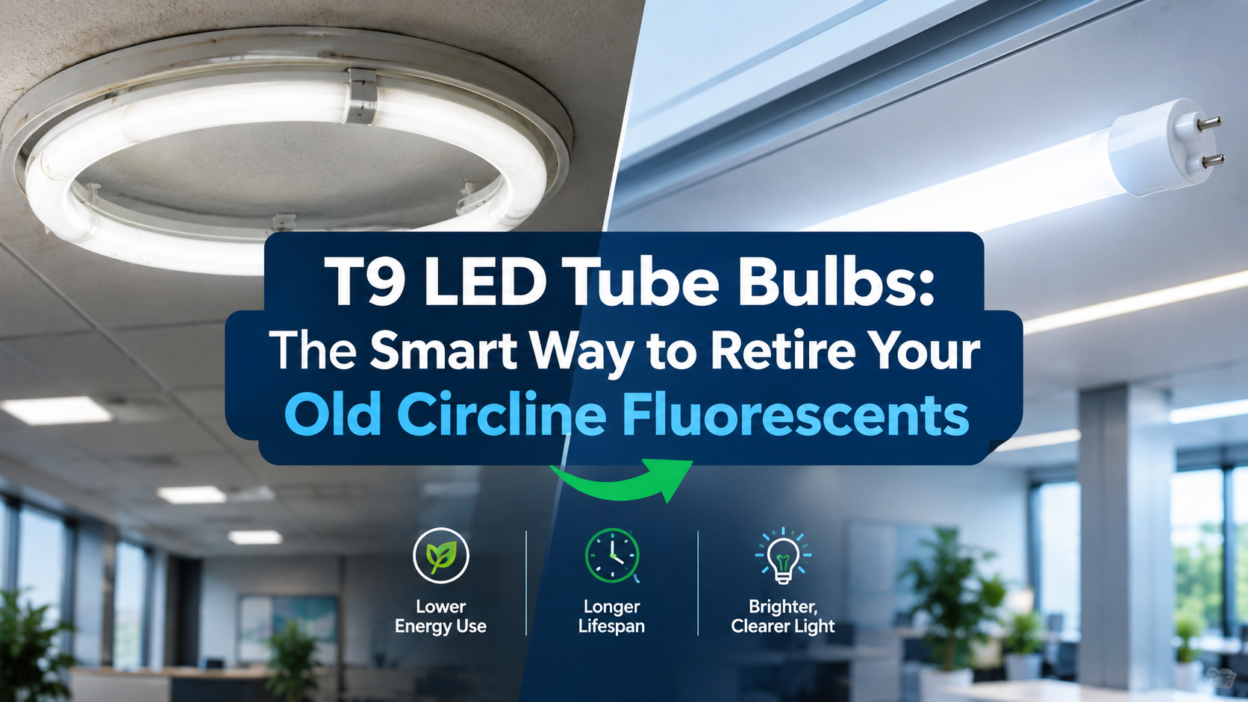
If you’ve ever squinted at a flickering circline fixture in a bathroom vanity, hallway, or kitchen ceiling, there’s a good chance a T9 fluorescent tube is to blame. These round tubes were everywhere for decades, but they’re aging out fast and for good reason. LED replacements now do the same job with a fraction of the energy use, none of the flicker, and none of the mercury. If you’re shopping for a reliable, modern option, the T9 Tube LED Bulb from Circ Lighting is worth a look before you make the switch.
What Exactly Is a T9 Tube?
The “T” in T9 simply stands for tubular, and the “9” refers to the tube’s diameter in eighths of an inch so a T9 measures roughly 1 and 1/8 inches across. Unlike the straight T8 or T5 tubes you’ll find in garages and offices, T9 bulbs are bent into a circle, which is why they’re often called circline bulbs. Instead of a screw-in base, they connect through a pin base, usually a 4-pin G10q connector, and sit inside round fixtures rather than long linear housings.
Because of that shape, T9 tubes have a narrower list of uses than their linear cousins. You’ll mostly find them in ceiling fan light kits, surface-mount fixtures, magnifier lamps, and vanity lighting anywhere a designer wanted a soft, evenly distributed glow without visible hot spots.
Why Fluorescent T9 Tubes Are Falling Out of Favor
Fluorescent circline tubes were a clever design for their era, but they carry some real downsides:
- They contain mercury, which complicates disposal.
- They flicker as they age, which can cause eye strain and headaches.
- They lose brightness steadily over their lifespan, so a “working” bulb may be putting out far less light than it should.
- They’re slow to reach full brightness in cold rooms.
None of that is a problem with an LED equivalent, which is why so many homeowners and electricians are quietly phasing fluorescent circline tubes out room by room.
Why an LED T9 Tube Makes Sense
Lower Energy Use, Lower Bills
LED technology converts a much larger share of the electricity it draws into visible light rather than heat. In practical terms, that usually means an LED T9 bulb needs noticeably fewer watts than a fluorescent tube to produce comparable brightness which adds up over months of daily use, especially in fixtures that stay on for hours at a time, like hallway or bathroom lighting.
A Longer, More Predictable Lifespan
Where a fluorescent circline might need replacing every couple of years, a well-made LED version is built to last many times longer. That’s a meaningful difference if your fixture is in an awkward spot: a stairwell ceiling, a fan blade housing where changing a bulb means dragging out a ladder.
Instant, Flicker-Free Light
LEDs reach full brightness the moment they’re switched on. There’s no warm-up delay and no flicker to worry about, which matters more than people expect, particularly in spaces used for close work like reading or grooming.
Consistent Brightness Over Time
Instead of gradually dimming the way fluorescent tubes do, LED tubes tend to hold their brightness much more consistently across their working life, so the light in your fixture on day 1,000 looks close to the light on day one.
What to Check Before You Buy
Fixture Compatibility
Confirm your fixture uses a standard 4-pin G10q base and check the physical diameter of your existing tube against the replacement T9 circline bulbs commonly come in a few standard diameters, so it’s worth measuring your old tube edge to edge before ordering.
Color Temperature
Color temperature, measured in Kelvin, determines whether the light reads warm and yellow-toned or cool and white. Warmer temperatures (around 2700K–3000K) suit living rooms and bedrooms, while cooler temperatures (4000K–5000K) work well in kitchens, bathrooms, and task-oriented spaces.
Ballast Compatibility
Some LED circline tubes are designed to work with your existing ballast (plug-and-play), while others require ballast bypass wiring. If you’re not comfortable rewiring a fixture, look specifically for a plug-and-play option.
Dimmability
Not every LED T9 tube is dimmable, so if your fixture is on a dimmer switch, that’s a spec worth confirming before checkout rather than after installation.
Making the Switch
Swapping a fluorescent circline for an LED version is one of the simplest upgrades you can make to a home’s lighting, and it’s usually a same-afternoon project. If you’re ready to stop replacing flickering fluorescent tubes and want a dependable, energy-efficient option, the T9 Tube LED Bulb is a solid place to start your search.