
Getting commercial real estate financing isn’t always straightforward. Traditional lenders may focus heavily on personal income, tax returns, credit history, and other financial metrics. Asset based lending takes a different approach by placing significant emphasis on the value and revenue-generating potential of the asset securing the loan.
For real estate investors and property owners, this approach can provide another financing option when a conventional loan doesn’t fit the transaction. Marques Commercial Capital offers asset-based financing for qualifying multifamily, mixed-use, investment, and commercial properties.
What Is Asset Based Lending?
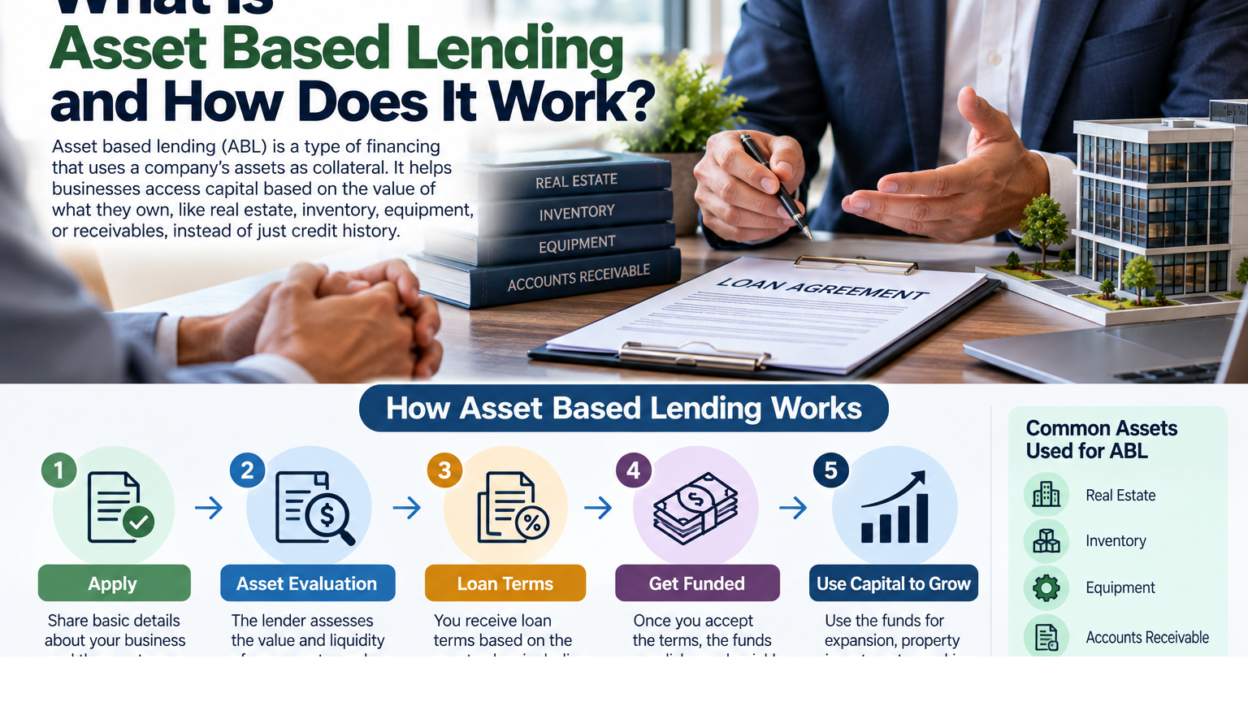
Asset based lending is a financing structure where the lender considers the value of specific assets when determining how much financing may be available.
In commercial lending, collateral can include accounts receivable, inventory, equipment, real estate, or other assets, depending on the loan structure. The OCC explains that the borrowing base can determine the amount available under an asset-based facility, with advance rates reflecting the quality and liquidity of the underlying collateral.
For real estate investors, the property itself can play a major role in the financing analysis.
This can be useful when the property has strong value or income potential but the borrower doesn’t fit neatly into a traditional lending model.
How Does Asset Based Lending Work?
The process usually starts with an evaluation of the asset being financed.
For a real estate transaction, the lender may review:
- Property value
- Rental income
- Existing leases
- Property type
- Location
- Operating expenses
- Loan-to-value ratio
- Borrower’s experience
- Proposed use of funds
- Exit or repayment strategy
The lender then determines the potential loan amount and terms based on the overall transaction.
The exact underwriting process varies by lender and loan program. Marques Commercial Capital states that its asset-based approach can focus on the property’s value and revenue-generating potential.
A Simple Example
Imagine an investor wants to purchase a multifamily property valued at $2 million.
The investor may have strong real estate experience and a property with established rental income, but their personal income documentation may not fit a conventional underwriting model.
An asset-based lender may place greater emphasis on the property, its income potential, and the overall transaction structure.
The actual loan amount, interest rate, fees, LTV, and qualification requirements would depend on the specific transaction.
Asset Based Lending vs. Traditional Lending
The biggest difference is where the lender places its emphasis.
| Factor | Asset Based Lending | Traditional Lending |
| Primary focus | Asset and transaction | Borrower financial profile |
| Collateral | Important | Important |
| Property value | Can be central | One part of underwriting |
| Property income | Often important | Often considered |
| Personal income | May receive less emphasis in some programs | Often significant |
| Flexibility | Depends on program | Generally standardized |
| Underwriting | Transaction-specific | Program-driven |
This doesn’t mean asset based lending ignores the borrower. Lenders still evaluate repayment capacity, collateral quality, transaction structure, and other risks.
The OCC notes that sound ABL underwriting includes credit analysis, liquidity assessment, borrowing-base controls, collateral monitoring, and appropriate advance rates.
What Types of Properties Can Use Asset Based Lending?
Asset-based commercial financing may be available for several property categories, depending on the lender and program.
These can include:
- Multifamily properties
- Mixed-use properties
- Office buildings
- Retail properties
- Warehouses
- Self-storage facilities
- Automotive properties
- Other commercial real estate
Marques Commercial Capital lists multifamily, mixed-use, investment, and commercial properties among the property types it finances.
Each property is different. A lender may consider its location, condition, tenant profile, income, value, and intended use.
How Does a Multifamily Bridge Loan Fit In?
A multifamily bridge loan is a short-term financing option designed for qualifying multifamily transactions.
Bridge financing can be useful when an investor needs temporary financing before moving into longer-term financing or reaching another stage of an investment strategy.
For example, an investor may purchase an apartment property that needs improvements or operational changes. A short-term loan may provide financing while the investor works toward stabilization or another long-term financing solution.
Marques Commercial Capital offers multifamily financing and states that a multifamily bridge loan may be available for qualifying transactions.
A bridge loan isn’t automatically the same thing as asset based lending. They describe different aspects of financing. “Asset based” describes an underwriting approach, while “bridge” generally describes the purpose or term of the financing.
When Might Asset Based Lending Be Considered?
Asset based lending may be worth exploring when:
1. The Property Has Strong Value
A property with substantial value may provide meaningful collateral for a financing transaction.
2. The Property Generates Revenue
Rental income and other property revenue can help demonstrate the asset’s financial potential.
3. Conventional Financing Doesn’t Fit
Some borrowers may have transactions that don’t fit standard lending guidelines.
4. The Investor Needs Flexible Financing
Certain alternative programs can provide different structures for acquisitions, refinancing, or other commercial real estate needs.
5. The Borrower Is Purchasing an Investment Property
Asset-based programs can be relevant to investors purchasing income-producing properties, subject to the lender’s requirements. Marques Commercial Capital describes its financing as available for qualifying investment properties, including multifamily, mixed-use, commercial, and 1–4 unit properties.
What Does a Lender Look At?
Asset based lending doesn’t mean “no underwriting.”
A lender still needs to understand the transaction and determine whether the collateral provides sufficient support.
Common considerations can include:
Property value
An appraisal or other valuation process may be used to establish the property’s value.
Cash flow
Rental income and operating performance can help demonstrate the property’s ability to support the financing.
Loan-to-value ratio
The lender may compare the requested loan amount with the property’s value.
Property condition
Repairs, deferred maintenance, occupancy, and other physical factors can affect underwriting.
Borrower experience
Real estate experience can be relevant, especially for investment transactions.
Exit strategy
For short-term financing such as a bridge loan, the lender may want to understand how the loan will ultimately be repaid or refinanced.
What Documents May Be Required?
Requirements vary by lender and program, but a commercial real estate financing application may involve:
- Property information
- Purchase contract, if applicable
- Rent roll
- Operating statements
- Existing loan information
- Property tax information
- Insurance information
- Financial statements
- Bank statements
- Entity documents
- Personal identification
- Appraisal or valuation information
A lender may request additional documentation after reviewing the initial submission.
Preparing these documents early can make the underwriting process more organized.
Benefits and Considerations
Asset based lending can offer flexibility, but it isn’t automatically the right structure for every borrower.
Potential advantages
- Greater focus on the underlying asset
- Alternative to some conventional financing structures
- Potential flexibility for investment properties
- May accommodate certain nontraditional borrower profiles
- Can be used with different commercial property types
Important considerations
- Interest rates and fees vary
- Loan-to-value requirements differ
- Collateral is at risk if the borrower defaults
- Short-term loans require a clear repayment strategy
- Property performance can affect underwriting
- Program availability depends on the transaction
The OCC emphasizes that collateral quality, liquidity, advance rates, monitoring, and repayment considerations remain important in asset-based lending.
Asset Based Lending and Real Estate Investors
Real estate investors often evaluate financing based on more than the borrower’s personal financial profile.
The property itself can be an important part of the financing equation.
For example, an investor may be purchasing a multifamily building with existing tenants and predictable rental income. Another investor may be acquiring a commercial property that requires improvements before it reaches its full income potential.
In both situations, the financing structure should match the property’s characteristics and the investor’s strategy.
An asset based lending program may provide an alternative when the transaction doesn’t align with a standard mortgage product.
Asset Based Lending for Multifamily Properties
Multifamily properties can be particularly relevant because they generate rental income from multiple units.
A lender may review:
- Number of units
- Occupancy
- Rental rates
- Operating expenses
- Net operating income
- Property condition
- Market location
- Current debt
- Proposed loan amount
Marques Commercial Capital offers multifamily financing for properties with five or more units and states that terms and qualification requirements depend on the individual transaction.
For investors considering a multifamily bridge loan, it can also be useful to define the reason for the short-term financing and the expected path to repayment before applying.
Frequently Asked Questions
What is asset based lending?
Asset based lending is a financing approach that relies significantly on the value of assets used as collateral. Depending on the program, the assets may include real estate, receivables, inventory, equipment, or other qualifying assets.
Is asset based lending only for businesses?
No. Asset-based structures can be used in different types of financing. In commercial real estate, certain programs can focus heavily on the value and revenue potential of the property.
What is a multifamily bridge loan?
A multifamily bridge loan is generally a short-term financing option for qualifying multifamily properties. It may be used when an investor needs temporary financing before obtaining longer-term financing or completing an investment strategy.
Can asset based lending be used for multifamily properties?
Yes, depending on the lender and program. Multifamily properties can be evaluated based on factors such as property value, rental income, occupancy, and the overall transaction.
Does asset based lending require collateral?
Yes. Asset-based lending is built around collateral. The specific collateral and advance structure depend on the financing program and transaction.
Is asset based lending the same as a bridge loan?
No. The terms describe different things. Asset based lending generally refers to an approach that emphasizes collateral, while a bridge loan generally refers to short-term financing designed to bridge a financing need.
What should I prepare before applying?
Gather property information, financial records, rent rolls, operating statements, existing debt details, purchase documents if applicable, and information about your intended use of the funds. The lender may request additional documentation during underwriting.
Final Thoughts
Asset based lending gives borrowers another way to approach commercial financing by placing significant attention on the underlying asset and its financial potential.
For real estate investors, the structure can be relevant for multifamily, mixed-use, and other commercial properties. A multifamily bridge loan can serve a different purpose when short-term financing is needed for a qualifying property.
The right structure depends on the property, loan amount, borrower profile, financials, intended use of funds, and repayment strategy. Comparing the available terms and understanding the collateral requirements before committing to financing can help you make a more informed decision.