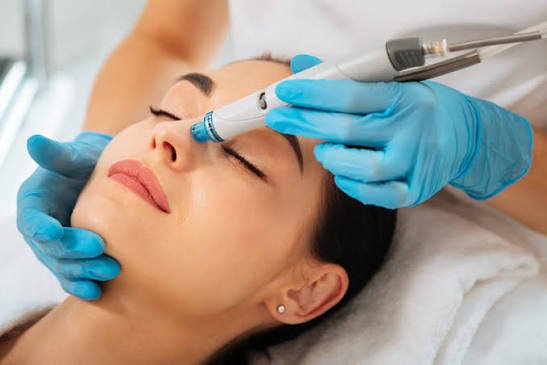
You’ve probably seen the price range and wondered why one clinic charges ₹3,500 for a HydraFacial and another quotes ₹9,000 for what sounds like the same thing. It’s not a random mark-up. A HydraFacial is really three treatments stitched into one session, and the price tag usually reflects exactly which parts you’re getting and how many extras have been added on top. Once you know what’s actually happening under the hood, comparing quotes stops being a guessing game.
It’s Not One Treatment, It’s Three, Done Back to Back
Think of a HydraFacial less like a single facial and more like a three-course meal where each course does a different job, and skipping a course changes both the result and the price.
Course one: cleanse and peel
A gentle exfoliating solution lifts away dead surface skin and loosens whatever’s sitting in your pores: sweat, oil, and the day’s grime. This is the step that makes everything after it work better, because products can’t absorb properly into skin that’s still coated in yesterday’s buildup.
Course two: extract and hydrate
This is the part people actually notice: a vortex-style device suctions out blackheads and debris while simultaneously flushing in a hydrating solution. It’s oddly satisfying to watch and genuinely effective, because it’s doing two opposite jobs, removing and replenishing, in the same motion instead of one after the other.
Course three: fuse and protect
The final step locks in antioxidants and peptides suited to your skin’s specific needs that day, brightening, firming, calming, and sealing it all in. This is also where most of the price variation between clinics actually comes from.
Where the Rest of the Price Comes From
The add-ons, or “boosters,”
Clinics typically offer optional boosters layered onto that third step; ones targeting pigmentation, fine lines, or acne-prone skin are common examples. Each booster adds cost because it’s a genuinely different formulation being used, not a marketing label on the same product. This is also the single biggest reason two HydraFacial quotes can differ by a few thousand rupees for what looks identical on the menu: one includes a booster, and one doesn’t.
LED light therapy, if it’s included
Some clinics fold in a few minutes of LED light at the end, calming blue for acne-prone skin and red for general skin health, which adds equipment cost and therefore price. It’s worth asking specifically whether this is included or billed separately, since menus don’t always spell it out.
Who’s actually doing the treatment?
A session performed by an experienced aesthetician or under closer clinical supervision tends to cost more than one run by newer staff, and that’s not just a name premium. Extraction, in particular, is easy to do too aggressively, and an experienced hand knows when to stop, which matters more for your skin than it sounds.
How often do you need it?
A single HydraFacial gives a visible, same-day glow, but it fades. Most dermatologists suggest a session every three to four weeks for an ongoing concern like congestion or dullness, which means the real cost to budget for is the monthly habit, not the one-time session. Compared to something like a skin laser treatment price, which is usually a defined course with an end point, HydraFacial sits in a different category entirely; it’s maintenance, not a fix, and pricing it as a recurring cost gives you a far more honest picture than the one-session number alone.
What a Fair Price Actually Buys You
A reasonable HydraFacial treatment price should include a proper skin assessment before the session starts, not just the three steps run on autopilot. It should include a professional actually adjusting suction strength and booster choice to your skin that day, rather than a fixed routine applied to everyone. And it should come with a clear answer when you ask what’s included versus what’s an extra charge; vagueness on this point is usually where people end up overpaying without realising it.
A Realistic Look at Results
HydraFacial is genuinely good at what it does: immediate glow, visibly clearer pores, and smoother texture, but it’s not a substitute for treatments that address deeper concerns like established pigmentation or fine lines; those usually need a different conversation entirely. Mild redness for an hour or two afterward is normal and not a sign that anything went wrong. It’s also not the right choice for very reactive or currently inflamed skin, active acne breakouts in particular, where a dermatologist may recommend calming things down first.
A De-Identified Case
A professional in her early 30s came in wanting a “quick fix” glow before a family event and was surprised by the price difference between the basic version and the one with a brightening booster. Once the actual concern—some dullness and mild congestion from a busy work schedule—was properly assessed, the recommendation was the basic three-step treatment without the booster, since her skin didn’t need what the add-on was designed for. The lower-priced option was the right one for her, which isn’t always the case, but it illustrates the point: the correct price is the one that matches your actual skin, not the most expensive menu item.
Questions Worth Asking Before You Book
- Which of the three core steps are included, and is anything skipped to hit a lower price?
- Which booster, if any, is recommended for my specific skin concern, and why?
- Is LED therapy included or an add-on?
- How often would you realistically recommend this for my skin?
- What’s included in the quoted price versus billed separately?
Key Takeaways
- A HydraFacial is three distinct steps: cleanse and peel, extract and hydrate, and fuse and protect, and price differences usually trace back to which boosters and extras are layered onto that last step.
- The person performing the treatment and how carefully extraction is done matter more to your results than most people realize.
- Because results fade over three to four weeks, the honest way to budget is as a recurring cost, not a one-time session.
- The right price is the one that matches what your skin actually needs that day, not the most expensive option on the menu.
Have you ever been upsold a booster you’re not sure you actually needed? It’s worth asking your clinic to explain the “why” behind every add-on before you say yes next time.