
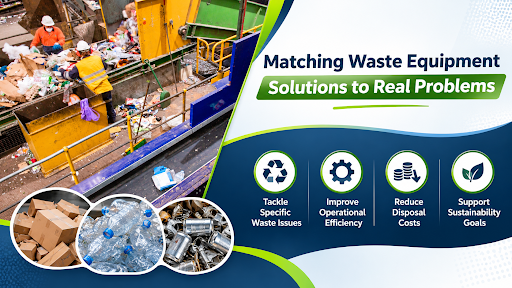
When a recycling line underperforms, the cause is rarely the whole plant, and usually one stage that does not suit the material arriving at it. Choosing waste equipment solutions works best when you start from the problem, such as contamination, low throughput, or poor bale quality, and then pick the machine that addresses it. This article takes that approach, linking common symptoms in industrial waste management to the equipment that treats them. It is written for plant managers and operators who want to improve an existing line or plan a new one.
Problem: Bags and Bulky Loads
Mixed commercial waste often arrives in sealed bags or as large awkward items that jam downstream equipment. In waste equipment solutions, bag openers release the contents without crushing recyclables, so later stages see loose material. Primary shredders then break bulky items into pieces that screens and conveyors can handle, while secondary shredders refine the output to a defined size when plastics, fuel, or fine sorting is the goal.
Problem: Mixed Sizes and Weights
A stream that is a blend of fines, flat pieces, and heavy objects cannot be sorted accurately until it is separated into groups. Disc screens and trommels split material by size. Ballistic separators distinguish flat, light items such as paper and film from rolling items such as bottles and cans. Windshifters use controlled airflow to lift light fractions away from heavier ones. Together, these waste equipment solutions turn a messy flow into several streams that are easier to process.
Problem: Metals in the Wrong Place
Ferrous and non-ferrous metals damage equipment and reduce the value of other fractions if they stay in the stream. Magnetic separators pull out steel and iron, and eddy current separators eject aluminium and other non-ferrous pieces. Placing a magnet before a shredder protects knives, and a second unit later cleans the product.
Problem: Purity and Colour
Buyers of recycled plastic, paper, and glass pay for clean, consistent material. Among waste equipment solutions, optical sorters analyse items on a fast conveyor, identify their composition and colour, and use air jets to eject the target material. They are especially useful at the end of a line for plastics such as PET, HDPE, and LDPE, and for glass cullet that needs separating by colour and quality. Better purity opens access to higher-priced markets.
Problem: Storage and Transport Costs
Loose recyclables take up space and make trucks leave part-empty. Balers, the workhorse of waste equipment solutions for storage, compress cardboard, paper, and plastics into dense bales, and bale wrappers seal them so they stay dry and intact during storage and transport. Dense, protected bales cut haulage costs and keep material value from falling because of moisture damage.
Problem: Inconsistent Performance
Even a well-designed industrial waste management line drifts as feedstock changes. Electrical control systems tune each stage and keep the plant operating safely. Artificial intelligence adds another layer by analysing sorting and processing data, spotting declines in recovery, and helping operators decide what to change.
Material-Specific Lines
Different streams combine waste equipment solutions in different ways. A cardboard and paper line focuses on screening, sorting, shredding, and baling. A plastic line adds washing and granulating. Skip bin recycling for construction and demolition recovers soils, aggregate, metals, wood, and concrete, and the light remainder can be processed into solid recovered fuel.
Selecting a Partner
When evaluating waste management solutions, ask whether the supplier designs the complete line or only sells machines. Integrated design reduces interface problems where one stage hands over to the next. Check local service capability, spare parts, and commissioning support, and look for equipment built for low maintenance. A supplier that offers design, manufacture, and installation under one roof can simplify accountability.
Conclusion
Matching equipment to the real fault is cheaper than replacing a whole plant, and it usually delivers faster gains. Begin by measuring where your line loses material, purity, or time. At OGTEC, we design, manufacture, and install complete recycling lines, partnering with Lindner Recyclingtech, Spaleck, Binder+Co, and Cross Wrap. Walk your line from the tipping floor to the bale and note the first stage that struggles.