The first shipment is rarely where ingredient sourcing problems begin. They usually start earlier, when a procurement team approves a sample without defining which characteristics must remain consistent when the order moves from kilograms to pallets. With mushroom powders, differences in cultivation, drying, milling, moisture, and particle size can become noticeable only after an ingredient enters routine manufacturing.
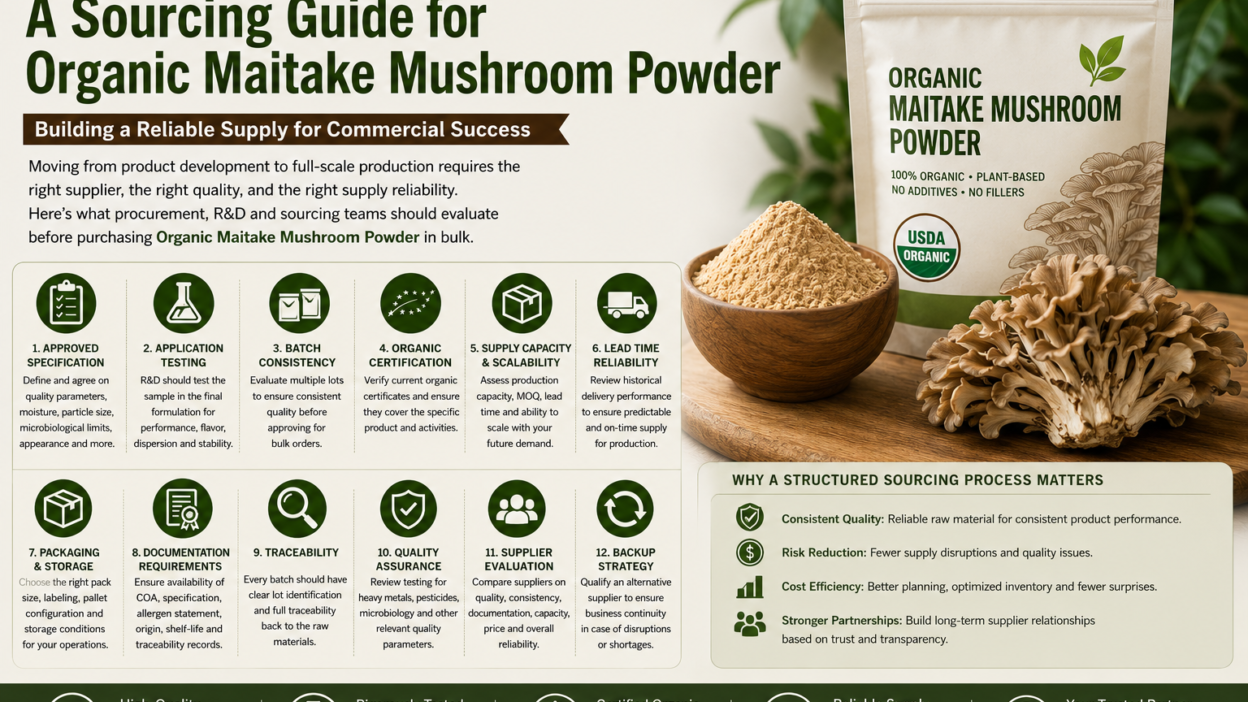
For teams evaluating Organic Maitake mushroom Powder, the key sourcing question is therefore straightforward: can the supplier reproduce the same technical profile across multiple lots?
Define the Ingredient Before Comparing Suppliers
Maitake (Grifola frondosa) is an edible mushroom used in food, nutraceutical, and functional ingredient applications. From a procurement perspective, however, the common ingredient name does not provide enough information for supplier comparison.
A sourcing specification should identify the mushroom material used, particularly whether the powder is made from fruiting bodies or mycelium. Cultivation substrate, origin, harvesting practices, drying process, and milling conditions can also affect the final ingredient.
Organic status should be independently supported by appropriate certification. Buyers should check that the certificate applies to the actual ingredient and supply chain rather than assuming that an organic product description is sufficient documentation.
Physical Properties Can Affect Production
A common formulation oversight is focusing on composition while giving less attention to how the powder physically behaves.
Moisture and water activity can influence storage performance and caking. Particle-size distribution can affect blending, dispersion, powder flow, and automated filling. Bulk density can also become important when equipment has been calibrated around a particular raw-material profile.
For example, an Organic Maitake mushroom Powder that performs well in a small dry blend may require process adjustments if the commercial material has a substantially different particle-size distribution or density.
Sensory characteristics also need consideration. Maitake has a distinct earthy mushroom profile that may become noticeable at higher inclusion levels. R&D teams should evaluate aroma and flavor within the intended finished formulation rather than making decisions from the raw powder alone.
What to Request With Organic Maitake Mushroom Powder Bulk
When purchasing Organic Maitake mushroom Powder Bulk, the COA should be treated as part of a broader technical package.
Depending on the application, specifications may include identity, moisture, ash, particle size, microbiological limits, heavy metals, pesticide residues, and other relevant contaminants. If a buyer requires a particular nutritional or compositional marker, the testing method should be stated clearly.
This is especially important when comparing different suppliers. Two COAs can show similar values while using different analytical methods, making the numbers less useful for direct qualification.
Supporting documentation may include organic certification, Non-GMO documentation, allergen statements, Kosher or Halal certification, SDS, country-of-origin details, and food-safety documentation. The required package should be established before commercial qualification rather than assembled after an order is placed.
Test Multiple Lots, Not Just One Sample
One of the most useful sourcing practices is to treat lot-to-lot consistency as a qualification criterion.
Mushroom cultivation can be affected by growing conditions, substrate composition, harvest timing, drying parameters, and storage. Consequently, a supplier may provide a technically compliant ingredient that still shows practical variation between batches.
Before approving significant Organic Maitake mushroom Powder Bulk volumes, procurement and R&D teams should compare more than one production lot whenever possible. Examine color, aroma, flowability, caking, bulk density, and dispersion in addition to laboratory results.
These observations can uncover issues that a conventional COA may not capture. A powder that consistently cakes during storage, for instance, can create more manufacturing disruption than a small difference in a laboratory measurement.
Match the Ingredient to the Application
Another important decision is whether the formulation actually requires a whole-mushroom powder or an extract. These formats should not be selected solely according to their headline analytical values.
Whole-mushroom powder may be appropriate when the formulation calls for the broader mushroom material. A concentrated extract may be better suited to applications requiring a more defined or concentrated fraction.
The decision should consider dosage, sensory impact, processing conditions, analytical specifications, regulatory requirements, and cost-in-use.
Ultimately, successful sourcing of Organic Maitake mushroom Powder is a quality-management exercise as much as a purchasing decision. The strongest supply programs are built around clear ingredient identity, documented processing, appropriate testing, and evidence of repeatability. Once those factors are established, price comparisons become far more meaningful because procurement teams are comparing genuinely equivalent materials rather than powders that only share the same product name.