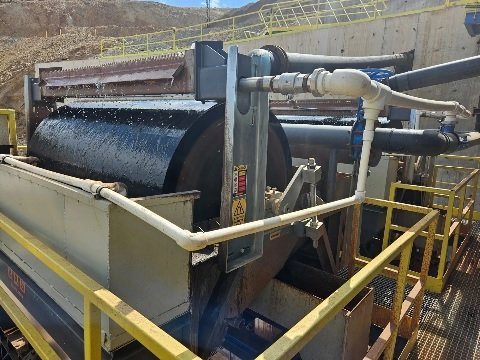
Magnetic separation is an important process or stage in mineral processing that recovers valuable magnetic minerals from ore and removes unwanted magnetic impurities from non-magnetic materials. Magnetic drum separators are used for this process.
However, mineral processing plants often face an important decision: should they use a wet magnetic drum separator or a dry magnetic drum separator?
The answer depends on the mineral’s magnetic properties, particle size, moisture content, processing stage and production requirements. In this guide, let’s understand the difference between a wet drum separator and a dry magnetic separator.
What Is a Magnetic Drum Separator?
A magnetic drum separator is a machine that uses a rotating drum and a magnetic field to separate magnetic materials from non-magnetic materials.
As the feed passes over the drum, magnetic particles are attracted to the magnetic field and retained on the drum surface. Non-magnetic particles follow a different path and are discharged separately. The captured magnetic material is then released at a designated discharge point.
Understanding Dry Magnetic Drum Separators
Dry magnetic drum separators process mineral material without adding water during separation. The feed is generally expected to be dry and free-flowing so that particles can move across the drum in a controlled manner.
Applications of Dry Magnetic Drum Separators
- Pre-concentration of suitable ores before further processing.
- Removing magnetic impurities from dry mineral products.
- Processing operations where water availability is limited.
- Separating dry, free-flowing materials in mineral processing plants.
Advantages of Dry Magnetic Separation
- Useful in locations with limited water availability
- Does not require process-water circulation or slurry-handling equipment
- Is good for early-stage separation
Limitations of Dry Magnetic Drum Separators
- Depends on highly consistent material flow
- Particles can stick together or form clumps
- Fine particles can be difficult to separate
Understanding Wet Magnetic Drum Separators
Wet magnetic drum separators process minerals in the form of a slurry, which is a mixture of solid particles and liquid, usually water.
The slurry is fed into the separator, where magnetic particles are attracted to the drum’s magnetic field.
Applications of Wet Magnetic Drum Separators
- Recovering magnetite from mineral slurries.
- Concentrating strongly magnetic minerals.
- Processing fine and classified mineral feed.
- Cleaning magnetic concentrates to improve product quality.
- Separating magnetic minerals from non-magnetic gangue in suitable slurry circuits.
Advantages of Wet Magnetic Separation
- Effective handling of fine particles
- Suitable for grinding circuits
- Supports mineral recovery and improves concentration quality
Limitations of Wet Magnetic Drum Separators
- It requires water and equipment for slurry handling
- The process produces wet concentrate and tailings
- Wet separation might not be the right choice for every ore containing moisture
Which Magnetic Drum Separator Is Better for Mineral Processing?
To choose the right magnetic drum separator for your mineral processing application, you should evaluate your requirements to understand which one fits your process best.
- When Dry Magnetic Separation May Be Better
Dry magnetic drum separation may be suitable when the feed is naturally dry or can be dried economically, the material flows consistently, and the process aims to remove magnetic material before further treatment.
- When Wet Magnetic Separation May Be Better
Wet magnetic drum separation may be more suitable when the mineral is processed as a slurry, especially after grinding and classification.
For example, magnetite beneficiation commonly involves grinding the ore to liberate the magnetic mineral, followed by wet magnetic separation to recover it from the slurry.
- Consider the Mineral’s Magnetic Properties
Magnetic response is one of the most important factors in separator selection. Magnetite responds strongly to magnetic fields and is commonly processed using low-intensity magnetic separation. Other minerals, such as hematite, may respond more weakly and could require high-intensity magnetic separation or a different beneficiation approach.
Magnetic Drum Separator Solutions from Electro Flux Equipments
Electro Flux Equipments is among the leading manufacturers of magnetic drum separators in India. They provide a wide range of products such as an excavator electromagnet, vibratory equipment, magnetic equipment, and machinery spare parts.
Their products are constructed of robust materials to withstand working environments and heavy use. Furthermore, they also provide installation, technical support, and after-sales services.
Conclusion
Wet and dry magnetic drum separators are used for different purposes. Dry drum separators can be of value when you’ve got a dry, free-flowing feed, for early-stage upgrading and in applications where you’re trying to cut down on water usage. Wet drum separators are generally the separator of choice for slurry applications and are particularly well suited to the recovery of strongly magnetic minerals (e.g. magnetite) after grinding and classification.
If you are wondering which drum separator to choose for your application, get in touch with Electro Flux Equipments. They customise the product to suit the client’s requirements.