
Social change is often associated with laws, campaigns, demonstrations, and political speeches. Yet it also begins in quieter places: a person recognizing an experience in someone else’s words or seeing a familiar issue from a new perspective. Poetry can create these moments.
A poem cannot rewrite a law or repair an institution on its own. What it can do is change the way people understand the lives affected by those systems. Poetry brings public issues into human focus. It turns broad subjects such as inequality, migration, violence, discrimination, and freedom into experiences a reader can feel and remember. That emotional connection is one reason poetry has remained closely tied to movements for justice.
Poetry Makes Injustice Personal
Statistics are necessary for understanding the scale of a problem, but numbers rarely show what it feels like to live through it. A report may record how many people have been displaced, underpaid, silenced, or denied an opportunity. A poem can reveal the fear of leaving home, the strain of working without security, or the exhaustion of repeatedly having to prove one’s worth.
Poetry does not replace research. Evidence explains the scope and pattern of injustice, while poetry can show its personal consequences. Together, they make an issue harder to treat as distant or abstract.
A poem may focus on a single room, conversation, object, or memory. Through that small detail, it can expose a much larger system. An empty chair might represent forced migration. A workplace uniform could reveal invisible labor. A family story may show how discrimination moves from one generation to another. The poem gives readers an entry point into a subject that might otherwise feel too large to grasp.
Giving Language to Experiences That Are Often Silenced
Injustice is sustained partly through silence. People may fear punishment, disbelief, or rejection. Others may sense that something is wrong but lack the language to describe it. Poetry creates room for those experiences to be named.
The form does not demand a formal argument. A writer can use imagery, rhythm, fragments, repetition, or direct statement. She can approach a painful subject gradually or describe it without explaining every detail. This flexibility is especially valuable when ordinary language feels inadequate.
When a poem names a dismissed experience, it gives that experience a visible place in the public record. Some readers may feel recognized; others may understand why the issue matters. A private truth can become a shared conversation.
Challenging the Stories Society Accepts
Every society tells stories about who deserves power, whose work matters, what success looks like, and which suffering should receive attention. These stories can become so familiar that they appear natural, even when they protect unfair systems.
Poetry can interrupt that familiarity. A poet may retell a historical event from the viewpoint of someone left out of the official account. She may question the expectations attached to gender, race, class, nationality, or age. She may take language once used to shame people and reshape it into a source of dignity.
This is an important part of the work of a social justice poet. The goal is not simply to tell readers what to believe. Strong poetry encourages them to notice what they have overlooked, reconsider assumptions, and sit with questions that do not have easy answers.
The effect can be subtle. A poem may stay in memory and return during a later conversation, decision, or encounter. Social awareness often develops through such repeated moments of recognition.
Emotion Can Open the Door to Empathy
Public debates often reduce people to categories. They become voters, migrants, workers, victims, offenders, or statistics. Poetry restores individuality by allowing one voice to speak from within an experience.
This closeness can encourage empathy, which should not be confused with pity. Empathy asks the reader to listen, recognize another person’s humanity, and consider how systems shape a life.
Poetry is effective here because it allows complexity. A person in a poem can be angry and hopeful, wounded and strong, uncertain and determined at the same time. That complexity resists the simple labels often used in public discussion. It reminds readers that people affected by injustice are not defined only by what happened to them.
Poetry Creates Connection Across Differences
No poem can represent every member of a community, and no writer should be expected to speak for an entire culture. Poetry is most powerful when it adds one clear voice to a much larger conversation.
Readers may recognize a shared emotion even when the details of their lives differ. Grief, fear, love, homesickness, anger, and hope can provide points of connection across cultures and generations. At the same time, a poem can preserve the specific history and identity of its speaker rather than turning every experience into a universal one.
That balance matters. Social change requires common ground without erasing meaningful differences. Poetry can teach readers to recognize a shared feeling while listening carefully to experiences unlike their own.
Performance Turns the Written Word Into a Shared Experience
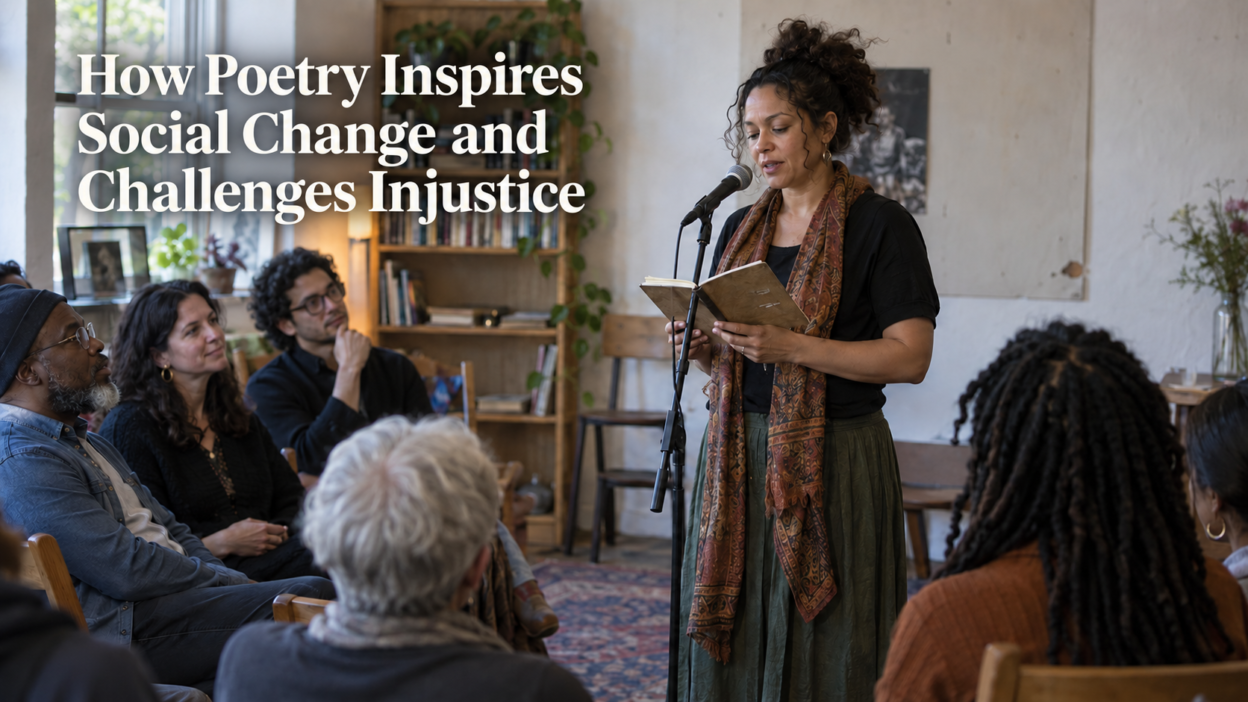
Poetry does not live only on the page. At readings, workshops, classrooms, and community events, a poem becomes a shared experience between the speaker and the audience. Tone, silence, pacing, and physical presence add meaning that may not be immediately visible in print.
A skilled social justice speaker can connect personal stories with wider questions about power, identity, and responsibility. The aim is not to lecture an audience or create a moment of temporary inspiration. It is to make space for reflection and encourage people to carry the conversation beyond the event.
Live performance also brings people together. Audience members sit with difficult lines and recognize that they are not considering the subject alone. Shared attention can become the beginning of discussion, learning, and community action.
From Awareness to Meaningful Action
It is easy to overstate what art can accomplish. Reading a powerful poem is not the same as changing an unfair policy, supporting affected communities, or examining one’s own behavior. Awareness matters, but it must be followed by choices.
Poetry can help prepare people for those choices. It may motivate a reader to learn more, listen more carefully, question biased language, support a local organization, or participate in civic life. It can also help people already involved in justice work remember the human purpose behind their efforts.
Responsible social poetry does not use suffering as decoration. It treats its subjects with dignity, respects the difference between witnessing and speaking for others, and avoids reducing complicated issues to slogans.
Why Poetry Still Matters
Poetry inspires social change by changing attention. It directs the reader toward a voice, experience, or injustice that might otherwise remain unseen. It questions inherited stories, protects memory, and creates emotional connections without pretending that every difference can be easily resolved.
The influence of a poem may begin with one reader rather than a large audience. That reader may carry a line into a conversation, reconsider an assumption, or choose to act with greater awareness. These shifts can seem small, but wider change is built from the ways people learn to see one another and respond.
Poetry cannot complete the work of justice. It can, however, help people understand why that work is necessary. By giving language to silence and humanity to public issues, it keeps difficult truths present—and invites readers to decide what they will do after listening.