
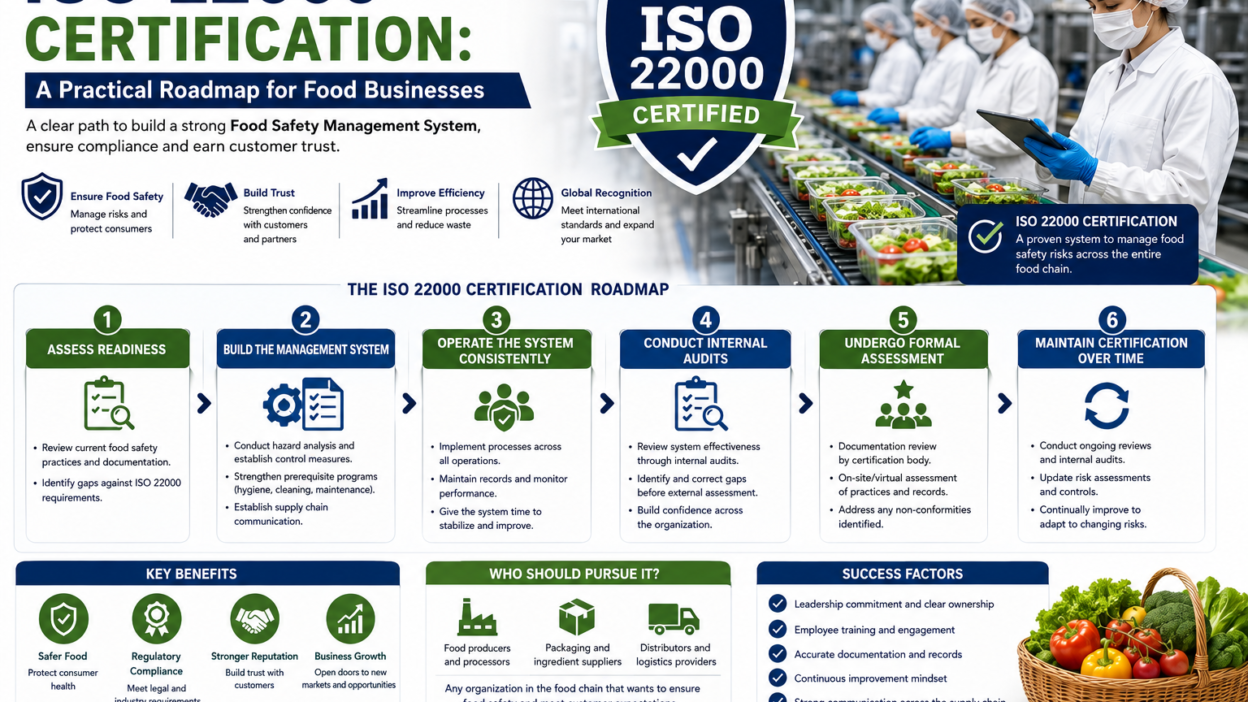
Food businesses researching ISO 22000 certification often find plenty of explanations about why food safety matters, but far fewer resources that walk through what pursuing certification actually looks like in practice. Understanding the practical roadmap, from initial readiness through to formal assessment, helps food businesses approach certification with realistic expectations rather than vague assumptions about effort and timelines.
This guide walks through ISO 22000 certification as a practical sequence of stages, giving food businesses a clearer sense of what lies ahead at each point in the journey.
Understanding What ISO 22000 Certification Actually Confirms
Verifying a Functioning Food Safety Management System
ISO 22000 certification confirms that an organization has built and is genuinely operating a food safety management system that addresses hazard analysis, prerequisite programs, and communication across the supply chain not just that policies exist on paper.
Recognizing the Standard’s Broad Applicability
The standard applies across the entire food chain, from primary producers through processors, packaging suppliers, and distributors, giving organizations at every stage a common framework for managing food safety risk.
Stage One: Assessing Readiness Honestly
Reviewing Current Food Safety Practices
Before pursuing ISO 22000 certification, most organizations benefit from an honest review of current hygiene practices, hazard controls, and documentation, comparing what’s actually happening against the standard’s specific requirements.
Identifying Gaps without Assumptions
This readiness assessment works best when it avoids assumptions about what’s already in place, since gaps often exist in areas that seem well-managed on the surface but haven’t been formally documented or tested.
Stage Two: Building the Management System
Establishing Hazard Analysis and Critical Control Points
A central part of ISO 22000 certification involves identifying where food safety hazards could occur across your operations and establishing controls specifically designed to manage them.
Strengthening Prerequisite Programs
Alongside hazard analysis, organizations typically need to strengthen prerequisite programs, including hygiene practices, pest control, and facility maintenance, since these form the foundation supporting more targeted hazard controls.
Establishing Supply Chain Communication
ISO 22000 certification also requires organizations to establish clear communication channels with suppliers and customers regarding food safety risks, since hazards can originate anywhere along the broader supply chain.
Stage Three: Operating the System Consistently
Before formal assessment, the food safety management system generally needs to operate consistently for a meaningful period, giving the organization a genuine opportunity to identify and correct any remaining issues before external review.
Exploring iso 22000 certification resources can help food businesses understand this roadmap in more detail, from initial readiness assessment through to what formal certification assessment typically involves.
Stage Four: Conducting Internal Audits
Catching Gaps before External Review
Many organizations pursuing ISO 22000 certification conduct internal audits before formal assessment, catching and correcting gaps early rather than discovering them for the first time during external review.
Building Organizational Confidence
Internal audits also help build genuine organizational confidence that the food safety management system is ready, reducing uncertainty around what formal certification assessment will actually involve.
Stage Five: Undergoing Formal Assessment
Reviewing Documentation against Requirements
Formal assessment for ISO 22000 certification typically begins with a review of documented hazard analysis, prerequisite programs, and communication processes against the standard’s specific requirements.
Verifying Practice Matches Documentation
Assessment also involves verifying that actual practices on the production floor genuinely reflect what’s documented, since assessors are specifically trained to identify gaps between the two.
Stage Six: Maintaining Certification over Time
Sustaining Practices through Ongoing Review
ISO 22000 certification isn’t a one-time achievement — it requires ongoing internal review to ensure hazard controls and prerequisite programs continue functioning effectively as operations evolve.
Adapting to Changing Risks
Food safety risks change over time, whether through new suppliers, new products, or evolving regulatory expectations, so a certified system needs to adapt continuously rather than remaining static.
What to Look for in Certification Support
Understanding the Assessment Process Clearly
Businesses pursuing ISO 22000 certification benefit from understanding upfront how the assessment process typically unfolds, including how documentation review and on-site or virtual verification generally proceed.
Considering Food Industry Familiarity
Support that understands the practical realities of food production, rather than applying generic management system concepts without adaptation, tends to make the entire journey considerably more efficient.
How This Roadmap Supports Long-Term Food Safety Culture
Building Beyond a Single Certification Event
Organizations that treat ISO 22000 certification as an ongoing commitment, rather than a single achievement, tend to build a genuinely stronger food safety culture that persists well beyond the initial certificate.
Connecting Certification to Broader Business Reputation
Food safety performance increasingly shapes how customers and partners perceive a business, making certification relevant to broader reputation and trust, not just regulatory compliance alone.
Who Should Pursue This Roadmap
Food producers, processors, and packaging suppliers working within larger supply chains are natural candidates for ISO 22000 certification, particularly when larger customers expect evidence of formal food safety management as a condition of doing business.
Smaller food businesses preparing to scale often find this roadmap particularly useful, since it provides structure precisely when informal food safety practices begin to strain under growth and increased production volume.
Common Challenges Along the Roadmap
Bringing Consistency Across Shifts and Locations
Food safety practices can vary considerably between shifts or locations without a structured system, and bringing that consistency into alignment tends to be one of the more demanding parts of pursuing ISO 22000 certification.
Maintaining Staff Engagement Throughout
Certification efforts sometimes lose momentum once the initial enthusiasm fades, so maintaining staff engagement throughout the entire roadmap, not just at the start, tends to determine how smoothly the process ultimately goes.
Common Questions About This Roadmap
How Long Does the Full Roadmap Typically Take?
Timelines vary considerably depending on organizational size and how mature existing food safety practices already are, since more established operations generally move through each stage more quickly.
Is This Roadmap the Same for Every Type of Food Business?
The core stages remain consistent, though the specific hazards and controls addressed will differ considerably depending on whether an organization is a primary producer, processor, or distributor.
Bringing It All Together
Approaching ISO 22000 certification as a clear, practical roadmap helps food businesses move through the process with confidence rather than uncertainty. Working through each stage thoughtfully, rather than rushing toward a certificate, tends to produce a food safety management system that delivers genuine, lasting protection for both the business and the consumers it ultimately serves.